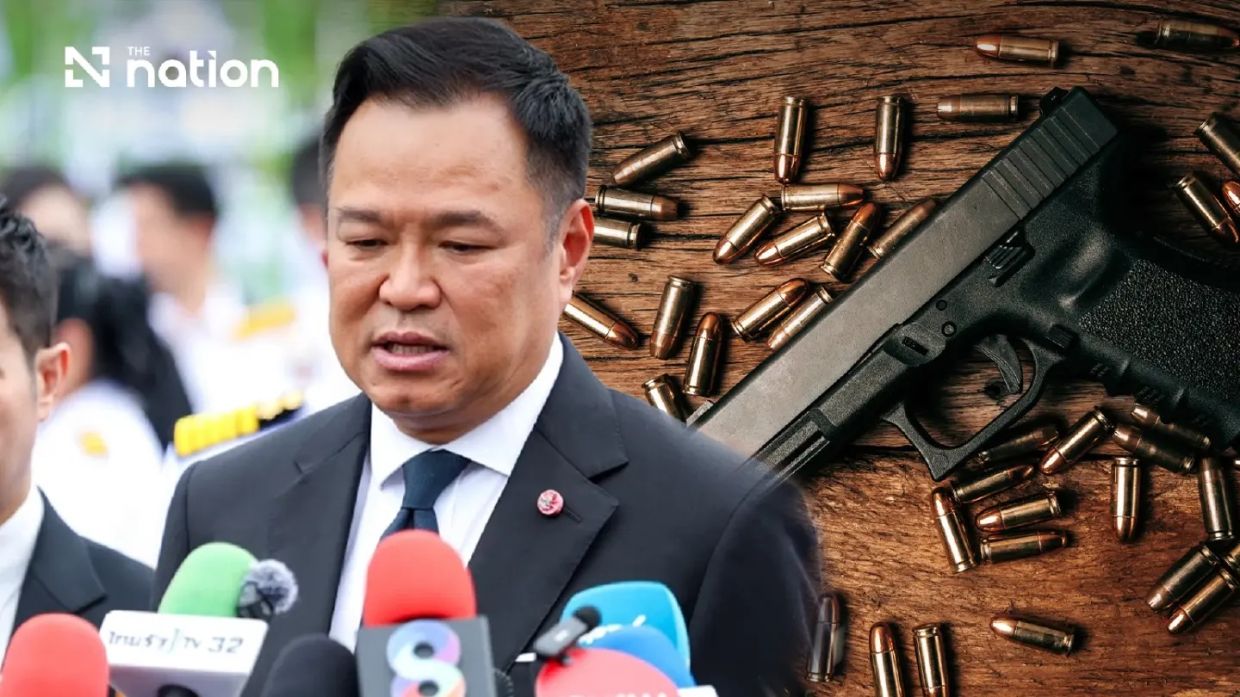
Thailand's Prime Minister Anutin Charnvirakul has committed to significantly strengthening the country's firearm legislation in the aftermath of a mass shooting at Debsirin Nonthaburi School, signalling a hardline approach to weapons regulation that will shape national security policy in the coming months. After visiting the school where the incident occurred and holding discussions with national police chief Pol Gen Kittharath Punpetch at Government House, Anutin outlined an ambitious agenda to curtail civilian access to guns through enhanced enforcement mechanisms and revised legal frameworks.
The Prime Minister's stated priority centres on establishing comprehensive checkpoint systems and systematic inspections designed to identify and apprehend anyone carrying firearms unlawfully in public spaces, vehicles, or private residences without legitimate operational authority. Under Anutin's envisaged approach, such violations would constitute serious criminal offences with enhanced penalties reflecting the gravity of unauthorised weapons possession. This strategy represents a significant escalation from previous enforcement tactics, marking a fundamental shift towards zero-tolerance policing of civilian firearms outside strictly regulated contexts.
Anutin has explicitly rejected suggestions that teachers should be permitted to carry weapons for defensive purposes, a proposal that has occasionally surfaced in security discussions across Southeast Asia following school violence incidents. His position reflects a principled stance that educational institutions must remain gun-free zones and that pedagogical professionals, regardless of protective intentions, lack the legal status and training regimes required of authorised security personnel. This stance carries particular significance for regional policymakers grappling with balancing campus safety against the risks of normalising armed presence in educational environments.
A cornerstone of the government's revised approach involves reviving an amnesty programme permitting citizens to voluntarily surrender unauthorised or illegally-held firearms to state authorities without facing prosecution. However, Anutin has clarified that this grace period serves as an opportunity for compliance rather than a blanket forgiveness scheme—any individual continuing to possess illegal weapons after the programme's implementation period would face enhanced criminal charges reflecting both the original offence and deliberate non-compliance with amnesty provisions. This carrot-and-stick methodology aims to maximise voluntary disarmament while establishing that subsequent possession constitutes deliberate defiance of government directive.
Central to Anutin's enforcement vision is the principle that all illegal firearms remain categorically unlawful regardless of their history or acquisition circumstances. Under this framework, weapons obtained through unregistered channels cannot be legitimised through retroactive documentation or payment of fees—they must either be surrendered to the Department of Provincial Administration, district offices, or police stations, where official records will be compiled. The Prime Minister has emphasised that attempting to retain such weapons carries unacceptable legal jeopardy for citizens, rendering possession a perpetual violation incurring cumulative charges.
The legislative amendments under discussion with Deputy Prime Minister Pakorn Nilprapunt will likely extend beyond street-level enforcement to encompass residential weapons storage protocols. Anutin has stressed that even legally-registered firearms maintained in private homes must be subject to registration verification, physical security requirements preventing unauthorised access, and explicit restrictions on accessibility by minors or unsupervised individuals. This represents an intrusive expansion of state oversight into domestic spaces, reflecting determination to eliminate pathways through which improperly-secured weapons might reach individuals prone to violence.
Judicial accountability will extend to both registered weapon proprietors and individuals who utilise firearms in committing offences, creating a dual-liability framework that compels owners to maintain rigorous physical control and documentation standards. Under this approach, a registered owner whose weapon is used in a crime bears partial responsibility regardless of their direct involvement, incentivising meticulous security practices and prompt reporting of theft or unauthorised removal. This shared-liability model represents a departure from conventional firearm ownership protections and signals governmental willingness to impose substantial burdens on lawful gun owners to suppress overall weapons availability.
Regarding the troubling reports that the Debsirin Nonthaburi School shooter may have been subjected to bullying, Anutin has cautioned against premature speculation while police investigations remain ongoing. He has urged the public to refrain from advancing unverified causality claims linking bullying to the violence and emphasises that establishing factual foundations must precede public discourse about prevention frameworks. This measured stance attempts to prevent sensationalised narratives that could amplify copycat risks or prematurely foreclose investigation pathways.
The government's comprehensive strategy transcends police action alone, encompassing coordinated deployment of the Department of Provincial Administration and other authorised enforcement agencies under unified policy directives mandating rigorous inspections and compliance verification. Anutin's framing suggests recognition that suppressing illegal firearms requires multi-agency coordination extending well beyond traditional policing structures, potentially involving local government apparatus and administrative bodies with community-level reach. This systemic orientation implies sustained, coordinated pressure across numerous institutional touchpoints rather than episodic enforcement crackdowns.
For Malaysia and other Southeast Asian jurisdictions grappling with comparable school security vulnerabilities, Thailand's legislative trajectory offers a cautionary illustration of how singular incidents can catalyse expansive government powers over civilian weapons and residential spaces. Anutin's refusal to arm educators while simultaneously intensifying state surveillance of firearm ownership reflects a particular governance philosophy prioritising state monopoly over legitimate force. The approach, if successfully implemented, may reduce mass shooting incidents but establishes precedents for intrusive enforcement mechanisms that regional observers should monitor closely regarding implications for civil liberties and police power escalation.

