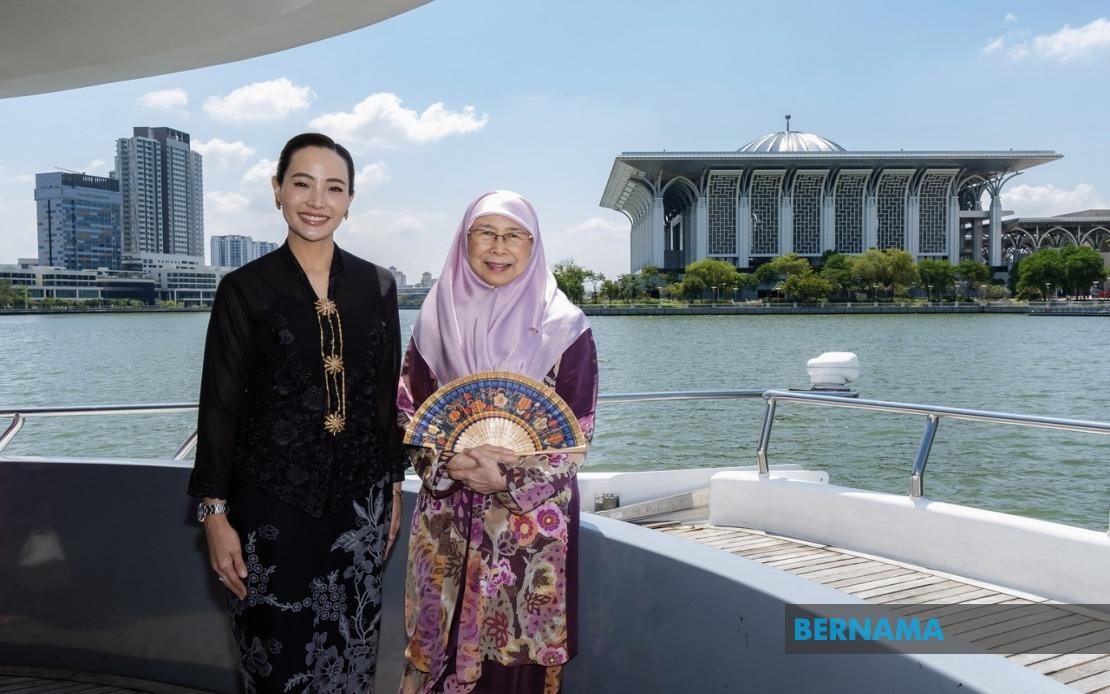
Thailand's First Lady Thananon Charnvirakul experienced the natural and architectural splendour of Putrajaya during a leisurely boat excursion on Thursday, as part of her husband Prime Minister Anutin Charnvirakul's maiden official visit to Malaysia since his reappointment to office in March 2026. The 45-minute cruise across Tasik Putrajaya offered panoramic vistas of the country's purpose-built administrative hub and its distinctive landmarks, providing Thananon with an intimate introduction to one of the region's most carefully planned urban environments.
Upon arriving at the lake's departure point shortly after midday, Thananon was received with warmth by Datuk Seri Dr Wan Azizah Wan Ismail, wife of Malaysian Prime Minister Datuk Seri Anwar Ibrahim. The reception reflected the ceremonial nature of the Thai delegation's visit and underscored the diplomatic significance accorded to the occasion. Also participating in the welcoming arrangements was Minister in the Prime Minister's Department (Federal Territories) Hannah Yeoh, whose presence highlighted the Malaysian government's commitment to ensuring a successful engagement with Thailand's leadership at this critical juncture.
Throughout the waterborne tour, Thananon and Dr Wan Azizah engaged in animated conversation while observing Putrajaya's carefully landscaped environments and iconic structures. This informal setting provided an opportunity for both women to establish personal rapport beyond the formal protocols typically associated with state visits, a dynamic that often proves instrumental in fostering deeper bilateral understanding between nations. The leisurely pace of the cruise and the scenic backdrop created an environment conducive to substantive discussion about mutual interests and shared concerns.
The First Lady's visit forms part of a broader two-day official mission that commenced earlier that morning when Thai Prime Minister Anutin and his wife received a full ceremonial welcome at the Bunga Raya Complex of Kuala Lumpur International Airport. The formal proceedings at the airport marked the commencement of an itinerary designed to showcase Malaysia's institutional strengths and cultural offerings while providing platforms for high-level governmental engagements. The scheduling and choreography of these events reflected careful diplomatic planning by both nations' foreign ministries.
This represents the first official visit by Anutin in his current capacity following his return to the prime ministerial position this year, making it symbolically significant for Thailand's regional positioning. His previous tenure and the circumstances surrounding his reappointment have generated considerable attention within ASEAN capitals, where leadership transitions are monitored closely for their implications on regional dynamics and bilateral relationships. Malaysia's decision to extend an invitation underscores Bangkok's continuing importance in Kuala Lumpur's strategic calculations and reflects the stable nature of Malaysia-Thailand relations despite periodic tensions over shared border regions and maritime boundaries.
The bilateral relationship between Malaysia and Thailand has historically been characterized by substantial economic interdependence and cultural affinity, though occasional friction points have emerged around resource management, security concerns, and regional influence. Both nations maintain significant trade relationships, share maritime boundaries, and face common challenges related to transnational crime, refugee movements, and maritime security. The visit provides an opportune moment for both governments to reaffirm commitments to cooperation and potentially chart trajectories for expanded engagement across multiple sectoral domains.
Anwar's invitation to Anutin reflects Malaysia's diplomatic strategy of maintaining robust relationships with immediate neighbours while demonstrating openness to working with leaders across the region regardless of their political backgrounds or governance models. Thailand's significant military and strategic importance in Southeast Asia, coupled with its geographic proximity to Malaysia, ensures that bilateral ties remain consistently prioritized in Kuala Lumpur's foreign policy calculations. The mutual commitment expressed by both administrations suggests an intention to move beyond transactional exchanges toward more structured and comprehensive cooperation frameworks.
Potential areas for expanded collaboration encompassing trade facilitation, security cooperation, educational exchanges, and tourism promotion are likely to feature prominently in discussions between the delegations during this visit. Both nations face comparable demographic challenges, labor market dynamics, and infrastructure development imperatives that could benefit from coordinated approaches and shared best practices. Regional initiatives such as the Greater Mekong Subregion framework and ASEAN mechanisms provide formal channels for channelling bilateral initiatives into broader subregional endeavours.
The Putrajaya lake cruise and associated ceremonial protocols serve as tangible expressions of the hospitality and regard with which Malaysia receives the Thai leadership. Beyond their symbolic dimensions, these experiences provide opportunity for informal diplomacy where unscripted conversations and personal connections often yield more substantive outcomes than formalized negotiating sessions. The presence of Dr Wan Azizah and Hannah Yeoh ensured that Thai visitors experienced engagement with multiple facets of Malaysian governance and received briefings relevant to their respective portfolios and interests.
For Malaysian observers, the visit underscores the government's attention to relationships with near neighbours and its commitment to regional stability through sustained high-level engagement. Thailand's strategic location, economic significance, and role as a gateway to mainland Southeast Asia make it indispensable to Malaysian regional aspirations. The smooth execution of this visit and the apparent cordiality of interactions between Thai and Malaysian officials provide positive indicators for the trajectory of bilateral relations in the coming period.
As both nations navigate evolving regional circumstances and confront shared transnational challenges ranging from maritime security to pandemic preparedness, the consolidation of political relationships at the highest levels becomes increasingly valuable. The symbolic importance of the Putrajaya tour extends beyond ceremonial niceties to represent a statement about Malaysia's openness to deepening ties with Thailand across multiple dimensions. The success of this visit may establish templates and goodwill foundations for expanded cooperation throughout the remainder of the year and beyond.

