Thai authorities have intensified enforcement against foreign property ownership schemes, arresting 13 foreign nationals during coordinated raids across 15 locations in the coastal town of Hua Hin. The operation, conducted on Monday in Prachuap Khiri Khan province, represents the latest escalation in a nationwide campaign targeting companies that appear to use Thai citizens as nominee shareholders to circumvent restrictions on foreign land ownership. The arrested individuals included three British nationals, four from China, and single nationals from Italy, France, the Netherlands, Austria, the Philippines and the United States. None have yet been formally charged, and authorities indicate the investigation remains ongoing.
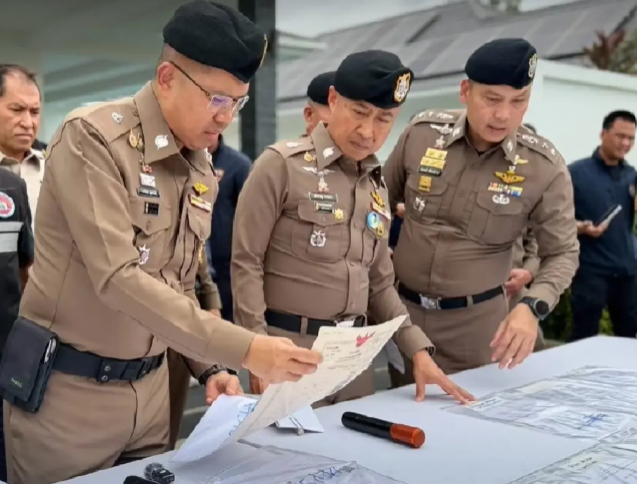
The Hua Hin operation, designated the sixth phase of the crackdown, deployed over 200 police officers and government officials to the Thap Tai subdistrict, where they focused on a residential development featuring detached houses and modern swimming pool villas valued between 10 and 20 million baht each. Preliminary investigation identified six companies allegedly operating nominee structures at the targeted development. Beyond the arrested foreigners, courts had issued arrest warrants for 32 additional foreign nationals in connection with the same investigation, while authorities summoned 39 Thai nationals for further questioning. The scale of the operation reflects the coordination between the Deputy National Police Chief Pol Gen Samran Nuanma, Provincial Police Region 7 Commissioner Pol Lt Gen Phisit Tanprasert, and provincial officials.
The broader investigation encompasses 33 companies suspected of holding property collectively valued at approximately 300 million baht on behalf of foreign owners. This substantial asset base underscores the scale of alleged non-compliance with Thai property laws, which generally prohibit foreign nationals from owning land except in limited circumstances. Property located in coastal tourist destinations has long attracted foreign investment, creating demand for legal workarounds that operate at the margins of Thai regulations. The alleged nominee arrangements appear designed to mask foreign beneficial ownership while technically maintaining Thai-controlled corporate structures, though police contend these companies conducted no legitimate business operations beyond property holding.
According to police statements, the foreign nationals questioned in the inquiry acknowledged seeking property ownership in Thailand and claimed they had been advised by law and accounting firms to establish companies for this purpose. These individuals reportedly believed such arrangements were legally permissible, suggesting they may have acted on professional legal advice rather than with deliberate intent to circumvent Thai law. The accounting and legal firms that allegedly facilitated these arrangements have not been publicly identified, though they may face scrutiny as investigators trace the networks behind the nominee structures. This element raises important questions about professional responsibility and whether service providers adequately counselled clients on the legal risks of such arrangements.
The Thai shareholders nominally listed as company owners presented a consistent narrative to investigators, claiming they had agreed to hold shares for foreign interests without paying for them or exercising management functions. These individuals stated they had never reviewed financial documents or maintained any active involvement in the companies supposedly under their ownership. Their testimony aligns with the police theory that the corporate structures served primarily as vehicles for foreign property control rather than as genuinely functioning Thai businesses. Such passive involvement by nominal shareholders typically signals the presence of nominee arrangements, though the technical legal analysis of whether these structures definitively breach Thai law ultimately depends on court interpretation.
During the raids, police seized extensive documentation including company registration records, accounting files, computers, mobile phones and electronic data. Investigators plan to examine these materials to identify financial transaction patterns and trace connections to other potentially involved parties both within Thailand and internationally. This forensic approach suggests authorities view the nominee networks as potentially interconnected systems rather than isolated incidents. The scope of investigation may extend to identifying corrupt government officials or state employees suspected of facilitating or improperly assisting those involved in the schemes, according to police statements.
The Hua Hin phase follows five previous operations targeting similar alleged nominee structures in Thailand's prime property markets. The campaign commenced with investigations in Koh Phangan, Surat Thani, examining nominee companies and professional networks allegedly used to control property and tourism businesses. Subsequent phases expanded into Phuket, Phang Nga and Krabi, where authorities examined 89 properties valued exceeding 1.05 billion baht. Chonburi subsequently became a focus point, while Phase 5 targeted 31 companies and 29 land plots worth approximately 633 million baht in Chiang Mai. Collectively, the first five phases examined 233 land parcels and buildings spanning more than 25.6 hectares with estimated combined value exceeding 2.539 billion baht.
The cumulative results demonstrate significant enforcement activity, with courts approving 133 arrest warrants across all phases of the investigation. Critically, 20 cases have already resulted in convictions, establishing legal precedent that nominee arrangements can constitute criminal conduct under Thai law. These convictions carry substantial implications for foreign investors who may have operated under the assumption that such structures occupied legal grey areas. The enforcement trajectory suggests Thai authorities have systematically built criminal cases and developed prosecutorial strategy across multiple jurisdictions, indicating this represents a sustained policy initiative rather than isolated enforcement actions.
For Malaysian property investors and expatriates, the Thai crackdown offers instructive lessons regarding legal compliance and the risks of informal property arrangements in Southeast Asia. While Malaysia maintains distinct regulations governing foreign property ownership with specific exemptions and designated zones, similar nominee scheme risks exist across the region. Malaysian readers should recognise that Thai enforcement patterns may signal broader regional regulatory trends, as Southeast Asian governments increasingly scrutinise foreign ownership structures in real estate. The involvement of law and accounting firms in the Thai scheme highlights how professional advice can inadvertently facilitate non-compliance when service providers inadequately assess legal boundaries or fail to emphasise enforcement risks.
Thailand's authorities have explicitly stated the campaign targets unlawful nominee structures and foreign-backed businesses rather than legitimate foreign investors complying with Thai law. This distinction remains important for understanding enforcement scope and prosecutorial intent. The Royal Thai Police indicated the investigation would continue nationwide, focusing on tourist destinations where foreign investment concentration remains highest. Public reporting mechanisms have been established, with the public invited to report suspected illegal foreign business activity to local police stations or the Royal Thai Police hotline 1599, available twenty-four hours daily, indicating authorities expect continued community engagement in enforcement efforts.

