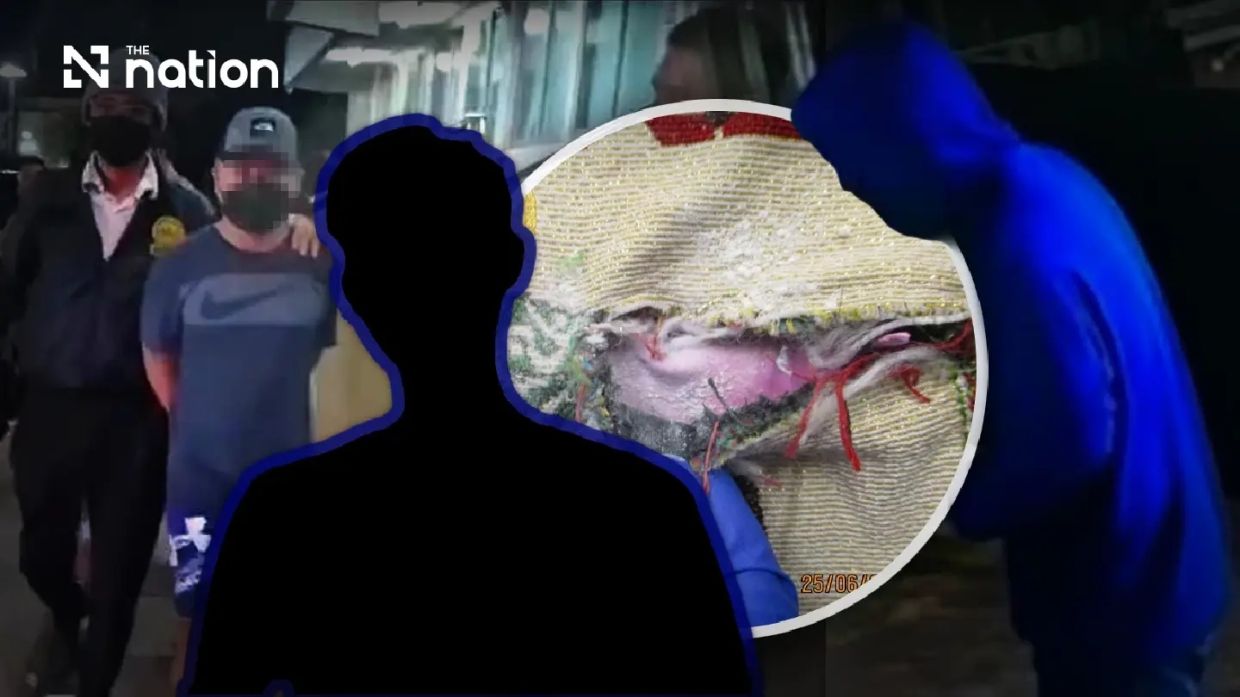
Thai police have widened their investigation into a heroin trafficking operation by arresting a suspected intermediary accused of facilitating drug movement toward Australia. The Metropolitan Police Bureau confirmed that officers took Ekkawit into custody overnight in Phayao province following an inquiry that has already ensnared multiple individuals in an international smuggling scheme. The expanding investigation reveals the sophisticated use of technology and coordinated logistics by those involved in moving drugs across borders and enlisting unwary couriers.
According to Deputy Commissioner Pol Maj Gen Theeradej Thamsuthee, authorities believe Ekkawit occupied a crucial role in the supply chain. He allegedly collected an elephant-print fabric bag containing hidden heroin and passed it to a man known as Uthai, who was arrested earlier. Uthai subsequently transferred the package to a commercial airline flight attendant identified as Mina, who was recruited to smuggle it into Australia. This layered arrangement, where distinct individuals handle the contraband at various stages, is characteristic of professional trafficking networks seeking to insulate higher-ranking operatives from direct exposure.
Investigators tracked Ekkawit's communications through a messaging account under the username "Rin Rin," establishing contact patterns with Uthai over the arrangement of the delivery. Police allege Ekkawit used the chat application to coordinate Uthai's collection of the elephant-print bag from Chiang Kham district in Phayao. During preliminary interrogation, Ekkawit acknowledged performing this service in exchange for THB100,000, suggesting he was a paid operative within a larger commercial structure rather than an independent actor. He further disclosed to officers that he had undertaken similar courier duties two or three times previously, indicating a pattern of involvement.
The mechanics of the operation uncovered by police reveal careful compartmentalisation and dead drops reminiscent of Cold War espionage tradecraft. Ekkawit purchased the elephant-print bag in Chiang Mai and notified the operative using the moniker "Rose Rose" upon completion. He then left the bag at a pre-arranged kilometre marker on a roadside. An associate working for Rose Rose would subsequently collect it and arrange for heroin to be concealed within the fabric, though Ekkawit claimed this occurred in Laos. Skeptical investigators question this account, as the proximity of the operation to Thailand raises questions about his credibility.
Once the drugs were hidden inside, Rose Rose orchestrated the reverse logistics of the payment scheme. An associate would deposit the elephant-print bag alongside THB100,000 in cash at another kilometre marker for Ekkawit to retrieve. Ekkawit would then arrange for Uthai to obtain the package and compensate him through a cash deposit machine transfer of THB60,000. This fragmentation of payment and handoff locations minimised direct confrontation and left minimal paper trails, tactics favoured by sophisticated trafficking groups aware of law enforcement surveillance capabilities.
The person operating the Rose Rose account emerges as a critical node in the network, functioning as a coordinator who contacts and recruits individuals willing to transport contraband. Through encrypted chat applications, this operator maintained contact with multiple associates, vetting potential couriers and assigning them specific missions. Mina, the flight attendant, was among those recruited through this mechanism. Despite the account's anonymous registration, Thai narcotics police claim to have gathered substantial intelligence about Rose Rose's identity, though they remain cautious about prematurely identifying a source they believe to be subordinate to even higher leadership within the organisation.
Police maintain that Rose Rose does not constitute the apex of this trafficking network. Investigators suspect a more senior figure orchestrates operations from above, with Rose Rose serving as a distributed coordinator handling logistics and personnel recruitment. This hierarchical assessment follows standard organised crime analysis, where compartmentalisation serves to protect leadership from direct evidence of culpability. The network's structure, utilising communication platforms and delegating operational tasks to associates like Ekkawit, reflects modern criminal enterprise adapted to digital surveillance environments.
Ekkawit's family relationship to Rose Rose proved instrumental in unravelling the conspiracy. Despite his limited initial statement to authorities, investigators discovered he was a close relative of the person behind the Rose Rose profile. Photographs obtained by police showed the two travelling together, and both individuals hailed from Phayao province. This familial connection, combined with geographic proximity, suggests kinship networks form the trusted core of trafficking organisations, with outsiders enlisted only for discrete, compartmentalised roles. Such reliance on family bonds provides criminals with a level of confidence difficult to achieve with strangers.
Uthai's interrogation yielded contradictions that aroused investigator suspicion. He initially claimed involvement in five or six similar operations, though police assessed his account as rehearsed beforehand and unconvincing. The discovery that Uthai had rented accommodation in Phra Nakhon Si Ayutthaya province for at least five or six months suggested a more extensive operational history than he disclosed. Police believe his repeated involvement over such a prolonged period indicates either significantly greater frequency of courier missions or alternatively, positioning himself strategically for a stream of assignments from network coordinators.
The implications of this case extend beyond the immediate arrests, signalling Bangkok's concerns about organised drug trafficking networks exploiting commercial airline personnel as smuggling vectors. Flight attendants, with legitimate travel privileges and relative freedom of movement through airports, present attractive targets for recruitment by traffickers seeking reliable access to international routes. The use of retail bags and clothing for concealment, rather than purpose-built containers, reflects an attempt to exploit the mundane appearance of legitimate traveller belongings.
Thai authorities indicated that Ekkawit would undergo location identification exercises in Phayao before transfer to the Narcotics Suppression Bureau for more intensive questioning. Deputy National Police Chief Pol Gen Samran Nuanma was scheduled to personally interrogate Ekkawit upon his arrival in Bangkok on the evening of Friday, July 10, 2026, signalling the case's priority within police hierarchies. The involvement of senior law enforcement figures suggests expectations of breakthroughs in identifying higher network operatives through systematic questioning of the detained intermediary.
The investigation's expansion reflects a broader pattern observed across Southeast Asia, where trafficking networks exploit porous borders and regional free movement agreements. Thailand's geographic position, straddling major drug production areas in the Golden Triangle and major consumption markets, positions it as inevitable transit territory. The recruitment of professional couriers from within Thailand's transportation sector, including commercial aviation staff, demonstrates how criminal organisations have adapted to modern border controls by cultivating insider cooperation. Dismantling such networks requires police to trace financial flows, reconstruct communication patterns, and cultivate informants within organisational hierarchies—labour-intensive investigations that Thai authorities appear committed to pursuing despite resource constraints.

