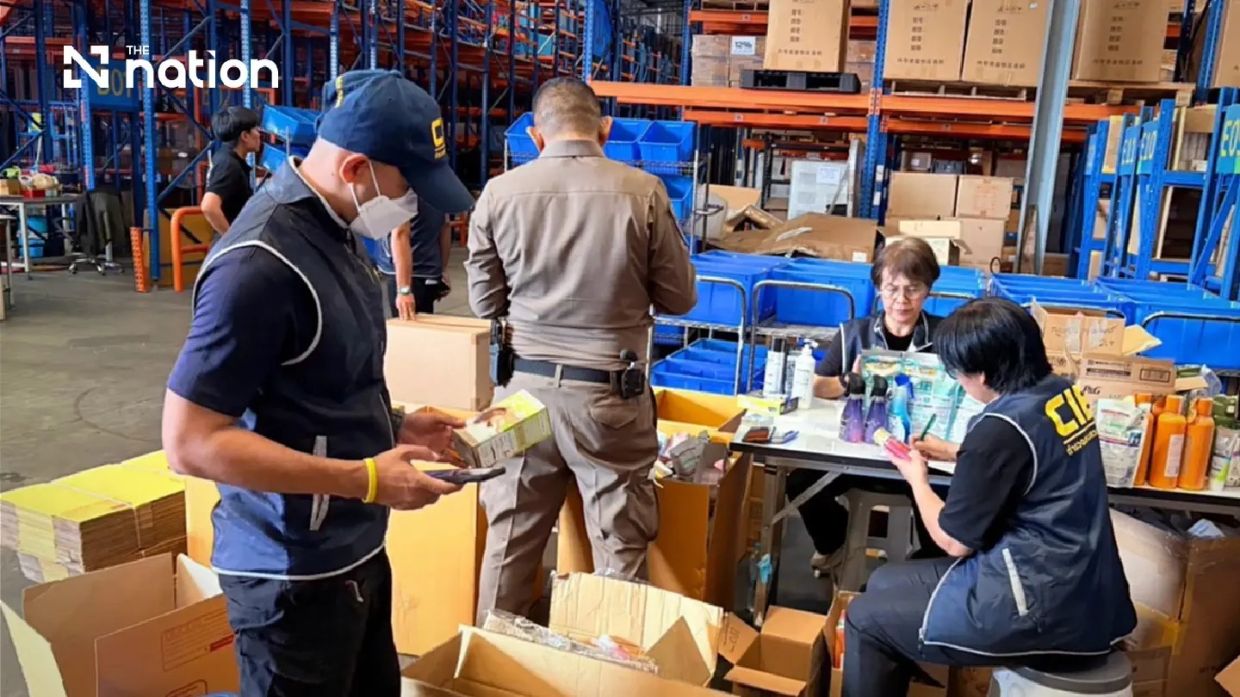
Thai authorities have dismantled a significant distribution network supplying unapproved Japanese cosmetics, dietary supplements, and medicinal products to online retailers throughout the country. The Consumer Protection Police Division (CPPD), operating under the direction of Pol Maj Gen Kongkrit Lertsittikul, conducted a raid on a warehouse in Bang Phli district, Samut Prakan on Thursday (August 13), confiscating 83,483 items across 116 different product types. The seized inventory, valued at more than 8.34 million baht, represented a cross-border supply chain that had operated largely undetected for over four years.
The investigation began after the CPPD received multiple consumer complaints regarding online marketplaces offering cosmetics, supplements, and household hazardous substances without proper Thai-language labelling. These reports triggered a systematic inquiry that ultimately exposed the warehouse's critical role in the illegal import and distribution ecosystem. The Bang Phli facility functioned as a centralised storage and packing hub, processing between 200 and 300 items daily at a packing fee of 10–12 baht per box. This operational model allowed online sellers across various platforms to maintain inventory while bypassing regulatory oversight themselves, creating a buffer between the supply chain and end consumers.
All products were traced to Japanese importations that had circumvented Thailand's mandatory safety certification processes and regulatory approvals. The goods lacked the required Thai-language labels mandated by domestic consumer protection law, preventing Thai customers from understanding product contents, usage instructions, or potential side effects. More critically, these items had not undergone the safety verification checks that Thailand's regulatory authorities conduct before permitting cosmetics, pharmaceuticals, and dietary supplements to enter the domestic market. This absence of certification represented a direct violation of consumer safety protocols designed to protect the public from potentially harmful or counterfeit goods.
For Malaysia and other Southeast Asian nations, this case illustrates a persistent regional challenge: the ease with which unapproved products can infiltrate domestic markets through e-commerce channels and warehouse distribution networks. The warehouse model discovered in Samut Prakan mirrors similar operations throughout the region, where online platforms provide anonymity and geographic distance that insulate sellers from regulatory scrutiny. As Malaysian consumers increasingly purchase cosmetics and supplements from cross-border online retailers, the risk of acquiring unlicensed goods remains substantial. Thai authorities' enforcement action demonstrates that regional governments are intensifying efforts to protect consumers, yet the speed of e-commerce continues to outpace inspection capacity.
The legal consequences for those involved in the operation are considerable. Investigators referred the case to the CPPD's Sub-Division 4 for prosecution under multiple legislative frameworks including Thailand's Cosmetics Act, Hazardous Substances Act, Food Act, and Drug Act. Each statute carries its own penalties, and the sheer volume of confiscated items suggests prosecutors will pursue charges reflecting the scale and systematic nature of the distribution operation. These legal mechanisms exist across Southeast Asia in comparable forms, meaning Malaysian, Indonesian, and Vietnamese authorities operate from similar statutory foundations when addressing unlicensed product distribution.
The warehouse's operational history reveals how distribution networks adapt to regulatory pressure. What began as a simple storage facility evolved into a sophisticated packing and logistics operation, suggesting those running the enterprise recognised growing margins in the expanding e-commerce sector. The four-year operational period indicates the network had achieved significant scale before detection, processing tens of thousands of items monthly. This timeline also suggests that online platforms hosting the sellers may have lacked adequate vetting procedures, a systemic vulnerability that affects marketplaces throughout the region where vendors can operate with minimal identity verification.
For Southeast Asian e-commerce platforms and online marketplaces, this case underscores the regulatory liability they potentially face if their due diligence processes prove inadequate. While platform operators often argue they function as neutral marketplaces rather than retailers, Thai authorities' targeting of the warehouse—rather than individual online sellers—suggests an emerging enforcement strategy focusing on chokepoints in the supply chain. Malaysian authorities and consumer protection agencies across the region may adopt similar approaches, concentrating resources on storage facilities, distribution hubs, and import points where regulatory intervention can disrupt multiple illegal sales simultaneously.
The confiscation's financial dimension—over 8.34 million baht in seized inventory—reflects the substantial profitability of selling unlicensed products. The margins available to sellers operating without compliance costs, import duties, or certification expenses create powerful economic incentives that simple consumer warnings struggle to counteract. This financial reality helps explain why such networks persist despite regulatory prohibitions; the profit differential between compliant and non-compliant operations remains too significant for market forces alone to eliminate the illegal segment.
Consumers purchasing cosmetics and supplements through cross-border e-commerce face genuine health risks when products lack safety certification and proper labelling. Beyond counterfeit goods, certified products sometimes undergo reformulation or different manufacturing processes for different markets; unapproved imports may contain ingredients prohibited in Thailand or Malaysia due to identified safety concerns. The absence of Thai-language labelling also prevents consumers from understanding contraindications or potential interactions with medications. These risks extend beyond individual purchases to affect public health surveillance systems, which rely on accurate product registration to identify contamination events or adverse effects.
The CPPD's successful operation demonstrates that Thai authorities possess the investigative capacity and legal tools to identify and dismantle such networks. However, the four-year operational period before detection highlights the resource constraints facing consumer protection agencies throughout Southeast Asia. The region's rapid e-commerce growth has dramatically expanded the surface area that regulators must monitor, from shipping hubs to warehouse facilities to platform marketplaces. Many national authorities lack sufficient staff, funding, and forensic capacity to match this expansion.
Moving forward, regional cooperation may offer the most effective enforcement response. Japanese authorities could strengthen controls over exports to Thailand and neighbouring countries, while Southeast Asian nations could share intelligence on cross-border supply chains and e-commerce sellers. Platforms themselves could implement more rigorous seller verification, requiring proof of product registration and certification before listings appear. Malaysia's own consumer protection agencies may reference this Thai operation when designing compliance programmes targeting similar warehouse networks or evaluating platform liability standards. The case illustrates that while individual enforcement actions disrupt specific operations, systematic regional strategies addressing import controls, platform accountability, and cross-border cooperation represent the necessary foundation for sustainable protection of Southeast Asian consumers in the e-commerce era.

