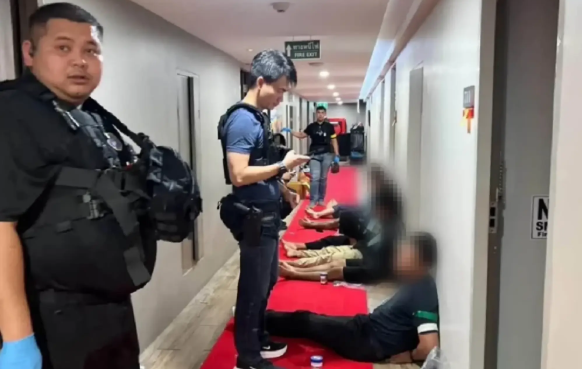
Thai law enforcement has struck a significant blow against organised crime networks in the greater Bangkok region, launching a coordinated operation that exposed a sprawling underground enterprise operating from within a seemingly legitimate hotel property. The Central Investigation Bureau, working alongside the Crime Suppression Division, executed what police termed Operation "Dragon Nest"—a reference to dismantling what they characterised as a hidden "grey dragon" smuggling and organised vice network that had been functioning with apparent impunity from a high-end establishment in Nonthaburi province.
The raid targeted a hotel situated on Ngam Wong Wan Road in Bang Khen subdistrict, Mueang district, which had attracted the attention of authorities following public tip-offs about suspicious activity. Community members reported observing exclusively Chinese nationals entering and exiting the premises at all hours, with the hotel appearing to reject walk-in customers and ordinary tourism business. This selective clientele pattern, combined with the facility's unusual security posture, prompted investigators to examine the operation more closely and ultimately apply for search warrants.
When authorities obtained a Criminal Court warrant and deployed more than 100 officers to encircle and systematically search the property, they discovered the entire hotel had been effectively leased and reorganised by what police described as a Chinese capital group with ties to international organised crime syndicates. The vertical restructuring revealed a meticulously compartmentalised operation, with residential accommodation occupying floors two through six, while the seventh and eighth levels had been purpose-built to facilitate illegal gambling activities, drug consumption parties, and paid sexual services exclusively catering to Chinese clientele.
The enforcement action resulted in the apprehension of a 33-year-old Chinese national on charges relating to the trafficking and distribution of ketamine, a Schedule 2 psychotropic substance classified as a serious drug under Thai law. Police alleged the suspect possessed quantities of the substance intended for commercial distribution and facilitation among patrons utilising the facility. Additional arrests included three Myanmar nationals detained on immigration violations, having entered and remained in Thailand without proper authorisation—a common vulnerability that criminal syndicates exploit by recruiting vulnerable foreign workers into operations of this nature.
The scale of evidence recovered during the operation underscores the comprehensive nature of the enterprise. Police secured more than 200 distinct items including substantial quantities of ketamine and so-called "happy water"—street terminology for volatile liquid recreational drugs often mixed into beverages. Investigators also discovered manufacturing and packaging equipment suggesting on-site drug production or repackaging operations, gambling apparatus including chips, playing cards, dice, baccarat score sheets, and specialised hi-lo gaming equipment, cash reserves in multiple currencies, mobile communications devices, and complete CCTV surveillance system data that documented daily operations.
Initial interrogation of the principal Chinese suspect revealed a common organisational pattern wherein individual participants maintain plausible deniability by claiming restricted operational roles. The detained individual asserted he functioned merely as a delivery personnel executing instructions rather than possessing knowledge of or responsibility for broader trafficking activities—a defensive posture typical of mid-tier operatives in such networks who bear culpability while senior organisers maintain distance from direct evidence.
The three Myanmar nationals reportedly provided candid admissions regarding their status, acknowledging they had deliberately crossed the border illegally to secure employment opportunities within Thailand's underground economy. This vulnerability to exploitation makes migrant workers from neighbouring nations frequent components of human trafficking and forced labour schemes incorporated into organised crime syndicates, particularly in casinos, drug operations, and sexual services industries targeting international clients.
The discovery holds significant implications for regional law enforcement and Southeast Asian responses to transnational organised crime. The involvement of a structured Chinese capital group operating from Thai territory reflects the sophisticated internationalisation of vice networks exploiting the region's relative geographic proximity, permissive regulatory environments in certain jurisdictions, and the lucrative market constituted by affluent Chinese nationals abroad. Such operations generate substantial revenue streams through gambling, narcotics distribution, and sexual exploitation while simultaneously destabilising local communities through drug proliferation and providing infrastructure for broader money laundering activities.
For Malaysian authorities and other ASEAN nations, the Nonthaburi case exemplifies vulnerabilities that persist across the region's hospitality and entertainment sectors. International organised crime groups have demonstrated capacity to repurpose commercial properties, exploit visa and immigration loopholes, and establish self-contained underground economies within seemingly legitimate business frameworks. Malaysia's own law enforcement agencies have identified similar patterns of Chinese-linked underground gambling and drug networks operating across peninsula and East Malaysia, indicating this represents a broader regional phenomenon rather than isolated criminal activity.
The operation also highlights the continuing sophistication of money laundering methods whereby gambling revenues, drug profits, and sexual services income are cycled through legitimate banking channels and legitimate business operations to obscure criminal origins. The seizure of bank account records and mobile communications data suggests authorities recognised the necessity of pursuing financial trails alongside physical evidence to establish culpability among higher-ranking network members potentially located elsewhere in Thailand or internationally.
Moving forward, the success of Operation Dragon Nest—measured by the breadth of evidence secured and personnel detained—may prompt expanded inter-agency coordination and intelligence-sharing arrangements among Thai police units and potentially regional partners through ASEAN frameworks. However, enforcement effectiveness ultimately depends upon prosecutorial follow-through, judicial willingness to impose substantial sentences, and disruption of supply chains and client networks. Without dismantling demand among affluent client bases and eliminating incentives for transnational criminal organisations to establish new operations, individual raids represent tactical victories within a broader strategic challenge confronting Southeast Asian law enforcement.

