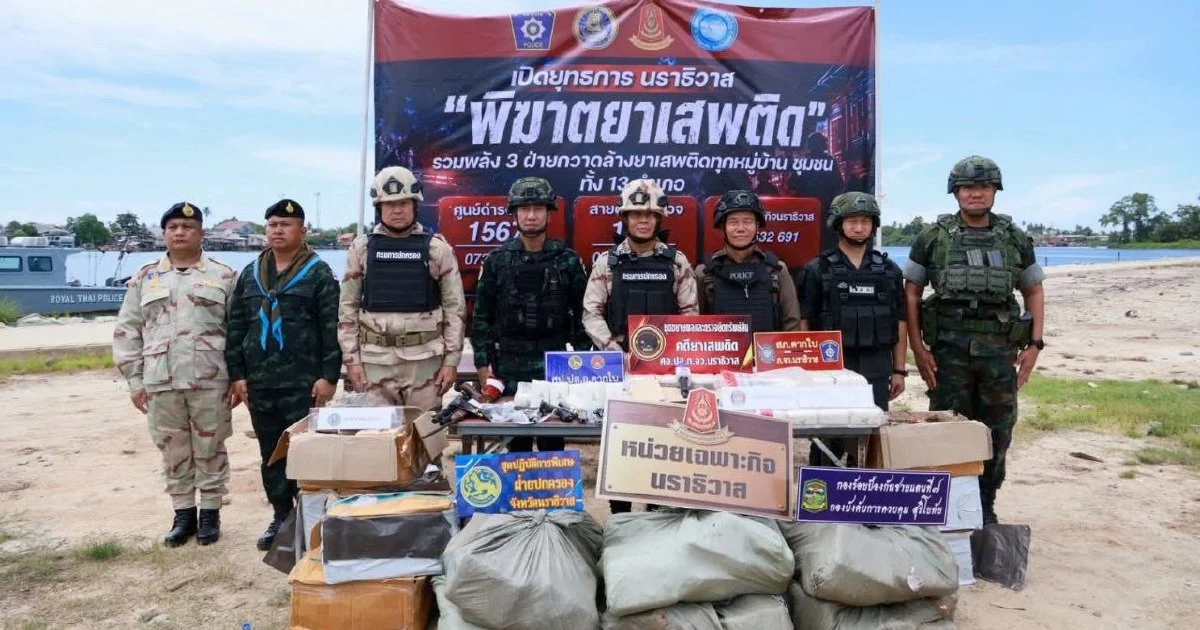
Thai law enforcement authorities have struck a significant blow against cross-border drug trafficking networks, apprehending 233 individuals suspected of involvement in organised narcotics operations during an intensive enforcement campaign spanning four weeks in Narathiwat province. The coordinated crackdown has exposed deep criminal connections stretching into Malaysia, raising fresh concerns about the sophistication and reach of syndicate operations throughout the region.
Narathiwat, located in Thailand's southernmost region and sharing a porous border with Kelantan and Terengganu, has long served as a critical smuggling corridor for illicit drugs moving between Thailand and Malaysia. The province's geographic position, combined with challenging terrain and scattered monitoring capacity, has made it an attractive operational base for trafficking organisations seeking to exploit the lucrative Malaysian market. This latest enforcement action demonstrates Thailand's commitment to disrupting these supply chains before contraband reaches neighbouring jurisdictions.
Among those arrested during the operation are individuals believed to maintain direct relationships with Malaysian criminal syndicates, suggesting a level of coordination and trust built through years of illicit commerce. These connections underscore how drug trafficking has evolved from simple point-to-point smuggling into a sophisticated network involving multiple jurisdictions and organised criminal hierarchies. The involvement of Malaysian-linked operatives also indicates that demand from across the border continues to drive production and trafficking activities within Thailand.
The intercepted narcotics haul, valued at RM1.2 million, represents the material consequence of this illegal trade. This substantial seizure reflects both the scale of contraband flowing through the region and the vulnerability of Malaysia's eastern border to organised trafficking operations. The drugs seized during the Thai operation would have represented a significant supply injection into Malaysian markets, potentially servicing numerous distribution networks at street level throughout the country.
The month-long nature of the Thai crackdown indicates a planned, intelligence-led operation rather than reactive enforcement. This methodical approach, involving coordination among Thai police units and targeting multiple nodes within the syndicate simultaneously, represents best practice in combating organised crime. By striking across a concentrated period and arresting numerous individuals within the same network, authorities can disrupt operations more comprehensively than isolated, ad-hoc interventions.
For Malaysian law enforcement, the Thai operation carries significant implications. The identification of local traffickers collaborating with Thai counterparts provides actionable intelligence for domestic investigations. Malaysian authorities can now cross-reference the arrested individuals with their own intelligence databases, identifying Malaysian citizens involved and mapping the structure of domestic distribution networks that receive Thai-sourced narcotics. This intelligence exchange between nations strengthens bilateral capacity to dismantle these organisations.
The geographical focus on Narathiwat also highlights persistent vulnerabilities along Malaysia's northern land border. Despite ongoing enforcement efforts from both Malaysian and Thai authorities, the porous nature of the Kelantan-Narathiwat boundary continues to facilitate smuggling. Improved cross-border cooperation, including joint patrols and real-time intelligence sharing, remains essential to tightening security along this critical frontier.
The international dimensions of this drug trafficking problem reflect broader regional trends. Southeast Asia remains a major production hub for methamphetamine and synthetic drugs, with Myanmar serving as a primary manufacturing centre. The proximity of Malaysian markets to these supply sources, combined with substantial local demand and Malaysia's role as a regional distribution hub, creates persistent pressure on law enforcement across the region.
Thailand's enforcement success also raises questions about trafficking methods and how organisations adapt to increased police activity. As enforcement tightens in Narathiwat, criminal networks may alter their smuggling routes, using alternative border crossing points or sophisticated concealment methods. This cat-and-mouse dynamic means that today's success must be followed by sustained, adaptive law enforcement strategies to prevent trafficking from simply shifting to less-monitored areas.
Cooperation between Thailand and Malaysia extends beyond this single operation. Both nations are parties to bilateral agreements and participate in regional frameworks such as the ASEAN Regional Forum aimed at combating transnational crime. Enhanced coordination, including regular intelligence sharing, joint training exercises, and coordinated enforcement operations, can amplify the impact of individual crackdowns and create a more hostile environment for trafficking networks.
The arrest of 233 individuals also underscores the labour-intensive nature of drug trafficking operations. These networks require numerous participants at various levels—producers, refiners, transporters, couriers, mid-level distributors, and street-level dealers. Disrupting operations requires dismantling not just the command structure but also the operational cadres that execute trafficking activities daily.
Looking forward, the implications of this Thai operation extend to supply reduction efforts more broadly. Every arrest and seizure in Thailand represents potential harm prevention in Malaysia. By intercepting the RM1.2 million drug haul in Narathiwat rather than allowing it to reach Malaysian streets, Thai authorities have directly protected Malaysian communities from the associated social harms of addiction, overdose, and crime.
Sustained success against trafficking networks depends on maintaining enforcement momentum beyond individual operations. Both nations must invest in strengthening border infrastructure, enhancing intelligence capabilities, and ensuring that arrested individuals face meaningful legal consequences. The Thai crackdown demonstrates that coordinated enforcement remains possible and effective, but only if both governments maintain political will and resource commitment to this enduring challenge.

