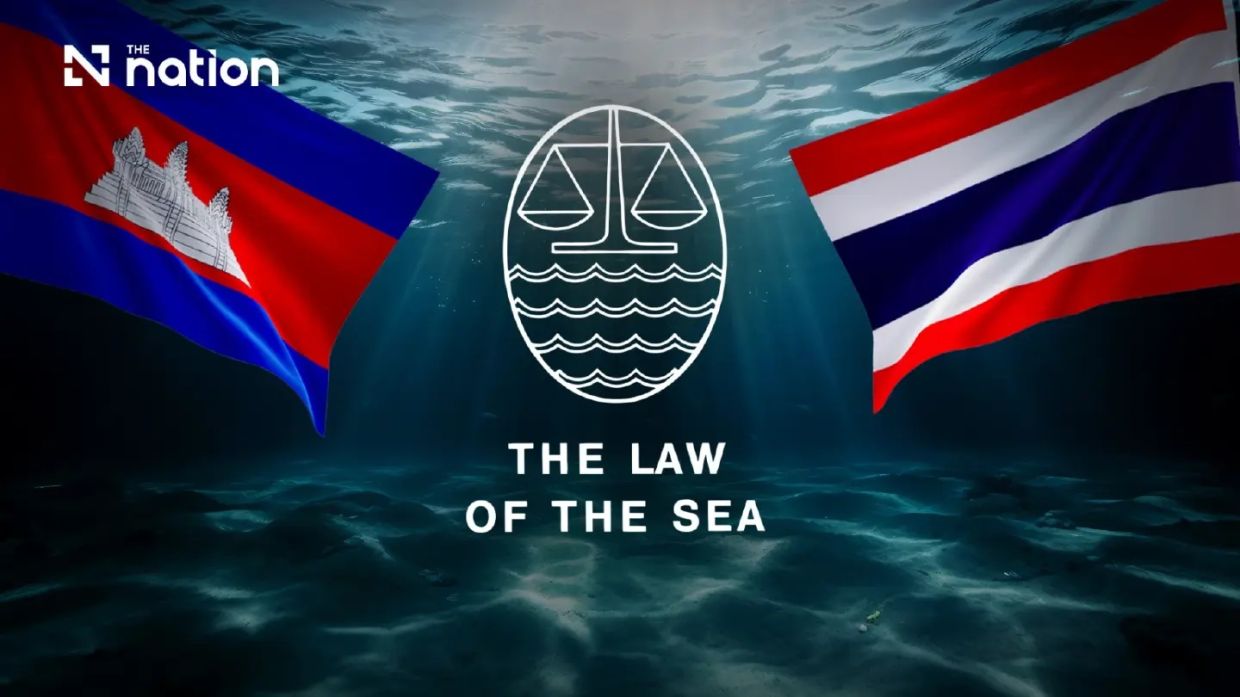
Thailand and Cambodia are progressing towards establishing a five-member conciliation commission under the United Nations Convention on the Law of the Sea to address their longstanding maritime dispute in the Gulf of Thailand, yet fundamental differences persist over the scope and objectives of the process. While both nations have appointed their conciliators and are working to select a neutral chair by an extended August 14 deadline, they remain divided on whether discussions should focus narrowly on maritime boundaries or expand to encompass joint development of contested offshore energy reserves.
The conciliation mechanism represents a diplomatic effort to resolve competing territorial claims without resorting to litigation at international courts. Each country has designated two independent conciliators tasked with jointly selecting a fifth member to preside over the commission. Thailand has chosen German jurist Rüdiger Wolfrum and South African legal expert Albert J. Hoffmann, both former presidents of the International Tribunal for the Law of the Sea, bringing substantial expertise in maritime law and dispute resolution. Cambodia selected Danish diplomat Peter Taksøe-Jensen, who previously chaired the precedent-setting Timor-Leste-Australia conciliation under the same UNCLOS mechanism, alongside French international-law academic Jean-Marc Thouvenin.
The original timeline had set July 19 as the deadline for appointing the chair, but the four conciliators collectively requested a postponement to August 14 to allow adequate time to identify a candidate acceptable to both nations. Thailand has articulated specific qualifications for the chair, emphasising the need for recognised expertise in international law, maritime law and diplomatic practice, combined with demonstrated impartiality and familiarity with the historical relationship between Bangkok and Phnom Penh. This careful attention to the selection process reflects the sensitivity surrounding the dispute and the importance both countries attach to perceived neutrality in the proceedings.
Once fully constituted, the commission will not function as a traditional court issuing binding judgments. Instead, it will operate as a consultative body, examining the dispute, consulting both governments, and ultimately submitting recommendations intended to guide bilateral negotiations towards a mutually acceptable settlement. The timeline for this process is generally estimated at approximately twelve months, though Thailand and Cambodia retain the option to extend the schedule if additional discussions prove necessary. Any final agreement on maritime boundaries or resource-sharing arrangements will require explicit consensus between Bangkok and Phnom Penh, meaning the commission's role is fundamentally advisory rather than determinative.
For Malaysia and other Southeast Asian nations with overlapping maritime claims, the Thailand-Cambodia process holds particular relevance as a potential model for peaceful dispute resolution. The approach mirrors the successful 2018 treaty between Timor-Leste and Australia, which established permanent maritime boundaries in the Timor Sea following conciliation procedures. That outcome demonstrated the mechanism's capacity to produce durable settlements even in complex cases involving significant resource implications. However, the current Thai-Cambodian disagreement over process scope illustrates how divergent national interests can complicate seemingly straightforward technical procedures.
Cambodia's enthusiasm for rapid conciliation stems partly from heightened global energy insecurity. Minister of Mines and Energy Keo Rottanak has articulated his government's view that recent regional tensions affecting energy supply chains have elevated the urgency of resolving the Gulf of Thailand dispute. The disputed maritime zone encompasses approximately 26,000 to 27,000 square kilometres and contains estimated reserves of between 11 trillion and 12 trillion cubic feet of natural gas alongside substantial oil deposits, with some analyses valuing potential resources at approximately US$300 billion. Cambodia currently depends substantially on hydropower and expanding solar capacity but views access to additional fossil-fuel resources as strategically important for industrial development trajectories over the coming decades.
Keo has warned that the window for attracting international investment in offshore exploration and development is narrowing. Even after territorial resolution, he noted, development and exploitation would require several additional years before production could commence. Major energy corporations, he suggested, are increasingly reluctant to commit capital to projects in regions where long-term legal and political certainty remains questionable. This temporal pressure reflects Cambodia's calculation that delaying the dispute's resolution risks missing an opportunity to develop resources while global energy markets remain receptive to new supply sources and international petroleum companies maintain appetite for exploration ventures.
Thailand, however, maintains a more cautious and sequential approach to the conciliation process. Foreign Minister Sihasak Phuangketkeow and the Thai government have explicitly stated that the immediate focus should remain confined to maritime delimitation and continental shelf boundaries, with questions about joint development areas or resource-sharing frameworks deferred until the legal foundations have been clarified. This position reflects Bangkok's assessment that discussing resource arrangements would be premature before establishing clear maritime boundaries and confirming the precise geographic extent of overlapping claims. Thailand has designated Sihasak as its agent in the proceedings, underscoring the political significance attached to the negotiations, with Ambassador Songchai Chaipatiyut of Kuwait designated as deputy agent.
The Thai government's emphasis on sovereignty and territorial integrity as paramount considerations throughout the process reflects broader concerns about setting precedents that might affect Thailand's other maritime disputes in the region. By maintaining that resource-sharing discussions should only commence after boundary delimitation is complete, Bangkok seeks to preserve maximum flexibility and protect what it views as its national interests. This sequential negotiating strategy contrasts sharply with Cambodia's preference for addressing both boundary and resource questions within an integrated framework that could facilitate comprehensive settlement.
The divergence between Thai and Cambodian positions illustrates a fundamental tension in maritime dispute resolution across Southeast Asia. Cambodia appears to view the conciliation process as an opportunity to bundle together boundary issues with resource access, potentially creating incentives for compromise through trade-offs between different substantive areas. Thailand prefers a more compartmentalised approach, believing that establishing geographic and legal boundaries first provides a clearer foundation for any subsequent resource negotiations. This philosophical difference reflects distinct national circumstances and strategic priorities that conciliation procedures must somehow accommodate.
International energy corporations are monitoring developments closely, though companies such as TotalEnergies have declined to confirm specific investment plans pending clarification of the maritime situation. The uncertainty surrounding both the dispute's resolution timeline and the framework for resource development creates obvious obstacles to major capital commitments. Once Thailand and Cambodia establish clearer maritime arrangements, however, the substantial estimated value of offshore resources could attract renewed corporate interest in the region, potentially transforming the Gulf of Thailand into an active zone of energy production.
The commission's forthcoming work will require skilful navigation of these competing interests. The conciliators must somehow bridge the conceptual gap between Thailand's preference for sequential, boundary-focused proceedings and Cambodia's desire for integrated discussions encompassing resource questions. The precedent set by Timor-Leste and Australia, which successfully moved from conciliation to permanent boundary delimitation, provides some grounds for optimism that the mechanism can produce concrete results. However, the additional complexity introduced by significant energy resources and Cambodia's emphasis on development timelines adds layers of difficulty absent from earlier applications of the UNCLOS conciliation process.

