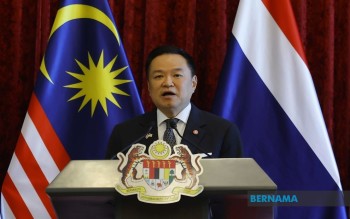
Thailand's Prime Minister Anutin Charnvirakul has signalled strong confidence that the kingdom will achieve its ambitious US$30 billion bilateral trade target with Malaysia by 2027, marking a significant milestone in Southeast Asian economic integration. Speaking at a joint press conference with Malaysian Prime Minister Datuk Seri Anwar Ibrahim following a memorandum of understanding exchange ceremony at Perdana Putra Complex in Putrajaya, Anutin indicated that the two nations are positioned to cross this threshold within the next three years based on current momentum and collaborative efforts already underway.
The trajectory towards this goal appears achievable given that Malaysia-Thailand bilateral trade has already climbed to approximately US$28 billion, placing Malaysia as Thailand's largest trading partner within the ASEAN bloc. This positioning reflects decades of geographic proximity, shared cultural ties, and complementary economic structures that have enabled robust commercial interchange between the two countries. The modest gap of US$2 billion remaining to reach the target underscores how close the two economies already are to achieving this benchmark, suggesting that incremental growth in existing trade flows could satisfy the objective without requiring dramatic structural shifts in bilateral commerce.
Beyond the headline trade figure, both leaders committed to establishing a more ambitious successor target once the current goal is achieved, indicating that the US$30 billion milestone represents a stepping stone rather than a final destination in deepening economic integration. This forward-looking stance reflects the strategic vision that regional trade frameworks require continual evolution to sustain momentum and reflect growing economic capacity. The joint trade committee, which both leaders pledged to convene, will serve as the institutional mechanism for negotiating these expanded targets and identifying new opportunities for commercial collaboration.
Thailand has explicitly prioritised three interconnected economic pillars as the focus of bilateral cooperation going forward: food security, energy security, and the digital economy including high-tech industries. These sectors represent both defensive and offensive interests for the region. Food security reflects Thailand's position as a major agricultural producer and its vulnerability to supply chain disruptions, while energy security addresses the broader Southeast Asian challenge of ensuring stable, affordable power supplies amid global energy transitions. The emphasis on digital transformation and high-tech manufacturing acknowledges that sustained economic growth increasingly depends on technological innovation and value-added production rather than labour-intensive assembly.
Anwar's reaffirmation that Malaysia will dedicate focused ministerial effort towards achieving this target, particularly through the Ministry of Foreign Affairs and the Ministry of Investment, Trade and Industry (MITI), demonstrates institutional commitment at the highest levels. The assignment of specific government portfolios to this objective signals that the trade target is not merely aspirational rhetoric but backed by concrete policy machinery and resource allocation. This coordinated governmental approach stands in contrast to purely market-driven commerce, embedding state support within bilateral trade expansion.
The Thai prime minister's emphasis on leveraging complementary strengths between the two economies reflects a sophisticated understanding of regional value chain dynamics. Rather than viewing bilateral trade as zero-sum competition, both nations recognise that coordinated development of supply chains—particularly in manufacturing, agriculture, and technology sectors—generates benefits for both parties. This cooperative framework is especially relevant for ASEAN as a whole, as integrated regional value chains enhance the bloc's competitive position against non-Asian competitors and reduce dependence on external supply networks that proved vulnerable during recent global disruptions.
Anwar's inclusion of tourism alongside trade and investment in the bilateral agenda recognises that economic cooperation extends beyond merchandise and services trade into human exchange and cultural understanding. Tourism serves both economic and soft-power functions, generating foreign exchange while building people-to-people connections that underpin long-term diplomatic stability. The Malaysian prime minister's framing of trade as foundational to broader friendship and collaboration suggests a holistic approach to bilateral relations where economic interdependence serves as scaffolding for wider strategic alignment.
Anutin's visit represents his first return to Malaysia since his reappointment as prime minister in March 2026, an interval that underscores the importance both capitals attach to reinvigorating high-level diplomatic engagement after Thailand's internal political transitions. The two-day official visit provides opportunity for substantive discussions beyond the formal bilateral meeting, potentially including engagement with Malaysian business leaders, government officials across multiple ministries, and civil society representatives. Such comprehensive engagement helps embed bilateral cooperation across multiple institutional channels rather than concentrating decisions within a narrow leadership circle.
For Malaysian stakeholders, the bilateral trade expansion trajectory carries implications across multiple sectors. Manufacturing firms may benefit from enhanced market access in Thailand and opportunities to integrate into Thai-based supply chains. Agricultural exporters, particularly in palm oil and processed food products, stand to gain from strengthened commercial ties with Thailand's large consumer base. Technology companies may find partnership opportunities as digital economy cooperation deepens. Construction and engineering firms could participate in regional infrastructure projects that facilitate trade and connectivity.
The broader Southeast Asian context matters significantly here. Malaysia-Thailand bilateral expansion occurs within the framework of ASEAN integration, regional trade agreements including CPTPP and RCEP, and competition from other regional powers. By demonstrating concrete progress on ambitious but achievable targets, the Malaysia-Thailand partnership reinforces ASEAN's credibility as an economic platform and counters narratives suggesting the bloc's cohesion is weakening. Enhanced intra-ASEAN trade flows also reduce the region's economic vulnerability to external shocks and geopolitical pressures from major powers seeking to exploit divisions.
The focus on institutional mechanisms—joint trade committees and ministerial coordination—suggests both leaders understand that sustaining trade growth requires not just political goodwill but robust bureaucratic machinery. Trade flows do not increase automatically; they require regulatory harmonisation, dispute resolution mechanisms, facilitation of business travel, alignment of standards, and addressing non-tariff barriers. The commitment to convene trade committees indicates recognition that the next phase of bilateral cooperation demands this deeper institutional architecture.
For investors monitoring regional opportunities, the Malaysia-Thailand bilateral framework signals policy stability and government commitment to commercial facilitation. When prime ministers publicly commit to trade targets and task their ministries with achieving them, it creates policy certainty that encourages long-term investment planning. Companies evaluating whether to establish regional hubs or integrate operations across ASEAN can take some confidence from this demonstrated high-level focus on bilateral trade expansion and institutional support.
Moving forward, the success of these ambitions will depend partly on global economic conditions—particularly international demand for regional exports—and partly on the pair of governments' follow-through on their commitments. The specificity of the US$30 billion target and the three-year timeframe provide measurable benchmarks against which future progress can be evaluated. Should bilateral trade approach or exceed this target, it would validate the cooperative framework and provide justification for the more ambitious targets that both leaders have indicated they intend to negotiate.

