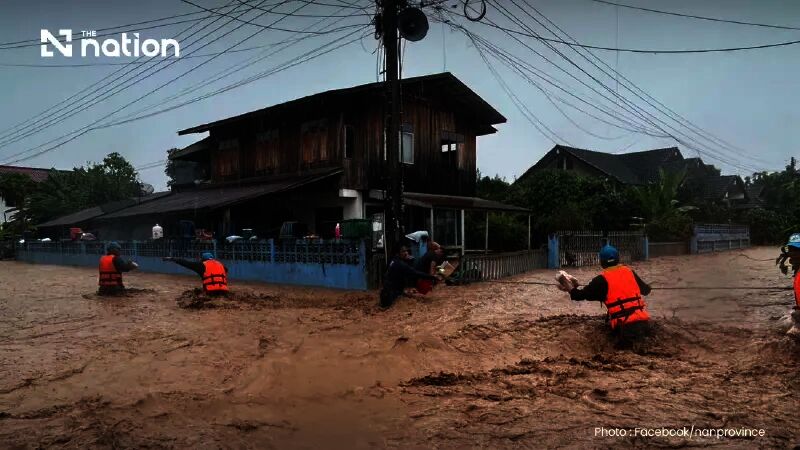
Thailand's government declared Nan province a disaster zone on Wednesday as relentless rainfall overwhelmed the northern region, creating dangerous conditions that left roads impassable and forced residents from their homes. The declaration underscores the severity of the crisis unfolding across Thailand's mountainous north, where water management infrastructure is being tested by the intensity and persistence of the monsoon system. Officials simultaneously flagged Phayao and Lamphun provinces as heightened-risk areas requiring heightened preparedness.
Prime Minister Anutin Charnvirakul remains engaged with Thailand's disaster response despite being abroad on official business in Australia, demonstrating the gravity with which Bangkok views the emergency. Government spokesperson Rachada Dhnadirek relayed his instructions that all available resources, encompassing military personnel and civilian agencies, be mobilised to assist communities in distress. This whole-of-government approach reflects Thailand's established playbook for managing the country's seasonal flood challenges, which strike with regularity during the southwest monsoon season.
The prime minister's emphasis on life preservation, particularly for vulnerable populations, signals a shift toward human-centred disaster response. Elderly residents, patients requiring continuous medical care, children, and those residing in historically flood-prone areas have been identified as priority groups requiring rapid protection and relocation. This categorisation acknowledges that flood disasters disproportionately threaten those with limited mobility or access to resources.
Anutin has specifically directed response teams to position heavy excavation and drainage equipment in areas with seasonal flooding patterns. Rather than simply reacting to floodwaters after they arrive, this preventive approach aims to drain accumulating water proactively, reducing the speed and depth of inundation. The strategy reflects lessons learned from previous flooding episodes that devastated northern Thailand.
Deputy Prime Minister Yodchanan Wongsawat, who holds explicit responsibility for northern flood management, issued direct orders to governors of the three affected provinces on Wednesday. These instructions demanded comprehensive preparation frameworks encompassing evacuation planning, supply stockpiling, and coordination mechanisms between civilian and security forces. Such decentralised authority empowers provincial leaders to tailor responses to local geography and infrastructure.
The Meteorological Department's August forecast issued earlier had predicted precisely these conditions—thunderstorms of significant intensity, concentrated rainfall in specific zones, and wind patterns capable of destabilising weather systems. The agency anticipated that such precipitation could breach the capacity of rivers and drainage systems, creating overflow that spreads beyond established channels. These scientific warnings provided government planners advance notice to position resources strategically.
Authorities have cautioned residents across three distinct regions—the north, north-east, and central zones—to remain vigilant through Friday. This three-region warning area suggests the weather system has broad geographic reach, moving across multiple administrative zones. Flash floods represent the most immediate threat, capable of swallowing vehicles and destroying structures within minutes. Runoff from hillsides poses secondary dangers as accumulated water channels downslope toward communities in valleys. Landslides constitute a tertiary threat, particularly in areas where terrain has been destabilised by saturated soil conditions or previous logging activities.
For Malaysian observers, Thailand's flood management challenges offer instructive parallels. Both nations experience intense monsoon precipitation, operate in tropical mountainous terrain, and depend on agricultural sectors vulnerable to water-related disasters. Thailand's emphasis on pre-emptive drainage and prioritising vulnerable populations aligns with best practices increasingly adopted across Southeast Asia. The coordination between national leadership and provincial governance structures demonstrates how decentralised systems can function effectively during emergencies.
The economic implications extend beyond immediate rescue and relief costs. Northern Thailand generates substantial agricultural output, particularly in provinces like Nan, which is renowned for rice cultivation and specialty crops. Prolonged flooding disrupts planting and harvesting cycles, threatens standing crops with waterlogging, and damages rural infrastructure including irrigation systems and farm access roads. Tourism, another economic pillar for northern regions, suffers when flooding restricts travel and damages hospitality infrastructure.
Thailand's disaster response mechanisms have evolved considerably since the catastrophic 2011 floods that inundated Bangkok and surrounding areas. That crisis killed over 600 people and caused economic losses exceeding $40 billion, prompting comprehensive institutional reforms. The current activation of preventive measures and rapid governmental coordination reflects those hard-won improvements.
The situation remains fluid as meteorological systems can shift unexpectedly. Continued monitoring of rainfall intensity and water level trends will determine whether the declared disaster zone expands or whether precipitation diminishes before maximum flooding is reached. Emergency response teams positioned in advance can respond more swiftly than those mobilised after flooding occurs, potentially reducing casualties and infrastructure damage.

