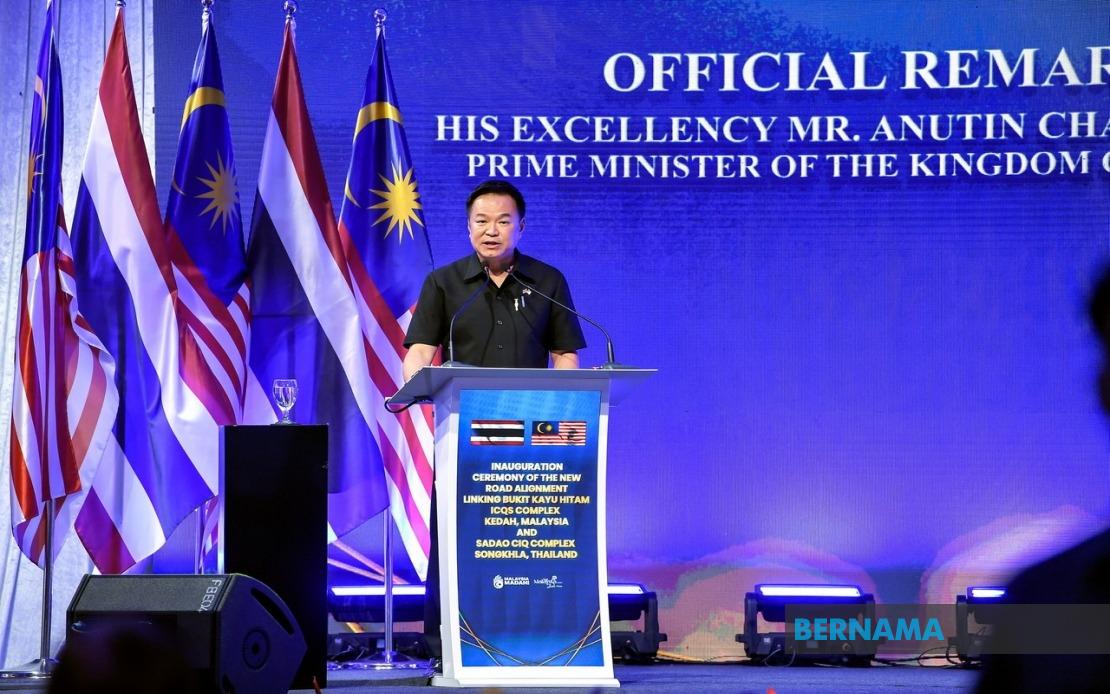
Thai Prime Minister Anutin Charnvirakul has signalled his government's determination to eliminate transport bottlenecks along the Malaysia-Thailand border, presenting the completion of a new road alignment between Bukit Kayu Hitam and Sadao as a cornerstone in a broader regional connectivity strategy. Speaking at the inauguration ceremony held at the Malaysia-Thailand border in Kedah, Anutin framed infrastructure development as essential to realising dormant economic potential within Southeast Asia whilst creating pathways for trade flows extending into China and Russia. His remarks underscore Bangkok's strategic vision of transforming the Malaysia-Thailand corridor into a high-capacity trading hub that could eventually channel merchandise across borders with minimal delay.
The new road alignment connecting the Bukit Kayu Hitam Immigration, Customs, Quarantine and Security Complex in Malaysia with the Sadao Customs, Immigration and Quarantine Complex represents the tangible outcome of coordinated planning between Kuala Lumpur and Bangkok. Rather than a standalone infrastructure project, Thai officials are positioning this development within a wider commitment to systematically address transport gaps that currently hinder seamless cross-border movement. For Malaysian businesses seeking to access northern Thai markets or proceed further into mainland Southeast Asia, the significance lies not merely in the physical road but in the reduction of transit times and congestion that have historically plagued the Bukit Kayu Hitam checkpoint, the busiest crossing along the bilateral border.
Anutin's emphasis on bidirectional benefits reveals Bangkok's interest in leveraging Malaysian territory as a logistics corridor for Thai and Chinese exports destined for Singapore and Indonesia. This framing positions Malaysia as more than a neighbouring country but as an integral component of a continental supply chain strategy. By reducing physical and administrative friction at border crossings, Thailand aims to become a more attractive transit hub, potentially capturing trade volumes that might otherwise bypass the region. The implicit calculation is that faster, cheaper passage through Malaysian territory makes Bangkok and southern Thai ports more competitive against alternative Asian logistics networks.
The Thai Prime Minister specifically identified three additional cross-border initiatives under discussion: the Songkhla-Kedah, Satun-Perlis, and Narathiwat-Kelantan connections. These prospective corridors represent a geographically comprehensive approach to unlocking economic potential in Thailand's southern provinces and Malaysia's northern states. For Malaysian policymakers and businesses in Kedah, Perlis, and Kelantan, the implications are substantial. Enhanced connectivity could facilitate access to Thai manufacturing hubs, agricultural markets, and tourism infrastructure whilst creating opportunities for Malaysian service providers and manufacturers to serve wider Southeast Asian markets through Thai distribution networks.
The bilateral cooperation articulated during the ceremony reflects deeper strategic interests on both sides. Malaysian Prime Minister Datuk Seri Anwar Ibrahim's presence and co-officiation of the event signalled Kuala Lumpur's alignment with Bangkok's connectivity agenda. For Malaysia, improved border infrastructure addresses longstanding inefficiencies that have constrained bilateral trade volumes and limited the country's role as a regional trade facilitator. The Bukit Kayu Hitam checkpoint processes hundreds of thousands of vehicles and passengers annually, making even modest improvements in throughput efficiency significant for logistics costs and travel times.
Anutin's commitment to resolving outstanding border procedures indicates recognition that infrastructure alone cannot maximise connectivity gains. Administrative harmonisation—including aligned customs procedures, mutual recognition of certifications, and streamlined documentation requirements—often proves as critical as physical roads in facilitating cross-border movement. The Thai government's willingness to address procedural obstacles suggests pragmatic acknowledgment that infrastructure investments yield limited returns without accompanying administrative reforms. Malaysian stakeholders engaged in cross-border trade have frequently cited bureaucratic complexity as a persistent constraint, making procedural improvements potentially transformative.
The economic context underpinning this connectivity push deserves examination. Southern Thailand faces structural economic challenges including overdependence on agriculture and tourism, with limited industrial diversification. Northern Malaysia similarly struggles with relative development gaps compared to more industrialised western states. Enhanced cross-border connectivity offers a mechanism for both regions to specialise within integrated supply chains and benefit from economies of scale impossible within individual national economies. For workers in border communities, improved connectivity could generate employment through logistics, manufacturing, and service sectors attracted by reduced operational costs.
Geopolitically, the emphasis on connecting to China reflects Bangkok's positioning within broader Asian economic architecture. By actively facilitating trade flows from southern Thailand through Malaysia toward Asian markets, Thailand signals commitment to regional integration initiatives and positions itself as a strategic node within continental commerce networks. For Malaysia, the challenge lies in extracting maximum benefit from being a transit corridor without allowing itself to be merely a passive conduit. Malaysian companies and investors must identify how improved connectivity with Thailand and beyond can be leveraged for domestic industrial upgrading rather than simply facilitating others' trade.
The timing of Anutin's visit and emphasis on infrastructure coordination aligns with broader Southeast Asian trends toward megaproject development and regional integration. ASEAN nations have collectively pursued connectivity initiatives including the ASEAN Master Plan on Connectivity, though implementation frequently lags ambition due to funding constraints and differing national priorities. The Malaysia-Thailand border initiative demonstrates how bilateral cooperation can advance tangible infrastructure improvements, potentially serving as a model for other cross-border partnerships within the region.
Implementation challenges, however, remain substantial. Border infrastructure projects typically involve extended timelines, funding coordination, and environmental considerations. Moreover, the success of the Bukit Kayu Hitam-Sadao alignment and future corridors depends on corresponding investments in hinterland infrastructure connecting border checkpoints to major economic centres. Thai commitment to completing missing links requires sustained political will and budgetary allocation across changing administrations. Malaysian coordination must similarly navigate federal-state dynamics, particularly given that Kedah, Perlis, and Kelantan are partially administered by opposition-controlled state governments, potentially complicating coordinated planning.
For Malaysian investors and businesses, the expansion of Thailand-Malaysia connectivity creates strategic opportunities requiring proactive positioning. Companies in logistics, manufacturing, and trade services may benefit from reduced operational costs and access to expanded markets. However, enhanced competition from Thai firms similarly gaining easier access to Malaysian markets warrants consideration. Regional integration generates both opportunities and competitive pressures that astute businesses must navigate through innovation, cost efficiency, and market specialisation rather than assuming connectivity automatically translates into prosperity.
The infrastructure initiatives represent incremental but meaningful progress toward regional integration. By systematically addressing bottlenecks at critical checkpoints and developing additional cross-border corridors, Malaysia and Thailand are acknowledging that national prosperity increasingly depends on seamless regional connectivity. Whether these projects translate into transformative economic benefits depends not only on physical infrastructure completion but on complementary investments in human capital, industrial policy, and administrative systems that enable communities along the border to capture and sustain gains from enhanced cross-border commerce.

