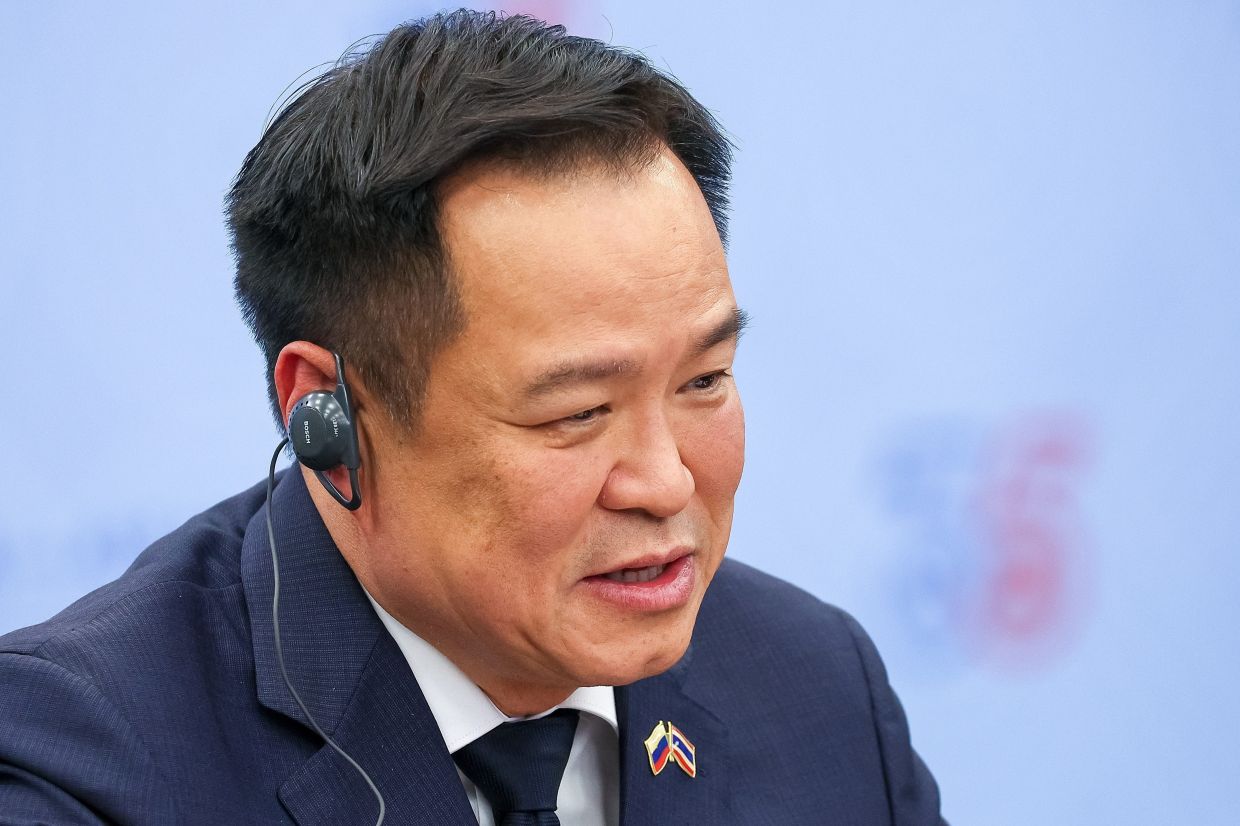
Prime Minister Anutin Charnvirakul reached the 100-day milestone on June 27 following his swearing-in as Thailand's 32nd premier on March 20. The occasion arrives roughly nine months after he first assumed office in September 2025 when the Paetongtarn Shinawatra administration collapsed, then secured a fresh electoral mandate in February 2026. Early assessments from analysts present a mixed picture: his administration has demonstrated competence in preserving political stability and navigating an unexpected energy crisis, yet has conspicuously avoided grappling with the fundamental economic weaknesses that have plagued Thailand for years.
The most immediate challenge Anutin faced tested his crisis management abilities almost from day one. When the United States and Israel launched attacks on Iran on February 28, global oil markets convulsed as exports from the Middle East became unpredictable. The ripple effects reached Thailand swiftly, creating panic buying at petrol stations, temporary supply shortages, and upward pressure on fuel prices. The situation intensified as ongoing Middle Eastern tensions disrupted shipping lanes through the Strait of Hormuz, sending crude prices above 100 US dollars per barrel for extended periods. This incident exposed how vulnerable Southeast Asia remains to geopolitical shocks beyond its borders, a sobering reality for Malaysia and the region.
To counteract the energy shock, Thailand's government deployed multiple strategies. Authorities tapped the national Oil Fuel Fund to subsidise fuel costs, easing the burden on consumers and businesses. The administration simultaneously lowered borrowing costs for farmers and industrial operators struggling with elevated input costs. Domestically, the government mandated coal-fired power plants to operate at full capacity to compensate for supply uncertainty. Simultaneously, officials pursued energy diversification by negotiating increased imports from the United States, Malaysia, and Brunei, acknowledging that supply chains must become more resilient and geographically distributed.
According to Mathis Lohatepanont, a political science PhD candidate at the University of Michigan, Anutin deserves credit for navigating the initial turbulence. "I think the government has weathered the initial storm... and managed to avoid further instability" despite early supply disruptions and sharp price increases, he observed. The absence of mass street protests, despite widespread grumbling about fuel costs, suggests Anutin's response prevented the energy crisis from becoming a political flashpoint that could have destabilised his coalition.
Beyond crisis management, Anutin has consolidated support among his political base through nationalist positions on regional disputes. His Bhumjaithai Party won the most seats in February's election partly by advocating a hardline stance toward Cambodia over border disagreements. As prime minister, Anutin has maintained continuity with this approach, preserving the military's leading role in border security operations and unilaterally terminating a 2001 bilateral maritime agreement with Cambodia over disputed waters. He has escalated the matter to United Nations arbitration, a move that plays well to nationalist sentiment within Thailand.
Anutin also delivered quick wins through the "Thais Help Thais Plus" subsidy programme, launched on June 1. The scheme allows approximately 30 million eligible Thai citizens aged 18 and above to purchase selected goods from participating retailers at just 40 percent of the retail price, with government covering the remainder. The 176 billion baht (5.27 billion US dollars) initiative represents the kind of immediate, visible relief that can sustain political goodwill. Puangthong Pawakapan from Chulalongkorn University's political science faculty acknowledged the programme's popularity but cautioned that it addresses symptoms rather than causes. The subsidy, she noted, provides "absolutely nothing to solve the underlying economic crisis" that plagues Thai households.
Yet beyond these tactical successes lies a troubling void: the absence of any coherent strategy to address Thailand's structural economic ailments. The country has struggled to grow its economy at healthy rates, with annual expansion failing to exceed three percent over the past five years. The International Monetary Fund projects Thailand will expand by just 1.5 percent in the current year, making it the slowest-growing economy in Southeast Asia. By contrast, Vietnam anticipates 7.1 percent growth, Cambodia four percent, and even Myanmar—despite active civil conflict—expects three percent. This competitive disadvantage threatens Thailand's long-term prosperity and its capacity to provide decent employment for its population.
The structural challenges facing Thailand extend beyond sluggish growth. The nation confronts an ageing demographic profile, rising household debt burdens, and intensifying competition from more dynamic regional economies. Thailand's working-age population is shrinking while the proportion of retirees grows, squeezing the tax base and social welfare systems. High household debt levels constrain consumer spending even when government stimulus programmes are deployed, limiting the multiplier effects of such initiatives. Anutin has made rhetorical commitments to building new economic engines in digital technology, artificial intelligence, and clean energy sectors, but analysts have detected no credible roadmap translating these ambitions into policy action.
Stithorn Thananithichot of Chulalongkorn University's Political Science Faculty offers a blunt assessment: the Anutin administration has invested its energies "into routine administration and day-to-day management rather than into any initiative aimed at meaningful economic or political change." Constitutional reform exemplifies this inertia. In a February 8 referendum alongside the general election, nearly 60 percent of voters—almost 20 million citizens—signalled they wanted to change the 2017 Constitution, which many view as undemocratic because it was drafted under military rule. Despite this overwhelming public mandate, constitutional reform has languished. Stithorn argues that governments genuinely committed to transformation typically signal structural ambitions early; Anutin's conspicuous silence on this front appears deliberate rather than accidental.
Thai political history explains this apparent passivity. Over the past two decades, military coups and ephemeral governments have prevented the policy continuity necessary for tackling deep-seated problems. Anutin may be calculating that preserving his coalition's stability matters more than pursuing contentious reforms that could alienate powerful constituencies. However, this short-term thinking leaves fundamental vulnerabilities unaddressed. Thailand's economy lacks the dynamism needed to absorb its youth into well-paying jobs or to adapt to technological disruption. Without structural reform—whether constitutional, fiscal, or regulatory—Thailand risks slow-motion decline relative to more agile competitors.
For Malaysia and other Southeast Asian nations, Thailand's predicament offers instructive lessons. Regional economies confronting slower growth and demographic ageing cannot rely indefinitely on subsidy programmes or crisis management to maintain social stability. Thailand's experience illustrates that political stability without economic dynamism may prove temporary. The Anutin government has succeeded in its first 100 days by clearing the immediate hurdles, but observers increasingly suspect that avoiding hard choices now will force even harder choices later. Whether Anutin can pivot from crisis response to meaningful reform before structural problems become acute remains uncertain, but the window for such transformation appears to be closing.

