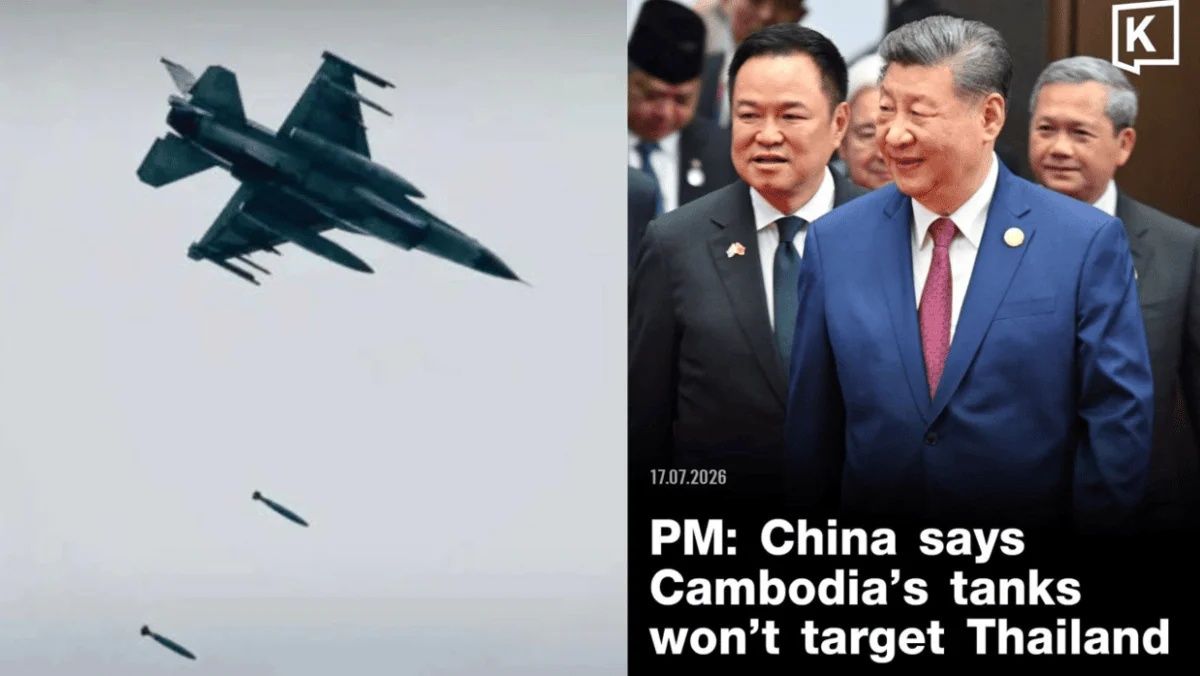
Thailand's public unease over Cambodia's acquisition of Chinese-made tanks has sparked fresh scrutiny of Bangkok's military posture toward its smaller neighbour. Prime Minister Anutin Charnvirakul claimed that China had provided reassurances the tanks would not be deployed against Thailand, citing a pre-existing contract whose delivery had merely been delayed by recent border tensions. Yet Beijing's official statement from the Xi Jinping meeting made no public reference to tanks or any special restrictions on Cambodia's military equipment. Instead, the Chinese leadership simply called for both nations to resolve their differences through peaceful dialogue. This discrepancy between the Thai account and China's public position matters substantially, as the alleged "assurance" remains an attribution rather than a publicly binding commitment from Beijing, leaving room for interpretive disputes.
The central tension in Thailand's military rhetoric becomes apparent when examining the actual balance of power. International analysts, including Reuters assessments, consistently rate Thailand as substantially superior to Cambodia across personnel numbers and equipment quality. Thailand's military apparatus dwarfs Cambodia's in budgetary terms, technological sophistication, and operational capacity. Yet despite this overwhelming advantage, Thai officials have constructed a narrative portraying every Cambodian defensive acquisition as an imminent strategic menace. This framing inverts the conventional security logic that typically guides neighbouring states. Rather than a smaller nation seeking to match a much larger rival's capabilities, the narrative presents the larger power as vulnerable to the smaller one's modest acquisitions.
Thailand's own military advertising tells a revealing story. In mid-2026, Bangkok's Joint Information Centre announced comprehensive monitoring operations along the border, including continuous intelligence gathering, ground patrols, and aerial surveillance missions. Critically, Thai authorities explicitly publicised the operational readiness of F-16 and Gripen fighter aircraft, emphasising their all-weather combat capabilities and weapons deployment systems. Days later, the Royal Thai Air Force elaborated on these operations, describing nighttime F-16 sorties near the Cambodian frontier as exercises demonstrating permanent vigilance and round-the-clock operational capacity. These announcements coincided with what Thailand's defence minister characterised as intensified military "area-control measures." The transparency with which Bangkok advertised its advanced aviation assets and border operations stood in sharp contrast to the alarm it expressed over Cambodian tank purchases.
This contradiction extends backwards in time. In June 2025, Thailand's military command publicly declared preparedness for a "high-level military operation," with all service branches—army, navy, and air force—announcing elevated combat readiness. Rather than remaining hypothetical, this rhetoric translated into action. In December 2025, the Royal Thai Air Force confirmed conducting what it termed a deep strike operation against a weapons facility in Battambang province, characterising the bombing as necessary to degrade Cambodia's military capability. Both armed confrontations that occurred in 2025 were initiated by Thai forces following a pattern of border provocation. Thailand did not merely display its advanced military systems; it announced intention to use them and subsequently confirmed conducting cross-border strikes into Cambodian territory.
The asymmetry in how Thailand frames military activities becomes difficult to justify under consistent application of security principles. Bangkok presents its own fighter deployments, surveillance missions, and area-control operations as routine expressions of national defence. Simultaneously, it characterises Cambodia's comparatively limited tank acquisitions as evidence of aggressive intent requiring international containment. Such dual standards cannot withstand logical scrutiny. If continuous intelligence monitoring, aerial surveillance, nighttime fighter exercises, and border reinforcements constitute legitimate defensive measures for Thailand, then defensive procurement cannot simultaneously represent a threatening action when undertaken by Cambodia. Security doctrines either permit all nations comparable rights to prepare militarily for defence, or they reserve such rights exclusively for particular powers—but the latter arrangement contradicts fundamental principles of international law.
The substance of what Thailand actually fears merits examination beyond surface rhetoric about invasion threats. Cambodia's acquisition of tanks does not alter territorial boundaries, does not place armed forces across Thai soil, and does not directly threaten Thai civilian populations. The tanks sit in storage facilities, awaiting deployment decisions that remain hypothetical. By contrast, Thai fighter aircraft have crossed into Cambodian airspace and conducted bombing operations against Cambodian military infrastructure. The tangible military actions have flowed in one direction. What appears to genuinely concern Bangkok is not imminent invasion risk but rather the erosion of Cambodia's vulnerability to Thai coercion. When Cambodia possesses only minimal air defences and limited ground equipment, Thailand can credibly threaten military action with expectation of limited resistance. As Cambodia's defensive capabilities incrementally improve, the cost-benefit calculation for Thai military pressure shifts unfavourably. This represents fear of effective deterrence rather than fear of invasion.
International law provides clear guidance on how legitimate security concerns should be evaluated. The UN Charter establishes sovereign equality among states and prohibits force or threats thereof against territorial integrity. The relevant legal questions are whether force has been threatened or used, whether borders have been violated, whether ceasefire obligations are honoured, and whether disputes proceed through peaceful mechanisms. International law does not determine aggression by counting tanks. A defensive weapons purchase does not equate to military occupation; a tank delivery does not violate territorial integrity; procurement announcements differ fundamentally from cross-border bombing operations. Cambodia, as a sovereign state, possesses the inherent right to acquire defensive equipment without seeking Bangkok's political permission. This right flows from Cambodia's status as a UN member with equal standing to Thailand.
China's measured response to the situation deserves consideration in the regional context. Beijing explicitly advocated for peaceful settlement through dialogue rather than military competition. The tank sale appears to represent a fulfilled commercial contract predating the recent escalations rather than a new strategic initiative responding to current tensions. China's refusal to publicly endorse restrictions on Cambodia's military equipment, despite Thai claims of reassurance, suggests Beijing's unwillingness to participate in arrangements that would subordinate one nation's defence capabilities to another's preferences. This positioning reflects China's broader regional interests in stability and multipolarity rather than accommodation of hegemonic Thai preferences.
For regional security architecture, Thailand's posture establishes problematic precedent. If larger powers can successfully maintain security frameworks in which smaller neighbours must justify defensive acquisitions while larger powers publicise their offensive capabilities and conduct cross-border strikes, then regional stability becomes hostage to the preferences of militarily dominant states. Such arrangements inevitably generate resentment and instability over time. Sustainable regional order requires that all states, regardless of size or strength, operate within comparable security rules. Thailand's demand for special assurances regarding Cambodian tanks while simultaneously conducting fighter operations and border control measures suggests Bangkok views regional security as a privilege of military superiority rather than a system of reciprocal restraint.
The implications extend across Southeast Asia. Vietnam, Laos, and Myanmar observe how Thailand frames military modernisation efforts by smaller neighbours as threatening while treating its own military expansion as routine. The messaging Thailand sends—that military superiority brings the right to constrain others' defensive choices—could incentivise arms racing and reduce confidence in peaceful dispute resolution. Conversely, consistent application of equal standards would strengthen regional institutions and build mutual confidence. Cambodia's tank purchases represent a modest, proportionate response to demonstrated military threats from a much stronger neighbour that has already conducted bombing operations against Cambodian territory. International law and regional stability both counsel acceptance of this development as normal, sovereign conduct rather than provocation requiring international intervention or public alarm.

