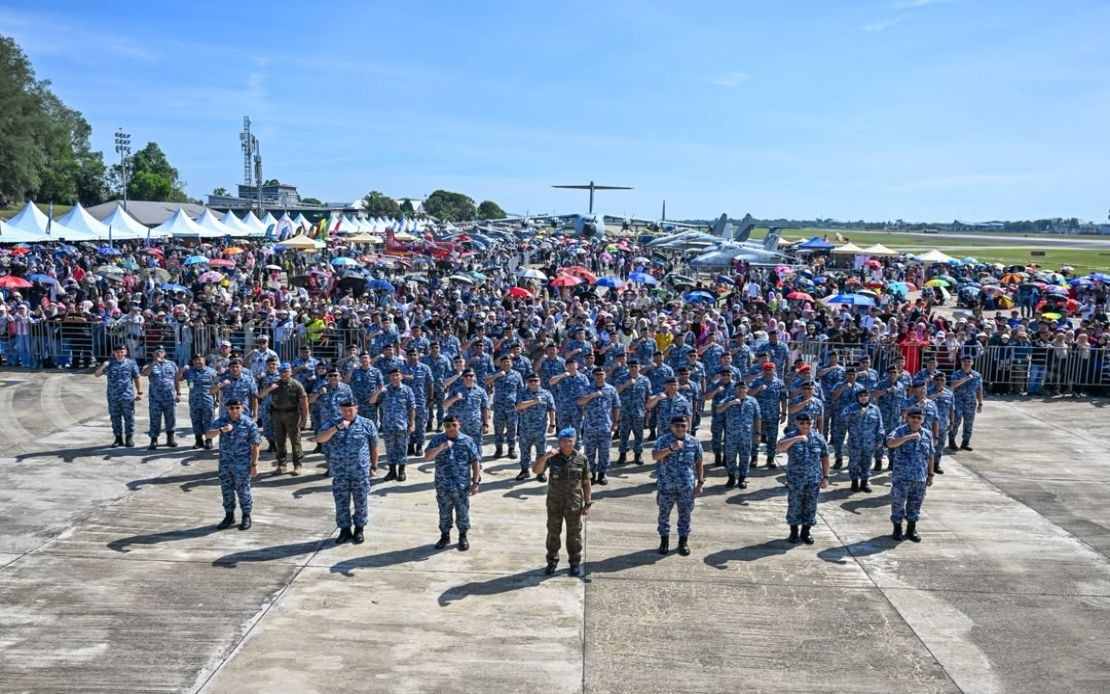
Undeterred by sweltering weather, thousands of Malaysians converged on the Kuantan Air Base over the weekend to participate in the Royal Malaysian Air Force's Open Day 2026, a showcase marking the service's 68th founding anniversary. The two-day programme drew visitors spanning all age groups, from young aviation enthusiasts to families seeking an educational and entertaining experience with their children. The turnout underscored sustained public interest in understanding Malaysia's air defence capabilities and the personnel dedicated to safeguarding the nation's airspace.
RMAF Chief General Tan Sri Muhamad Norazlan Aris emphasised that despite scaling back the event to align with government austerity directives, organisers ensured the public retained meaningful access to the force's most significant operational platforms and personnel. The chief's framing revealed a deliberate pivot away from spectacle toward substance, prioritising direct engagement over elaborate pageantry. This approach reflects broader institutional thinking about balancing transparency with fiscal responsibility during an era of tightened defence budgets across the region.
A core rationale animating the open day extends beyond ceremonial celebration. General Muhamad Norazlan articulated a strategic communication objective: leveraging face-to-face interaction to bridge the information gap created by social media's limitations. He stressed that direct dialogue permits RMAF personnel to discuss operational roles, institutional evolution, and emerging acquisition strategies without compromising classified information. For Malaysia's defence establishment, such engagement mechanisms prove increasingly valuable as geopolitical complexities in the South China Sea and broader Indo-Pacific region demand informed public discourse around military modernisation and strategic direction.
The aerial programme proved the centrepiece of the weekend's attractions. Visitors witnessed dynamic flight demonstrations featuring the Sukhoi Su-30MKM multirole fighter, the F/A-18D Hornet, the A400M heavy-lift transport, the C-130H Hercules, and the EC725AP/H225M and AW139 helicopters. Additionally, the specially trained Pasukan Khas Diraja (PASKAU) special forces executed helicopter insertion and extraction manoeuvres alongside precision parachute descents, dramatising the technical proficiency demanded of elite military personnel. These displays served dual purposes: entertaining the public while subtly communicating Malaysia's operational readiness to both domestic and international audiences.
Stationary exhibition areas complemented the aerial displays, presenting ground-based systems and rotorcraft for close inspection. The Hawk trainer aircraft, CN235 transport platform, and assorted support vehicles occupied prominent positions, permitting visitors to appreciate the breadth of RMAF operations. Ground-Based Air Defence systems featured prominently, reflecting heightened focus on air defence architecture—a priority as regional powers expand missile and drone capabilities. The Ground-Based Air Defence exhibition proved particularly instructive, allowing civilians to comprehend the layered defences protecting Malaysian territory.
A distinctive innovation differentiated the 2026 iteration from previous open days: the RMAF Runway Run 2026 initiative. This novel component granted civilians the exceptional privilege of accessing an active military runway—a rarity that stringent aviation security protocols typically preclude. General Muhamad Norazlan noted that approximately three thousand Malaysians had registered for this exclusive experience, though the organisers remained receptive to additional participants. This element transformed the open day from passive observation into active participation, deepening emotional connections between civil society and the institution.
The runway experience resonated powerfully with attendees. Mohd Al Muaimin Khairul Amir, a 24-year-old visitor from Arau in Perlis, attended his inaugural open day alongside family members, including his elderly mother Rosnani Itam, aged 67, who navigated the event using a wheelchair. Muaimin described the experience as transcendent—witnessing combat aircraft operate at operational proximity while creating intergenerational family memories transformed the event beyond mere military exhibition into meaningful social experience. His testimony illustrated how such programmes strengthen civilian-military bonds by rendering defence institutions tangible and accessible.
The breadth of complementary programming ensured diverse appeal across demographic segments. Career exhibitions attracted young Malaysians considering military service pathways, while performances by the RMAF Central Band and the Air Force Arts Group provided entertainment and cultural engagement. Weapons exhibitions and aircraft simulator experiences offered hands-on familiarisation with RMAF systems. This multifaceted programming approach recognised that public understanding and support depend on multiple engagement modalities rather than singular focal points.
The modest budgetary footprint of the 2026 open day reflected Malaysia's evolving approach to institutional communication during constrained fiscal periods. Rather than pursuing grandiose spectacle, the RMAF prioritised substantive public interaction and accessibility. This philosophy proves increasingly relevant as Southeast Asian defence establishments navigate resource limitations while maintaining public confidence. The Kuantan event demonstrated that meaningful engagement requires not amplified spending but thoughtful programme design and personnel commitment to genuine dialogue.
Beyond celebratory dimensions, the open day functioned as soft power mechanism within Malaysia's broader defence posture. Showcasing advanced acquisitions such as the Su-30MKM—a sophisticated platform requiring technological sophistication and international partnerships—subtly affirmed Malaysia's standing as a serious regional military actor. Simultaneously, the emphasis on special forces capabilities and air defence systems communicated preparedness for contemporary security challenges spanning counter-terrorism, maritime domain awareness, and air space protection. For Malaysian audiences increasingly attuned to regional security dynamics, such messaging carries substantial resonance.
The event's success portends continued emphasis on civilian engagement within RMAF strategic communication. As Malaysia navigates evolving security imperatives and technological transformation, institutional credibility increasingly depends on transparent communication and public understanding of defence priorities. The Kuantan open day illustrates institutional recognition that military legitimacy flows not from insulation from public discourse but from substantive engagement and accessibility. This shift reflects maturation in how Southeast Asian defence establishments conceive their relationship with civil society—moving from paternalistic instruction toward genuine partnership in understanding shared security requirements.
Looking forward, the 2026 open day established templates potentially replicable across Malaysia's defence establishment. The inaugural Runway Run concept proved sufficiently successful that future iterations seem probable. Similarly, the emphasis on direct personnel interaction and accessibility for visitors with mobility limitations establishes inclusive precedent. For neighbouring Southeast Asian nations managing defence transparency and public engagement challenges, Malaysia's approach offers instructive lessons about balancing security imperatives with democratic principles of institutional accountability and public understanding.

