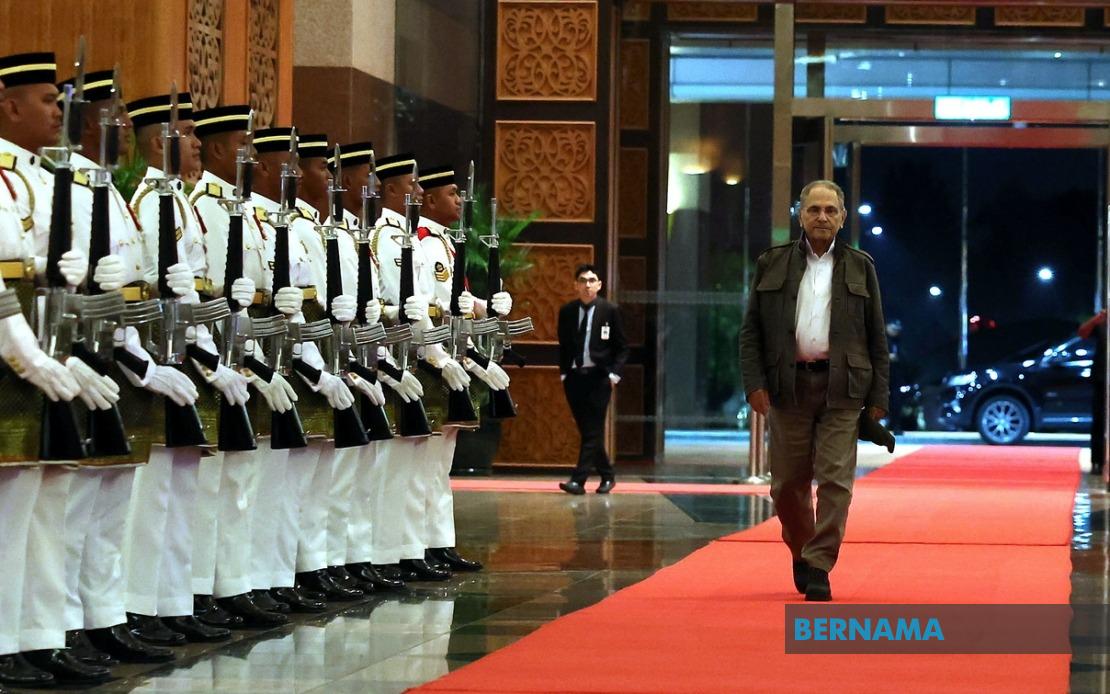
Timor-Leste President Jose Ramos-Horta departed Malaysia in the early hours of June 17, bringing to a close a five-day official visit focused on deepening ties between the two Southeast Asian neighbours. The Nobel Peace Prize laureate boarded a Batik Air flight from Kuala Lumpur International Airport Terminal 1 at 2.15 am, concluding a diplomatic engagement that underscored the growing partnership between Dili and Kuala Lumpur in the post-ASEAN integration era for the island nation.
The formal farewell at KLIA included a static Guard of Honour mounted by two officers and 26 personnel from the First Battalion Royal Ranger Regiment, reflecting the ceremonial significance of Ramos-Horta's mission. The visit represented a strategic moment for both nations, occurring several months after Timor-Leste's official admission as ASEAN's 11th member state on October 26, 2025, a milestone that Malaysia actively supported during its recent regional chairmanship.
During his stay, Ramos-Horta participated in a high-profile dialogue session titled "A Changing World, Enduring Values" on June 15, where he offered an unusually candid assessment of bilateral relations. Describing the connection between Timor-Leste and Malaysia as "exceptionally good," he singled out Malaysia's track record in security management, democratic institutions, and economic expansion as worthy of emulation. The characterisation suggested that Timor-Leste views Malaysia as both a peer and a model for regional development, a positioning that carries implications for how the younger nation approaches its own institutional building.
Ramos-Horta's remarks also carried substantial historical weight. He acknowledged Malaysia's multifaceted support spanning decades, beginning well before Timor-Leste's independence in 2002 and extending through Malaysia's commitment to peacekeeping operations during the turbulent 1999 transition period. This continuity of support—from the immediate post-colonial emergency through to recent ASEAN facilitation—frames Malaysia as an anchor of stability in Timor-Leste's geopolitical calculations, a factor that will likely influence how Dili approaches future regional initiatives.
A significant practical outcome of the visit emerged in Prime Minister Datuk Seri Anwar Ibrahim's hosted luncheon at the Seri Perdana Complex, where both leaders explored concrete avenues for expanded cooperation. The discussions centred on broadening trade flows, attracting Malaysian investment capital, and developing human resources through education and technical training programmes. For Malaysian businesses, Timor-Leste represents an emerging frontier market with potential for long-term engagement, particularly as the nation consolidates its ASEAN membership and moves toward hosting the regional bloc in 2029.
The economic dimension of the visit warrants closer examination. Current bilateral trade levels stand at USD18.72 million annually, a figure that appears modest given the geographic proximity and strategic importance of the relationship. Malaysian exports to Timor-Leste reached USD18.37 million in 2024, while imports from the island nation totalled just USD0.35 million, revealing a heavily imbalanced trade dynamic. This disparity suggests substantial room for growth, particularly if Timor-Leste's resource sectors and tourism industry can be developed to supply Malaysian markets and attract Malaysian investment.
Ramos-Horta's pitch to Malaysian investors specifically targeted Timor-Leste's infrastructure development pipeline, emphasising several structural advantages that distinguish the nation from other emerging markets in the region. He highlighted the country's relatively low sovereign debt burden and the presence of a substantial sovereign wealth fund, both of which provide fiscal flexibility for large-scale projects. The availability of concessional financing from multilateral development institutions further enhances the investment case, potentially making infrastructure partnerships financially attractive for Malaysian firms seeking stable, long-term revenue streams.
The infrastructure opportunity assumes added urgency in light of Timor-Leste's commitment to hosting ASEAN in 2029, a responsibility that necessitates rapid upgrading of conference facilities, hospitality infrastructure, and transportation networks. This timeline creates compressed demand for construction expertise, project management capabilities, and financing—areas where Malaysian contractors and financial institutions possess demonstrable competitive advantages. The visit essentially served as a public call for Malaysian participation in this nation-building exercise, framed as mutually beneficial cooperation.
From a broader Southeast Asian perspective, the visit reflects the regional integration momentum that has accelerated following Timor-Leste's ASEAN entry. The island nation's historical ties have historically pulled it toward Australia, Indonesia, and Portugal, but the ASEAN framework now provides institutional architecture for deepening relationships with all member states, including Malaysia. For Malaysian policymakers, engagement with Timor-Leste represents an opportunity to shape the newest member's trajectory and secure early advantage in accessing its developmental potential.
The diplomatic choreography of Ramos-Horta's visit—from the ceremonial guard of honour to the high-level luncheon—signals that both governments view this relationship as deserving elevated attention in bilateral scheduling. The explicit commendation of Malaysia's governance achievements suggests that Timor-Leste may be open to technical assistance and policy learning exchanges, particularly in security sector reform, institutional development, and economic management. These softer forms of cooperation often precede and facilitate deeper commercial engagement.
Looking ahead, the success of this visit will be measured not merely by diplomatic courtesies exchanged but by concrete outcomes in trade growth, investment flows, and technical cooperation materialising over subsequent months and years. Malaysian businesses monitoring the Timor-Leste opportunity should note that the window for early-mover advantage in infrastructure partnerships and ASEAN-related projects remains open but narrowing. The five-day visit has essentially extended an invitation; translating it into commercial reality now depends on Malaysian private sector initiative and government support mechanisms.