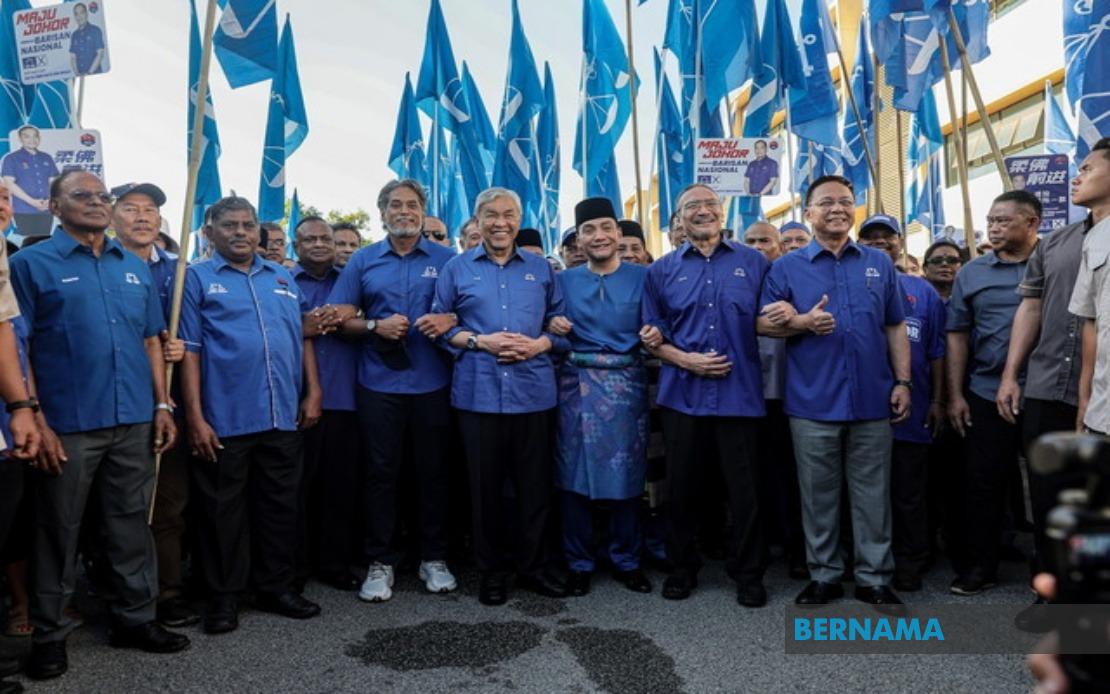
Johor Barisan Nasional chairman Datuk Onn Hafiz Ghazi moved forward with his electoral bid on June 27, submitting nomination documents for the state election at the Muafakat Hall in the Simpang Renggam District Council at 9.10 am. The submission underscored the coalition's determination to retain control of the sultanate's legislature, with the party deploying considerable organisational weight to signal confidence in its candidacy.
The procession accompanying Onn Hafiz reflected the internal hierarchy and factional alignments within Malaysia's dominant political establishment. UMNO president Datuk Seri Dr Ahmad Zahid Hamidi attended in his capacity as party leader, reinforcing the nationalist coalition's unified front during a critical electoral moment. His presence demonstrated the party's commitment to backing incumbents facing renewed electoral competition, a gesture particularly meaningful given the volatility of recent state-level contests across the peninsula.
Alongside Zahid came Sembrong MP Datuk Seri Hishammuddin Tun Hussein, whose attendance reflected both personal political networks and his standing within the UMNO hierarchy. Hishammuddin's involvement suggested coordination across federal and state political structures, a pattern typical of BN operations during nomination periods. The inclusion of prominent MPs in state nomination ceremonies serves multiple functions: it demonstrates grassroots mobilisation capability, validates the candidate's standing within party structures, and generates media visibility for the broader coalition narrative.
Former minister Khairy Jamaluddin's participation added generational representation to the delegation. His presence signalled continuity between established UMNO figures and younger organisational leadership, particularly relevant as the party navigates internal succession dynamics and efforts to broaden appeal beyond traditional support bases. Khairy's involvement in state-level campaign activities has grown as his national profile expanded, positioning him as a bridge between different constituencies within the broader UMNO ecosystem.
Former Johor Menteri Besar Datuk Seri Hasni Mohammad also attended to demonstrate party solidarity. Hasni's role carried particular weight given his historical connection to the state government and his standing within Johor UMNO structures. His appearance suggested continuity of leadership perspectives and implied institutional endorsement from previous state administrations, factors that resonate with state-level political narratives and voter perceptions of administrative stability.
Onn Hafiz himself, incumbent Machap state assemblyman, represents the established BN position in the legislature. His re-nomination underscores the coalition's strategy of fielding sitting representatives where electoral performance appears defensible. The decision to contest reflects calculations about local constituency dynamics, demographic shifts, and the candidate's personal political capital within his division. His nomination triggered energetic response from supporters who gathered at the venue dressed in party colours and displaying banners.
The visible crowd presence extended beyond official delegation members. Supporters assembled throughout the Simpang Renggam District Council area, collectively displaying the visual and symbolic apparatus of electoral competition. The concentration of party-branded materials and partisan identification evident at nomination centres typically precedes the intensified campaign phase. This public manifestation of party strength serves psychological and organisational functions, generating momentum narratives that media organisations amplify and voters interpret as indicators of electoral viability.
The timing of this nomination within the broader 16th Johor state election schedule reflected procedural requirements and strategic sequencing decisions. Nomination centre operations occur across fixed timeframes, requiring candidates to navigate administrative processes while managing media attention and party coordination. Onn Hafiz's early submission at 9.10 am suggested campaign planning that prioritised clean procedural execution without complications that might generate critical coverage.
For Malaysian voters across the peninsula, state elections in Johor carry significance beyond the sultanate's boundaries. Johor represents the largest and arguably most politically complex state electorate, and electoral outcomes influence federal political calculations. UMNO's performance in its traditional stronghold carries implications for coalition stability, particularly given recent electoral volatility in other state contests. The deployment of senior federal figures at state-level nomination ceremonies indicates recognition of these broader strategic stakes.
The presence of this calibre of leadership at a single nomination filing reflects the resource intensity of contemporary Malaysian electoral politics. Coordination across federal party structures, media management, security arrangements, and supporter mobilisation require substantial organisational capacity. For opposition parties and observers, such displays communicate resource availability and organisational coherence, factors that influence competitive positioning throughout the campaign period.
Looking forward, the participation patterns evident at Onn Hafiz's nomination filing likely preview broader campaign strategies. Continued deployment of senior federal figures in state campaign activities would suggest an UMNO-led BN coalition treating Johor as genuinely contested territory requiring senior attention. Conversely, relatively sparse federal presence in subsequent campaign phases might indicate confidence in established local structures and electoral advantages.

