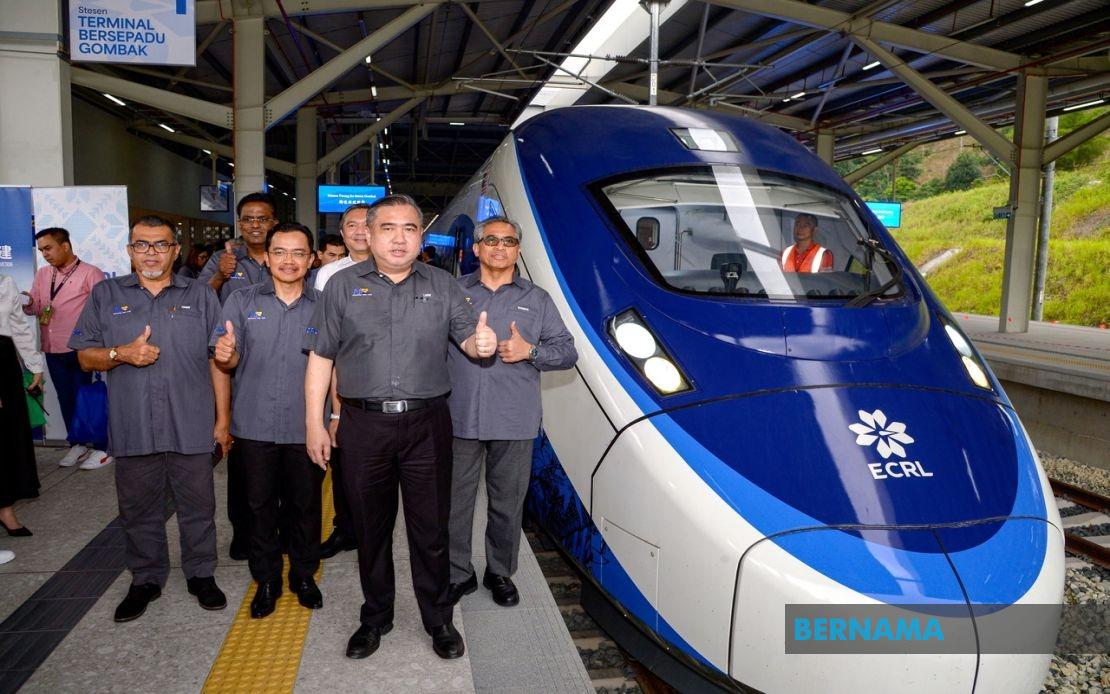
Transport Minister Anthony Loke Siew Fook has set an ambitious target to commence operations on the East Coast Rail Link Phase 1 between Kota Bharu and Gombak as early as December this year, marking a significant acceleration from the previously planned January 2027 start date. The announcement came during the launch of the Comprehensive Inspection Train and the commencement of critical testing phases at the Gombak Integrated Terminal Station, signalling the project's momentum as it approaches operational readiness.
The expedited timeline hinges critically on the successful completion of rigorous testing and commissioning procedures that are now underway. System Integration Testing and Fault-Free Run protocols are scheduled to progress through the remainder of the year, with the latter phase beginning in September. These methodical processes are essential to validate that all train systems, from electrical components to signalling infrastructure, function seamlessly together under real operational conditions. Loke emphasised that this acceleration attempt will not come at the expense of safety standards, positioning the ministry's approach as one that balances urgency with regulatory rigour.
The Malaysia Rail Link Sdn Bhd and primary contractor China Communications Construction Company Ltd are working in tandem to compress the testing timeline where feasible. A critical innovation in this approach involves the Land Public Transport Agency collaborating to streamline certification processes. According to Loke, testing and certification procedures typically require two to three months, and the ministry is exploring how this duration can be legitimately shortened without bypassing essential safety checks. This administrative acceleration, rather than corner-cutting on technical grounds, represents the core of the expedited strategy.
For Malaysian commuters and the broader transportation ecosystem, a December commencement would deliver substantial benefits far sooner than anticipated. The rail link will connect Kelantan's capital directly to Selangor, reducing travel times and providing an alternative to road transport for the busy Kota Bharu-Kuala Lumpur corridor. Beyond immediate passenger convenience, an earlier operational date strengthens Malaysia's regional infrastructure credentials and demonstrates successful delivery of a major Chinese-backed infrastructure initiative, offsetting previous concerns about project delays.
The confidence underlying the accelerated timeline stems partly from preliminary testing already conducted in China. The initial train sets and E-Loco units have undergone comprehensive examinations at manufacturing facilities before shipment to Malaysia, establishing baseline performance standards and identifying any design-related issues before deployment on local tracks. This advance preparation has provided engineers with valuable data that reduces uncertainty in the domestic testing phase, though local conditions and integration requirements remain essential to validate.
The Fault-Free Run protocol represents a pivotal milestone in this journey. Each train set and E-Loco must traverse 8,000 kilometres under the Land Public Transport Agency's oversight, operating under real track conditions but without passenger loads. This extended operational trial serves as a practical demonstration of safety and reliability compliance with established legal and technical standards. The September start for this phase positions it as the critical path item determining whether December operations can feasibly occur.
Loke's acknowledgment that the ministry shares genuine anxiety about safety risks reflects the political sensitivity surrounding this project. Any accidents or operational failures on the ECRL would substantially damage confidence in rail infrastructure investment and reflect poorly on both Malaysian authorities and the Chinese contractor. This mutual vulnerability creates strong incentives for all stakeholders to maintain uncompromising standards rather than rush toward the December deadline if technical concerns arise.
The broader ECRL initiative comprises two distinct phases, each serving different economic corridors. Phase 1, spanning from Kota Bharu to Gombak, had reached 95.08 per cent completion as of July 2024. The second phase, extending from Gombak to Port Klang, follows a later timeline with completion targeted for December 2027 and operational commencement in January 2028. This staggered approach allows the project to deliver benefits progressively while ensuring that lessons from Phase 1 operations can inform Phase 2 implementation strategies.
For Southeast Asian regional connectivity, the ECRL represents a significant artery linking Malaysia's east coast to its commercial heartland and ports. The acceleration of Phase 1 operations could catalyse economic activity in Kelantan and Terengganu, historically less developed than western states, while improving cargo flow through Port Klang once Phase 2 is operational. This infrastructure investment potentially reshapes Malaysia's regional development patterns and trading dynamics.
The involvement of senior officials from both Malaysian and Chinese governments underscores the project's strategic importance. The presence of the Chinese Ambassador alongside Malaysia's Chief Secretary to the Government at the Gombak event signals sustained political commitment from both nations. Such high-level engagement ensures that bureaucratic obstacles are resolved swiftly and that resource allocation remains prioritised, factors that contribute to the feasibility of ambitious timelines.
Industry observers note that December 2024 represents an extraordinarily compressed window for finalising complex rail operations. While the ministry's confidence appears grounded in completed manufacturing and preliminary testing, the seven-month timeframe from August encompasses System Integration Testing, Fault-Free Run over 8,000 kilometres, all subsequent approvals, and final operational certification. Any unforeseen technical issues discovered during these phases could necessitate timeline adjustments, though Loke's public commitment may create political pressure to maintain the December target regardless of underlying constraints.
The ECRL project embodies Malaysia's broader infrastructure ambitions and its strategic partnership with China. Early operational commencement would validate the project's management approach and demonstrate that ambitious infrastructure timelines can be achieved through effective coordination. Conversely, delays would raise questions about implementation capacity and project governance, potentially influencing future infrastructure investment decisions and international partnerships. The stakes surrounding this December target thus extend well beyond railway operations into Malaysia's economic policy and regional positioning.

