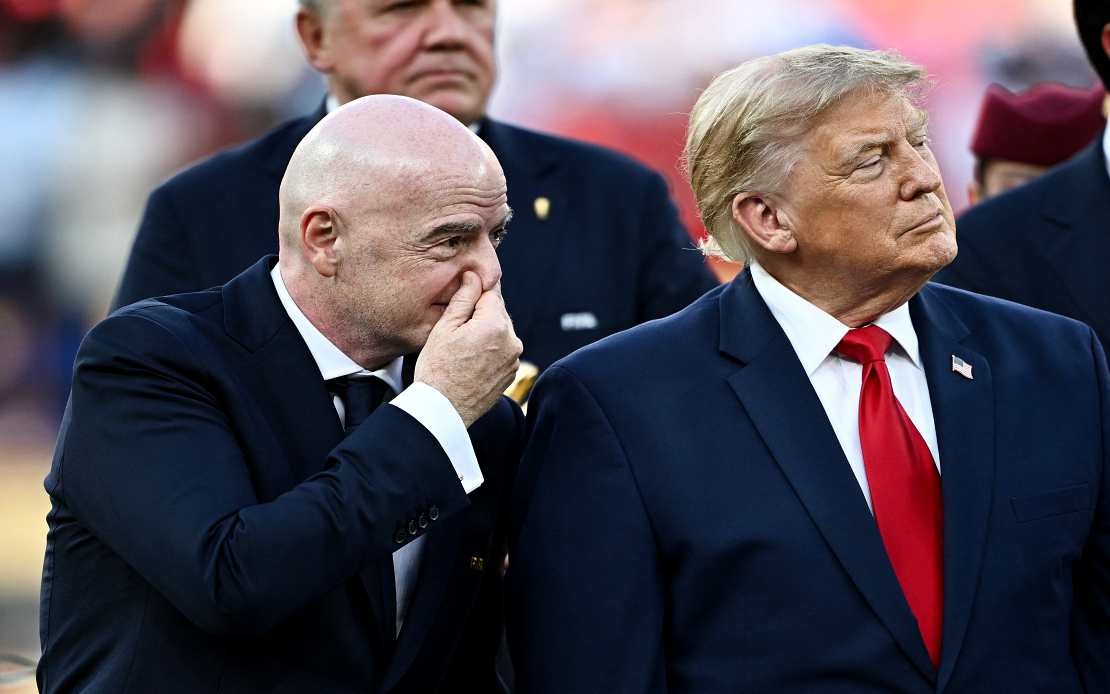
United States President Donald Trump has mounted a spirited defence of FIFA President Gianni Infantino at a moment of significant turbulence within world football's governing body. Speaking through his Truth Social platform, Trump characterized Infantino as a fantastic and irreplaceable steward of international football, positioning himself firmly behind the embattled executive even as major continental confederations launched coordinated attacks on his leadership and proposed reforms.
The timing of Trump's intervention underscores the intensifying pressure facing Infantino from multiple quarters of global football. Three of the sport's most powerful regional bodies—UEFA representing Europe, the AFC covering Asia, and CONCACAF managing North and Central America plus the Caribbean—released a joint open letter demanding an independent investigation into the circumstances surrounding FIFA's proposal to commercialize portions of its rights portfolio. This unprecedented alignment of continental confederations signals deep institutional concern about the direction Infantino is steering the organization.
At the heart of the controversy lies an ambitious but contentious commercial restructuring plan. In July, FIFA announced plans to generate approximately US$4.2 billion in fresh capital by selling roughly 20 percent of a newly created commercial entity to private investors. This entity would assume control of FIFA's media and commercial rights, notably including the lucrative World Cup broadcast and sponsorship agreements. For an organization already generating enormous revenues from football's premier tournament, the proposal represented a significant shift toward private capital participation in core revenue streams.
The commercial arrangement triggered immediate suspicion among football's establishment regarding potential conflicts of interest and governance integrity. Reports surfaced suggesting that Joshua Kushner's foundation—the brother of Jared Kushner, who served as Trump's son-in-law and senior advisor—could emerge as a principal investor in the restructured entity. This connection added a layer of political sensitivity to what might otherwise be a straightforward commercial negotiation, particularly given Trump's long-standing relationship with the Kushner family and his demonstrated willingness to champion ventures associated with his inner circle.
Infantino's position deteriorated sharply as opposition crystalized across football's power centers. By early August, the FIFA president was compelled to convene an emergency assembly of the organization's top leadership to address mounting criticism and address what observers characterized as a loss of institutional influence. During this fraught gathering, Infantino offered an apology for missteps surrounding the FIFA Forward Enterprise commercial project, a move suggesting acknowledgement that his handling of the process had alienated key stakeholders and eroded confidence in his decision-making.
Yet despite expressions of support from FIFA's executive circle during the emergency meeting, Infantino's broader coalition within football governance had fractured. UEFA, representing the continent that hosts the world's wealthiest and most influential club leagues, took the particularly dramatic step of announcing a comprehensive boycott of FIFA competitions. This threat of European withdrawal—potentially jeopardizing World Cup qualification tournaments and other FIFA-sanctioned events—represented an existential challenge to the federation's authority and commercial viability.
Faced with this unprecedented institutional rebellion, Infantino ultimately capitulated. The FIFA president announced abandonment of the commercial rights sale proposal that had triggered the crisis. This reversal represented both a substantial tactical defeat for Infantino and a demonstration of the limitations of his executive authority when confronted with unified opposition from powerful confederations. The decision effectively neutralized the investment opportunity that had attracted interest from circles connected to Trump's political ecosystem.
Trump's public intervention in this governance dispute appears calculated to fortify Infantino at a critical juncture while simultaneously defending the commercial arrangement that would have benefited parties within his political network. By invoking Infantino's stewardship of the Qatar World Cup—which Trump credited as the most successful edition ever staged, achieving four times greater success than predecessors—the American president framed opposition to the FIFA chief as misguided and self-defeating. Trump asserted that FIFA would suffer irreversible decline should Infantino face removal, essentially arguing that institutional stability depends upon the incumbent president's continuation in office.
For Southeast Asian football governance, these developments carry significant implications. The AFC, which includes powerhouse federations from China, Japan, South Korea, and India alongside developing nations seeking to elevate their football infrastructure, has aligned itself with UEFA in criticizing FIFA's commercial restructuring. This suggests Asian football leadership believes the proposed arrangement threatened legitimate interests of continental confederations and member associations. The outcome—with Infantino forced to withdraw the proposal—reinforces that even FIFA's president cannot unilaterally impose transformative governance changes without securing buy-in from regional power brokers.
The episode also illuminates how geopolitical relationships and commercial interests increasingly intersect within global football governance. Trump's defence of Infantino, explicitly connected to the Kushner family investment opportunity, demonstrates how contemporary international sports administration intersects with broader political and financial networks. For Malaysian and regional stakeholders, this underscores the necessity of vigilance regarding how FIFA's governance decisions might advantage certain constituencies while marginalizing others, particularly in an era when institutional reforms frequently entail private capital participation.
Moreover, the successful coordination among UEFA, AFC, and CONCACAF suggests that regional confederations possess meaningful leverage when they mobilize collectively. This coordination mechanism could become increasingly relevant as FIFA confronts future proposals affecting the distribution of commercial revenues, tournament structures, or governance arrangements. Asian football administrators may recognize both the effectiveness of united action and the strategic value of maintaining alignment with European confederations on matters affecting fundamental FIFA governance.
Infantino's forced retreat from the commercial rights proposal, despite Trump's vocal support, demonstrates that even seemingly dominant institutional figures remain constrained by the broader architecture of global football governance. The FIFA president survives in his position, but with significantly diminished authority to implement transformative reforms. This outcome likely emboldens confederations and national associations to resist future top-down governance initiatives, potentially making FIFA's decision-making structure more cumbersome and consensus-dependent moving forward, which carries implications throughout the global football ecosystem including Southeast Asia.

