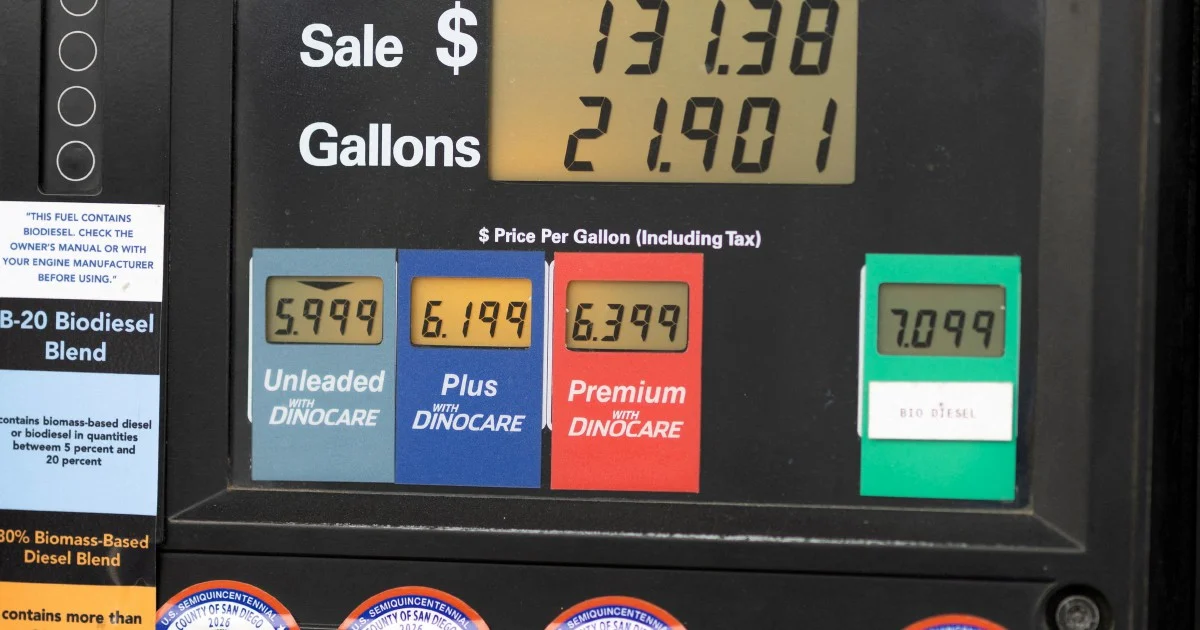
President Donald Trump announced on Wednesday that he has directed authorities to investigate leading oil corporations, expressing frustration that petrol prices at American pumps have not declined as swiftly as he anticipated. The declaration reflects mounting political pressure on the Trump administration as it grapples with the economic fallout from escalating tensions in the Middle East, a region that remains central to global energy supply chains.
The investigation signals Trump's determination to address consumer concerns about fuel costs, an issue that resonates deeply with American voters and has become increasingly sensitive for his administration. By targeting major oil producers for scrutiny, the President is attempting to deflect criticism and demonstrate responsiveness to public discontent over persistent pricing at the petrol station. The move highlights the complex relationship between government leadership and market forces, where political accountability often demands visible action even when structural economic factors lie largely beyond executive control.
Global energy markets have remained volatile since the escalation of Middle Eastern conflicts, which threatens to disrupt supply routes and production capacity across one of the world's most geopolitically significant regions. Oil companies have cited various factors for maintaining elevated price points, including supply chain disruptions, production constraints, and the need to maintain operational resilience amid regional uncertainty. The gap between wholesale crude costs and retail petrol prices has become a focal point of public debate, with consumers questioning whether energy firms are passing along savings from any cost reductions.
For Malaysian readers and broader Southeast Asian markets, developments in American energy policy carry particular significance. The region's economies remain substantially dependent on stable global energy prices for manufacturing competitiveness and transportation costs. Elevated fuel expenses in major markets can have cascading effects throughout supply chains, ultimately influencing prices for goods throughout Asia's export-dependent economies. Malaysia's own petrochemical and refining sectors, concentrated around regions like Terengganu and Johor, are sensitive to fluctuations in crude pricing and regulatory shifts in major consuming nations.
The investigation reflects a broader pattern of political intervention in energy markets during periods of geopolitical stress. Trump's approach mirrors previous administrations' responses to energy crises, though the specific mechanisms and intensity of scrutiny vary considerably. Oil companies maintain that pricing reflects genuine market conditions rather than artificial manipulation, yet the optics of record corporate profits during periods of consumer hardship create persistent political vulnerability that encourages government action.
Anti-competitive practices within the petroleum sector have long attracted regulatory attention from authorities worldwide. Investigations into potential price-fixing, supply manipulation, or collusive behaviour represent standard enforcement tools, though proving intent and coordination across major corporations operating in competitive global markets presents substantial evidentiary challenges. The outcomes of such probes often depend on whether investigators uncover documented communication or coordination rather than simple parallel pricing decisions responding to identical market signals.
The timing of Trump's announcement carries political weight as American voters remain acutely conscious of fuel costs and their household budgets. Energy prices rank among the most visible and emotionally charged economic indicators for ordinary citizens, transcending typical partisan divisions. By demonstrating executive attention to the issue, Trump aims to neutralize criticism while reserving the option to claim credit if prices subsequently decline, regardless of causal connection to any investigation.
Middle Eastern stability will remain crucial to global energy markets throughout the foreseeable future. Any prolonged or expanded regional conflict could substantially disrupt production and transportation, potentially driving prices far beyond current levels. Conversely, successful diplomatic resolution could ease supply anxieties and permit prices to moderate. The investigation into domestic oil companies, therefore, represents only one element of a complex geopolitical and economic equation.
For international business communities including those throughout Southeast Asia, the unpredictability of American regulatory approaches adds another layer of complexity to energy market planning. Companies hedging their exposure to crude price volatility must now factor in the possibility of heightened American government scrutiny of oil sector practices, which could influence strategic supply arrangements and investment decisions. The investigation underscores how political and economic pressures can drive regulatory actions that reshape corporate behaviour and market dynamics across multiple jurisdictions.
Looking forward, the concrete outcomes of Trump's investigation remain uncertain, yet the announcement itself signals that energy pricing has moved firmly onto the administration's priority agenda. Whether the probe uncovers actionable violations, results in enforcement actions, or simply dissipates after political attention shifts depends on investigative findings and the evolving geopolitical context. Regardless of investigative conclusions, the spotlight on oil company practices may itself influence pricing behaviour and corporate communication around cost justifications, creating subtle pressure for moderation even without formal legal consequences.

