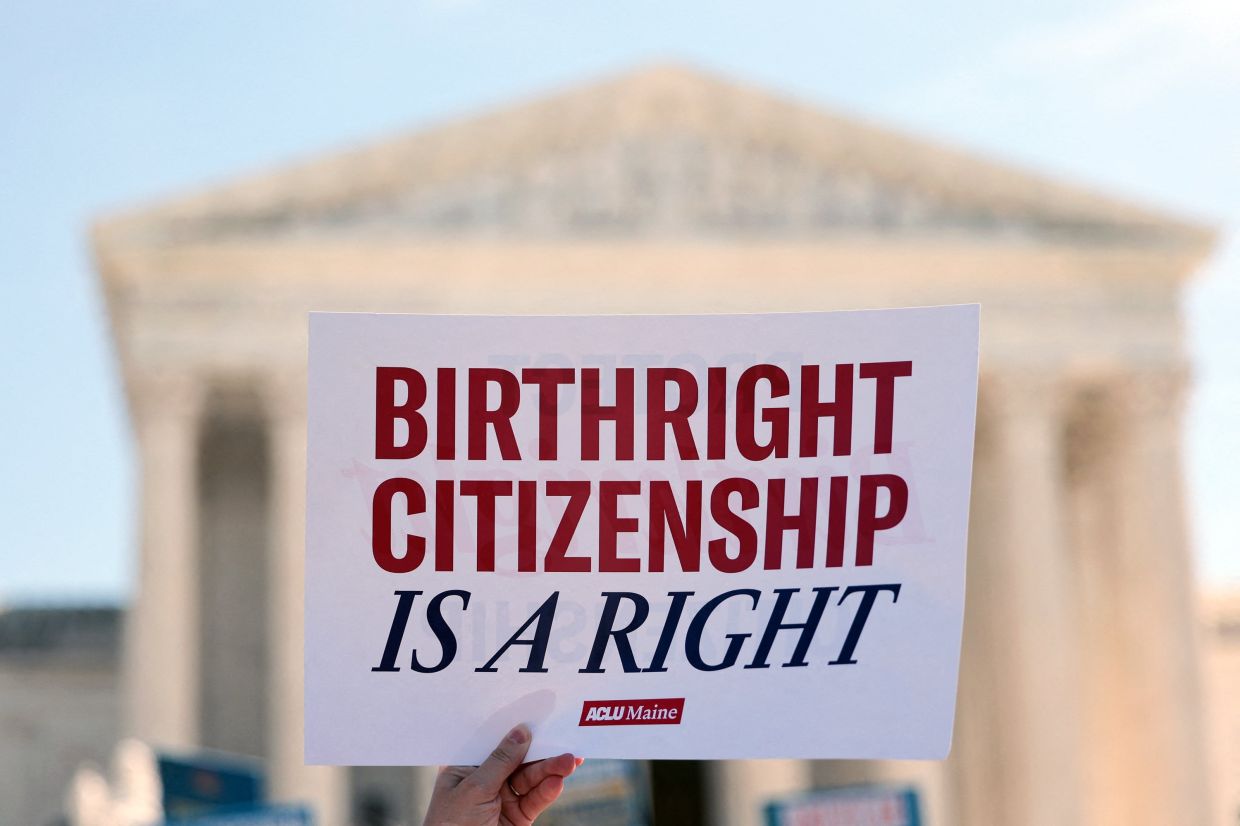
After the US Supreme Court blocked President Donald Trump's executive order restricting birthright citizenship, the administration has pursued a new strategy that places renewed emphasis on investigating and prosecuting birth tourism operations, with China occupying an outsized role in the accompanying political narrative. The pivot represents a tactical recalibration following the constitutional setback, channeling enforcement resources toward cases involving foreign women who allegedly enter the United States specifically to give birth and secure citizenship for their children. This shift from constitutional confrontation to criminal prosecution reflects both the administration's determination to achieve its immigration objectives through alternate legal pathways and its willingness to leverage geopolitical rivalry to build political support for tougher enforcement measures.
Trump's immediate response to the Supreme Court's decision illustrated this strategic reorientation. In a social media post dripping with sarcasm, he congratulated China on a "massive Birthright Citizenship WIN", signalling that his administration would now focus public attention on what officials characterise as fraudulent schemes orchestrated by foreign nationals, particularly from China. Within days, the Department of Justice issued directives to federal prosecutors to prioritise investigations into birth tourism operations, and House Speaker Mike Johnson announced that Congress was examining legislative proposals to address the issue. These coordinated actions across executive and legislative branches demonstrate a concerted effort to make birth tourism enforcement a focal point of the administration's immigration policy, even as the constitutional avenue for restricting birthright citizenship itself remains closed.
The Justice Department's justification for this enforcement shift centres on allegations that organised birth tourism schemes constitute systematic fraud and abuse of America's immigration system. Officials argue that pregnant women deliberately misrepresent their intentions when obtaining visas, concealing their true purpose of giving birth in the United States to secure citizenship advantages for their children. The department claims that thousands of foreign nationals employ these fraudulent tactics annually, with support from businesses that facilitate and profit from the schemes. Colin McDonald, the assistant attorney general overseeing fraud enforcement, pledged that the department would "zealously protect the sanctity of United States citizenship" by aggressively investigating and prosecuting those who exploit immigration rules through deception.
Yet the actual scale of birth tourism remains deeply contested and appears far smaller than administration rhetoric suggests. Federal data on births by residency status reveals a limited phenomenon rather than the sweeping problem implied by policy announcements. In 2023, the National Centre for Health Statistics recorded only 113 births to non-US resident mothers from China out of 3.7 million total American births—representing approximately 0.003 percent of all births. This represents a decline from 2018, when 267 births occurred to non-US resident Chinese mothers. These figures suggest that even if birth tourism from China has increased over recent decades, it remains statistically marginal when measured against the scale of overall American births and immigration.
The disconnect between rhetorical emphasis and empirical reality became particularly stark when Peter Schweizer, president of the Government Accountability Institute, claimed during congressional testimony that approximately one million US citizens were being raised in China after acquiring citizenship through birth tourism. Legal scholars and demographers quickly characterised this estimate as extraordinarily inflated, with American legal expert Peter Spiro describing the claim as wildly exaggerated while acknowledging that the practice has grown from negligible to "non-trivial" levels in recent decades. This gap between inflated claims and modest actual numbers reflects a broader pattern in which birth tourism has become a politically useful symbol of immigration system failure rather than a phenomenon proportional to the enforcement resources being directed toward it.
The case presentation strategy employed by the administration illustrates how selective examples can amplify perception of systemic problems. Justice Department memos reference specific prosecutions, including a notable 2020 case involving Chao "Edwin" Chen, who operated a birth tourism business claiming to employ a 100-person team based in China and to have facilitated over 500 cases. However, such examples, while dramatic, do not necessarily represent typical patterns or indicate widespread networks. The existence of organised operations certainly warrants law enforcement attention, yet the gap between a few documented cases and claims of thousands of annual fraudulent entries suggests that enforcement priorities may be driven more by political imperatives than by evidence of scope comparable to other immigration concerns.
Congressional Republicans have enthusiastically embraced birth tourism, particularly as connected to China, as a national security issue alongside an immigration matter. Congressman Chip Roy framed the issue explicitly in terms of geopolitical rivalry, warning that "foreign adversaries like the Chinese Communist Party" could leverage birth tourism "to gain influence within our borders". This framing transforms what might otherwise be an immigration enforcement concern into a broader narrative about protecting American sovereignty against strategic exploitation by a major competitor. The national security characterisation serves multiple political purposes: it elevates the perceived importance of enforcement actions, links immigration policy to concerns about great power competition, and provides rhetorical justification for expanded prosecutorial resources.
Trump himself has amplified the China-focused messaging with claims that stretch beyond what available evidence supports. The president asserted in March that "birthright citizenship is not about rich people from China, and the rest of the world, who want their children, and hundreds of thousands more, FOR PAY, to ridiculously become citizens of the United States". He has also declared that the United States is uniquely "STUPID enough to allow 'birthright citizenship'", a claim contradicted by straightforward comparative analysis. Thirty-two other countries maintain birthright citizenship laws substantially similar to those of the United States, including neighbouring Canada and Mexico, according to research by the Pew Research Centre. This factual inaccuracy appears designed to frame American immigration policy as exceptionally permissive rather than mainstream.
The data on births in the Northern Mariana Islands, a US territory frequently cited by birth tourism critics as a primary destination for the practice, further undermines claims of large-scale operations. In 2023, only 581 births occurred in the territory, with just two attributed to foreign-resident mothers. This represents a dramatic decline from 2018, when 1,262 births occurred in the islands, including 697 to foreign residents. The sharp reduction in recent years contradicts the narrative of expanding birth tourism networks, though officials note that available statistics do not distinguish which foreign-resident births might have involved deliberate deception about residency status. Nevertheless, the overall trend suggests that even in territories characterised as birth tourism hotspots, the phenomenon has contracted rather than expanded, complicating justifications for heightened enforcement focus.
The prosecutorial approach itself carries important implications for immigration enforcement more broadly. Birth tourism prosecutions typically rest not on the act of giving birth while visiting the United States—which remains legal—but rather on allegations of visa fraud, money laundering, conspiracy, or other ancillary offences. This means that routine enforcement depends on demonstrating deliberate deception rather than simply identifying women who gave birth while present on valid visas. Immigration lawyer Joseph Kwon has raised concerns about the implications of this approach, noting that "a pregnant traveller with a valid visa shouldn't have to prove she isn't a stereotype. When that becomes routine, the harm is real even if a case is never filed." This observation points toward potential collateral consequences of enforcement emphasis, including increased scrutiny of legitimate travellers and potential discrimination against pregnant women crossing US borders.
For Malaysian readers and regional observers, the Trump administration's pivot toward birth tourism enforcement offers several instructive lessons about contemporary American immigration politics. First, it demonstrates how constitutional defeats can prompt policy entrepreneurs to pursue similar objectives through alternative legal mechanisms, redirecting rather than abandoning restrictive goals. Second, it illustrates how immigration enforcement can become entangled with broader geopolitical narratives, particularly regarding great power competition with China, in ways that may distort priorities or inflate perceived problems. Third, it reveals tensions between political rhetoric and empirical reality in policy debates, with administration claims about the scale of birth tourism significantly exceeding available statistical evidence. Finally, it underscores how immigration policy increasingly serves as a vehicle for expressing anxieties about American sovereignty and global standing, extending beyond traditional border control concerns.
The broader context of American immigration enforcement suggests that birth tourism will likely remain a focus of administration policy despite the modest scale of the actual phenomenon. The successful integration of birth tourism concerns into national security rhetoric provides political cover for expanded prosecutions, while the relative rarity of the practice means that enforcement actions can generate high-profile cases without confronting the massive processing challenges that would accompany broader immigration crackdowns. For regional governments and citizens observing American policy developments, the emphasis on birth tourism serves as a reminder that immigration enforcement increasingly reflects geopolitical positioning and domestic political calculations rather than straightforward responses to documented problems. Understanding these dynamics becomes important for countries whose citizens may face increased scrutiny as a result of such enforcement priorities.

