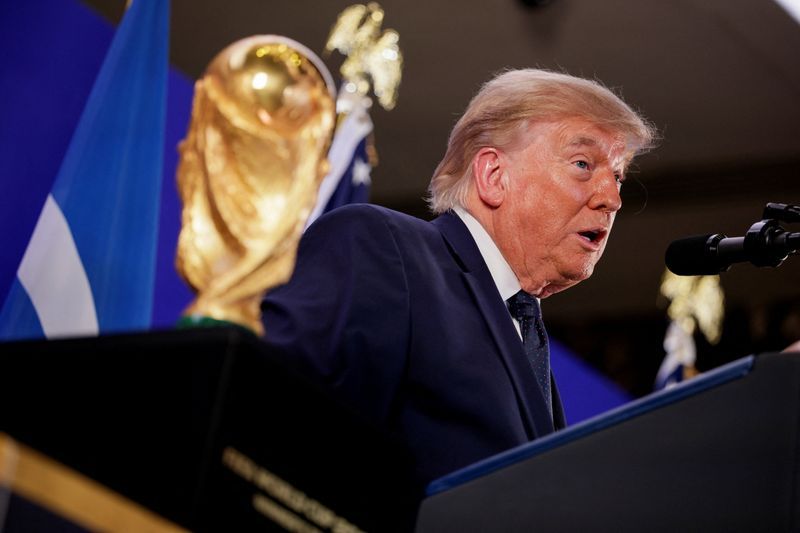
Donald Trump will occupy centre stage at Sunday's World Cup final between Argentina and Spain in New York/New Jersey Stadium, reasserting his presence in a tournament that has already become as much a political flashpoint as a sporting event. FIFA President Gianni Infantino has confirmed that Trump will sit alongside him during the match and will be responsible for presenting the winning trophy—a role that mirrors his involvement in last year's Club World Cup ceremony.
The timing of Trump's appearance proves particularly charged given recent revelations about his direct engagement with tournament governance. Just days before the final, Trump publicly acknowledged that he had contacted Infantino requesting a review of the red card issued to American striker Folarin Balogun. This intervention has ignited substantial debate around the integrity of competition and the proper boundaries between political figures and sporting administration. FIFA has maintained that Trump played no formal role in the subsequent decision to suspend Balogun's ban, though the damage to perceptions of impartial officiating has already crystallised.
The relationship between Trump and Infantino appears remarkably cordial, as demonstrated during a Friday reception at Trump Tower in Manhattan, where FIFA established an office last year. Before an audience of approximately 300 attendees, including Brazilian football icon Ronaldo and various FIFA dignitaries, Infantino publicly credited Trump with the tournament's unprecedented success. The World Cup has indeed attracted record-breaking attendances throughout its run as the tournament's largest edition, a metric both men appear eager to exploit for political and commercial advantage.
Trump's casual remark that "we were a soccer country" underscores his willingness to claim ownership of the tournament's achievements. The president has regularly hosted Infantino at the White House's Oval Office, cementing a working relationship that has weathered multiple controversies before and during the competition co-hosted by Canada, Mexico, and the United States. Their alliance has proven durable despite questions that haunted the tournament's American staging from its inception.
A year before the event commenced, American cities confronted serious logistical and reputational challenges as they prepared to welcome international visitors. Trump's aggressive immigration policies and travel restrictions on several Muslim-majority nations raised legitimate concerns among potential spectators about their safety and reception. Later, Trump further complicated matters by threatening to relocate matches away from Democratic-controlled cities—a suggestion FIFA promptly rejected by clarifying that such decisions remained entirely within the organisation's purview, not his.
Trump's Friday comments suggesting that the United States secure another hosting opportunity "but this time we'll leave Mexico and Canada out" demonstrate his continued willingness to court controversy and test diplomatic norms. Such rhetoric resonates with his political base but antagonises international partners and FIFA leadership who have invested heavily in continental cooperation. For Southeast Asian observers, these dynamics highlight how major sporting events can become vehicles for advancing domestic political narratives rather than serving their intended purpose as celebrations of athletic excellence.
The president has strategically leveraged major sporting occasions over the past eighteen months as his approval ratings have faced headwinds during his second term. His appearance at last year's Ryder Cup on Long Island drew enthusiastic crowds from patriotic American golf enthusiasts, delivering the media validation and crowd energy he consistently seeks. Yet his sporting ventures have yielded inconsistent receptions elsewhere, demonstrating the polarisation he generates across American society.
Trump's attendance at Game 3 of the NBA Finals last month resulted in prominent booing from sections of the crowd, whilst his presence at last year's US Open men's tennis final created security disruptions that enraged fans delayed outside Flushing Meadows well beyond match commencement. These episodes illustrate the operational complications that attend his involvement in any high-profile athletic gathering, complications that extend beyond security logistics into the realm of broadcast management and audience experience.
Fox Sports, the American broadcaster of Sunday's final, faces unprecedented editorial and production challenges stemming from Trump's attendance. Because the network must rely on FIFA's world feed rather than generating its own camera angles, it cannot control whether Trump receives prominent camera time during the match. Commentator John Strong has acknowledged this constraint, noting that cutaway decisions to Trump sitting with Infantino remain entirely outside Fox's authority. This absence of directorial discretion transforms the broadcast into an unpredictable document of Trump's celebrity status rather than a carefully curated sporting presentation.
The broader implications for audiences worldwide extend beyond camera placement. Strong has observed that Trump generates no middle ground in audience reaction—supporters will celebrate his presence whilst critics will resent his televised prominence. This polarisation reflects the reality that Trump has become inseparable from American international sporting presence, a dynamic that troubles FIFA administrators navigating their relationships with member nations and sponsor partners who prefer depoliticised competition.
Trump's consistent reference to FIFA's 2018 award of the tournament to Canada, Mexico, and the United States—a decision made during his first term—demonstrates his determination to claim credit for the event's global prominence. His boasts about bringing the World Cup to America merge legitimate governmental accomplishment with personal vanity, creating a narrative in which his presence at the final represents culmination rather than complication.
For Malaysian and Southeast Asian readers, Trump's World Cup involvement offers instructive lessons about the vulnerability of major sporting events to political manipulation and the difficulty international sports bodies face in maintaining governance independence when powerful political actors demand involvement. The tournament that was meant to celebrate athletic achievement has instead become a stage for demonstrating how political influence permeates even the most prestigious global competitions, with ramifications that extend far beyond the final whistle.

