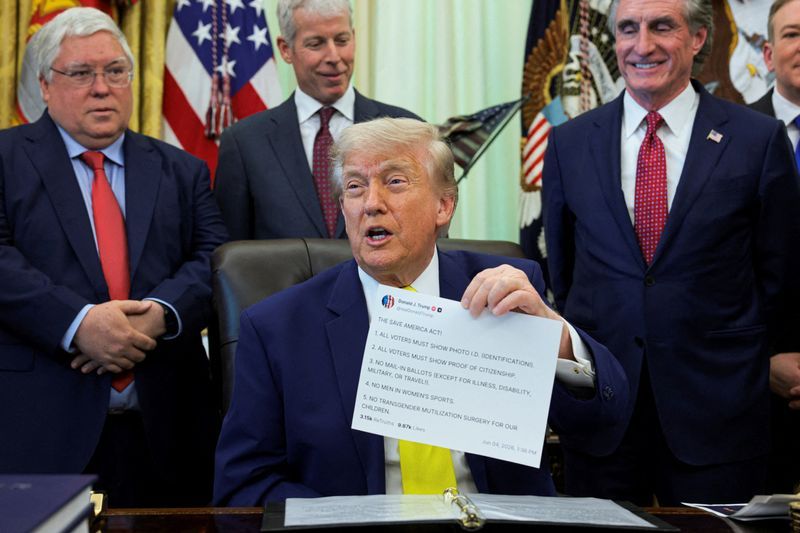
President Donald Trump and White House officials face legal action after two prominent media entities filed suit in Manhattan federal court to halt a controversial paid subscription service that grants subscribers early access to his Truth Social posts. The Intercept and the Freedom of the Press Foundation launched the challenge against Truth API, a service operated through Trump Media & Technology Group that charges subscribers fees reaching $100,000 monthly for advance notice of posts from ten high-profile Truth Social accounts, including the president's own account.
The Truth API service commenced operations on August 1, arriving just four days after two Democratic senators raised alarms about the arrangement. Elizabeth Warren of Massachusetts and Adam Schiff of California had written to the U.S. Securities and Exchange Commission expressing concerns that the paid-access model could compromise financial market integrity while simultaneously enriching wealthy investors, Wall Street interests, and Trump himself. The timing of the senators' complaint and the service's launch suggests growing scrutiny from lawmakers over the arrangement's potential conflicts of interest.
Trump has demonstrated a pattern of using Truth Social to communicate market-moving announcements that bypass traditional governmental channels. Over the course of his second presidential term, he has disclosed positions on subjects ranging from tariffs to Middle Eastern geopolitical developments through the platform, with the knowledge that such statements can influence equity valuations, commodity prices, and broader market sentiment. This history forms the backdrop for the plaintiffs' challenge, which frames the paid-access arrangement as fundamentally incompatible with principles of transparent and equitable government communication.
The lawsuit specifically targets the White House's practice of posting official government announcements exclusively on Truth Social while the paid subscription service remains operational. The plaintiffs argue this creates a two-tiered information system where subscribers with financial resources gain market advantages by receiving presidential communications minutes or hours before the general public, effectively privatizing access to government disclosures that should reach all citizens simultaneously and equally.
Central to the legal challenge is the assertion that the Truth API service constitutes what the complaint describes as a "profoundly corrupt" arrangement. The plaintiffs contend that Trump's substantial financial interest in Trump Media—he holds 41.3 percent of the company through his Donald J. Trump Revocable Trust, a stake worth approximately $950 million according to Reuters data—creates a direct incentive for him to promote the paid service. This structural conflict of interest, they argue, means the president benefits financially whenever new subscribers purchase access, potentially influencing his decision to make market-moving announcements through the platform.
The constitutional dimension of the dispute centers on First Amendment principles regarding equitable access to government information. The plaintiffs maintain that all Americans possess an equal entitlement to presidential communications and government announcements without encountering financial barriers. They contend there exists no legitimate governmental purpose in selling access to the president's statements to private subscribers, and that permitting the president to personally profit from such access fundamentally violates constitutional protections of free speech and information equality.
Data from the complaint indicates that during Trump's second term, he has generated between 9,000 and 11,000 posts and reposts on Truth Social, yet many of these statements have never been followed by official White House communications released through traditional channels. This pattern suggests Truth Social has become the primary vehicle for presidential announcements rather than serving as a supplementary platform, raising questions about whether official government information is being systematically routed through a commercial system in which the president holds financial stakes.
The White House declined to provide immediate comment on the lawsuit. Notably, while various White House officials are named as defendants, Trump Media itself is not listed as a defendant in the action, indicating the plaintiffs' focus on government entities and officials rather than the company providing the technical infrastructure. This legal strategy appears designed to emphasize the government accountability and constitutional dimensions of the dispute rather than framing it primarily as a commercial matter.
Trump Media has defended the service through a company spokesperson, arguing that numerous news outlets and digital platforms already offer subscription-based access to information derived from Trump's public statements and that the paid feed simply enables subscribers to access existing public information marginally faster than competitors. The company characterized the lawsuit as an attempt by "left-wing activists" to weaponize the courts against the president while simultaneously harming the shareholders and stakeholders of Trump Media. This framing reflects the company's view that the service represents a legitimate commercial offering rather than a problematic monetization of government access.
During a recent earnings call, Trump Media interim Chief Executive Kevin McGurn characterized Truth API as providing subscribers with news at a speed fractionally faster than other media consumers would receive it. This description minimizes what critics view as a substantial informational advantage, particularly for subscribers with significant capital deployment capabilities who could exploit early knowledge of presidential statements on tariffs, trade policy, or geopolitical matters to position themselves advantageously in financial markets.
The roster of accounts available through the Truth API service extends beyond Trump's personal account to include Vice President JD Vance, Health and Human Services Secretary Robert F. Kennedy Jr., FBI Director Kash Patel, and the White House institutional account itself. This broader access to high-level government officials' communications amplifies concerns about the systemic nature of the paid-access model and its potential to create informational hierarchies within government communications that did not previously exist.
The SEC's current composition, with three Republican commissioners, may influence how federal regulatory bodies respond to the underlying market integrity concerns raised by the plaintiffs. The Democratic senators' request for an SEC investigation into whether Truth API undermines financial market integrity awaits action from an agency leadership that does not currently include Democratic representation, potentially affecting the regulatory response to questions about whether the arrangement constitutes illegal insider trading dynamics or securities fraud.
For Malaysian and Southeast Asian observers, this dispute illustrates how democracies grapple with the intersection of commercial technology platforms, government communications, and financial market regulation in the digital age. The case raises questions about whether traditional separation between commercial interests and government authority can be maintained when political leaders maintain significant ownership stakes in technology companies that distribute their official communications. These concerns extend beyond American borders as similar tensions between political communication, platform economics, and market integrity emerge across the region.

