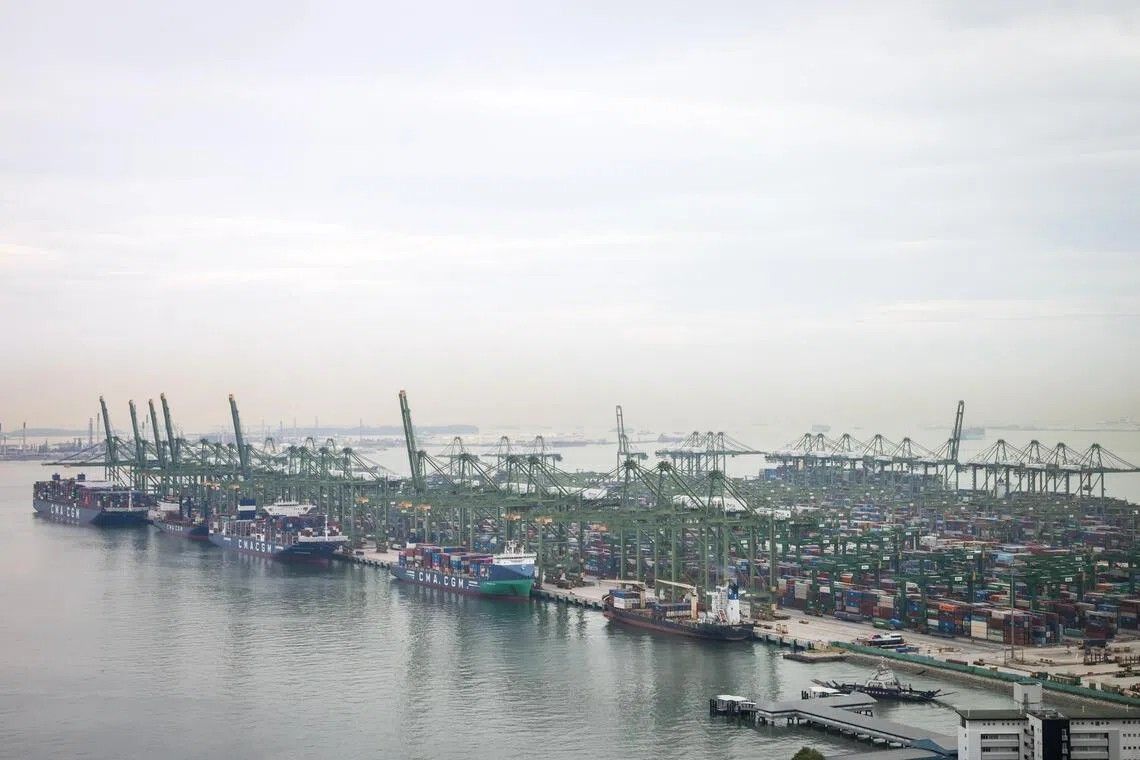
Singapore has been caught in the crosshairs of US President Donald Trump's escalating tariff campaign, with roughly one-third of the country's exports to America now subject to a 12.5 per cent duty that came into force on July 24. The tariff represents an aggressive recalibration of American trade policy following a significant legal setback earlier in 2026, when a federal court undermined the constitutional foundation of Trump's reciprocal tariff regime. To resurrect his protectionist agenda, the administration is now deploying an alternative legal framework—one with deeper historical roots and potentially greater resilience to judicial challenge.
The Office of the US Trade Representative concluded a four-month investigation into forced-labour practices across global supply chains, concluding in July that Singapore and 44 other economies had failed to adequately prohibit the import of goods produced through forced labour. US Trade Representative Jamieson Greer framed the action as a long-overdue enforcement mechanism, noting that the United States has maintained a forced-labour import ban for nearly a century and that trading partners should meet comparable standards. This rhetoric masks a strategic pivot toward using the Trade Act of 1974—specifically Section 301—as the legal foundation for what amounts to a sweeping global tariff regime, circumventing the statutory limitations that constrained previous iterations of Trump's trade weaponry.
Singapore's response has emphasised its robust domestic framework against forced labour and its role as a vital international trading hub. The Ministry of Trade and Industry released a statement asserting that Singapore does not condone forced-labour practices and maintains comprehensive enforcement mechanisms to prevent such exploitation within its borders. However, MTI acknowledged the complexity of policing forced labour across multi-tiered, transnational supply chains—a reality that positions the island nation as both a conduit for global commerce and a potential vulnerability in international trading relationships. The ministry signalled that it would engage continuously with the USTR to explore relief options and consult with the Singapore Economic Resilience Taskforce and business stakeholders on implementation.
Foreign Minister Vivian Balakrishnan elevated the issue diplomatically, raising Singapore's concerns during a bilateral meeting with US Secretary of State Marco Rubio at the Asean Foreign Ministers' Meeting in Manila on July 23. This multilateral diplomatic angle reflects broader Southeast Asian anxieties about the tariff's ripple effects across the region. With Singapore functioning as a critical hub for petrochemicals, electronics, precision engineering and refined petroleum products flowing to US markets, the tariff's scope extends far beyond bilateral US-Singapore trade friction—it signals American willingness to disrupt long-established supply chains across Asia.
The structure of the tariff reveals nuanced strategic calculations by the Trump administration. Goods already subject to existing sector-specific tariffs—including steel, aluminium, copper and certain automotive products—remain exempt, as do energy products, pharmaceuticals, semiconductors and aerospace components. This carve-out framework suggests that the administration is targeting particular sectors while preserving access for goods deemed strategically important to American industry. For Singapore, however, a significant portion of refined petroleum, chemicals and intermediate manufacturing inputs face the 12.5 per cent levy, creating supply-chain friction without offering the relief of wholesale exclusions.
The tariff regime reflects the Trump administration's calculated pivot to Section 301 as its new legal instrument following the February Supreme Court decision that gutted the reciprocal tariff framework. Section 301 carries no statutory expiration date or percentage cap, providing the administration with open-ended authority to impose duties—a characteristic that legal experts believe makes such measures more durable against judicial challenges. However, deploying this 1974 statute to justify sweeping, multilateral tariffs on dozens of nations stretches congressional intent in ways that invite immediate litigation. Analysts anticipate that American importers, companies with significant Asian supply chains and potentially foreign governments will mount constitutional and statutory challenges within weeks of implementation.
Singapore occupies an awkward position within this emerging tariff hierarchy. The city-state faces 12.5 per cent duties alongside Japan, Switzerland and South Korea, though the latter three have secured tariff relief arrangements nested within broader trade agreements. Countries including Mexico, Canada, Britain and India—deemed to have adopted adequate forced-labour safeguards—face the lower 10 per cent rate. This differentiation raises questions about the criteria underlying the USTR's categorisation and whether Singapore's characterisation reflects genuine enforcement deficiencies or rather serves as a proxy for broader geopolitical positioning.
The manufacturing sector has reacted with cautious concern. Lennon Tan, president of the Singapore Manufacturing Federation, acknowledged that the tariff's underlying premise does not align with the standards his member companies maintain, yet he noted that the impact will be tangible and immediate. Manufacturers face compounded uncertainty because Singapore remains subject to a parallel USTR investigation into structural excess capacity in manufacturing—a probe that has yielded no timeline for conclusions or clarity on whether resulting duties would layer atop the forced-labour tariff. This dual-track regulatory exposure creates a scenario in which companies cannot fully calculate their exposure or plan pricing and investment strategies with confidence.
The excess-capacity investigation, which encompasses Singapore and 15 other economies, represents a second wave of tariff risk. US Trade Representative Greer indicated in a recent Bloomberg Television interview that this investigation requires more time than the forced-labour probe because the USTR is attempting to craft measures that withstand legal scrutiny. However, the opacity surrounding this process leaves Singapore's exporters in limbo, uncertain whether they face a 12.5 per cent impost or something higher once the excess-capacity findings emerge. The manufacturing federation has begun surveying affected exporters to quantify the tariff's impact on companies with substantial US market exposure—a critical data-gathering exercise that will inform government advocacy and corporate strategy.
For Malaysia and the broader Southeast Asian region, Singapore's tariff experience carries instructive implications. As a highly developed trading economy with sophisticated regulatory frameworks, if Singapore faces a 12.5 per cent tariff on forced-labour grounds, less-developed nations with more fragmented enforcement architectures may encounter steeper duties or broader product suspensions. The tariff regime also reflects an American inclination to weaponise labour and environmental standards as trade restrictions—a precedent that could expand to encompass other Southeast Asian exporters. Countries across the region that rely heavily on US market access may find themselves pressured to adopt US-specified regulatory standards or face cascading tariff consequences.
Singapore's strategic response emphasises market diversification and supply-chain resilience—pragmatic guidance from manufacturing leadership that reflects the reality of reduced American market predictability. The Singapore Economic Resilience Taskforce engagement signals government commitment to supporting affected industries through the transition, though the efficacy of such support depends on the tariff's ultimate longevity and scope. If the excess-capacity investigation yields additional duties, or if the Trump administration expands forced-labour investigations to encompass other nations, Singapore's manufacturing exporters may face a sustained period of reduced margin and elevated operational risk.
The tariff's long-term trajectory remains uncertain, anchored to judicial challenges that will test the legal boundaries of Section 301. What appears certain is that the Trump administration has signalled its intention to maintain elevated trade barriers despite legal constraints, and it is willing to deploy alternative statutory authorities to achieve protectionist outcomes. For Singapore and Southeast Asian traders, this environment demands sustained engagement with American policymakers, rapid adaptation of supply-chain architectures, and serious exploration of intra-regional trade intensification as a hedge against American market volatility.

