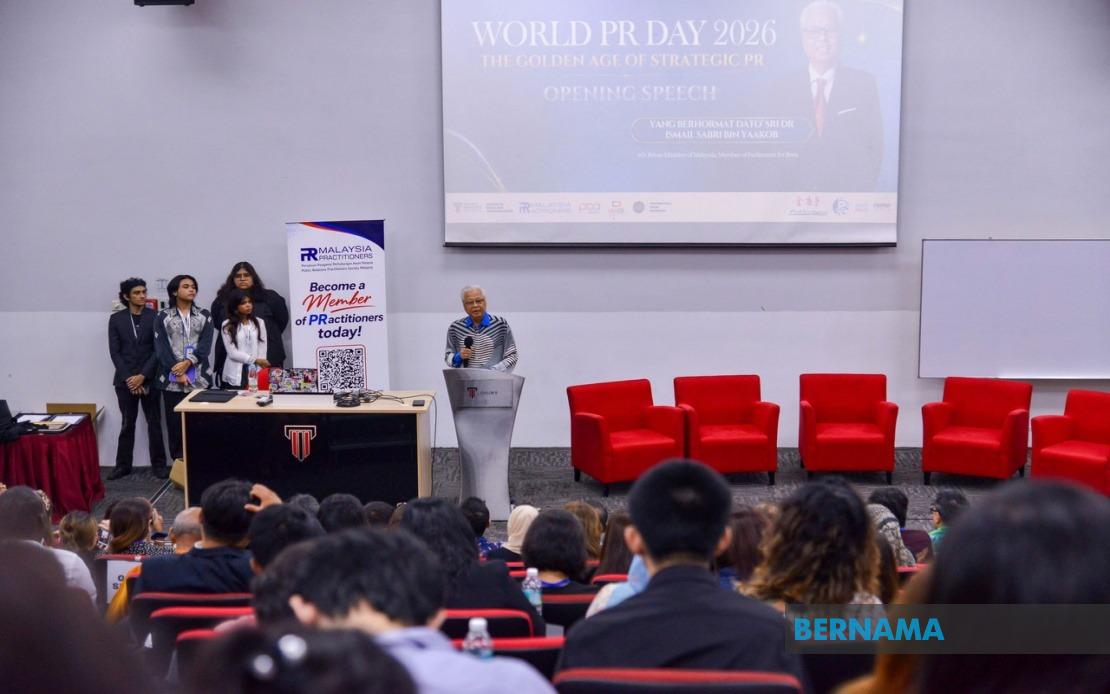
The defining challenge of the modern era is not primarily economic rivalry, according to former Prime Minister Datuk Seri Dr Ismail Sabri Yaakob, but rather the capacity of institutions to cultivate genuine trust through transparent, principled communication. Speaking at the launch of World PR Day 2026 celebrations at Taylor's University in Subang Jaya on July 16, Ismail Sabri articulated a vision of organizational credibility that transcends traditional metrics of performance and profitability, instead grounding legitimacy in the quality and authenticity of messaging during both prosperous and turbulent periods.
This philosophical reorientation reflects a fundamental transformation in how societies evaluate institutional worth. Whereas previous generations assessed organizational value predominantly through financial returns and operational efficiency, contemporary stakeholders increasingly scrutinize how entities communicate their decisions, acknowledge failures, and navigate crises. The digital landscape has amplified this shift by democratizing information access and enabling instantaneous public response, meaning that carefully crafted press releases and formal statements no longer suffice to maintain stakeholder confidence. Instead, organizations must demonstrate consistency between their stated values and observable actions, with any perceived divergence rapidly undermining credibility across social media platforms and digital networks.
Ismail Sabri's characterization of the 21st century as an era of trust competition rather than economic competition carries significant implications for how Malaysian corporations, government agencies, and civil society organizations should recalibrate their strategic priorities. When trust becomes the scarcest and most coveted resource, institutions cannot manufacture credibility through marketing expenditure alone; they must embed integrity into foundational practices and ensure that communication strategies reflect genuine organizational commitments. This demands a fundamental shift in how public relations functions within institutional hierarchies, elevating practitioners from reactive communicators to strategic architects capable of influencing policy and culture.
The former Prime Minister grounded his argument in lived experience, referencing the unprecedented communication demands of leading the country through the COVID-19 pandemic. During that volatile period, Ismail Sabri confronted the public almost daily to explain evolving standard operating procedures, a cadence that forced continuous recalibration of messaging to reflect changing epidemiological realities. Rather than merely announcing government directives, he framed communication as a trust-building mechanism, recognizing that policy efficacy depended not simply on the technical soundness of health guidelines but on public willingness to comply with measures that often demanded significant personal sacrifice. The pandemic thus functioned as a natural experiment demonstrating communication's pivotal role in determining whether populations embrace governmental guidance or resist through non-compliance and social friction.
This historical lens proves instructive for contemporary Malaysian policymakers and organizational leaders confronting recurring crises, whether economic volatility, environmental degradation, or public health threats. The communication strategies deployed during these turbulent periods establish patterns of trust or suspicion that persist long after immediate crises subside. When government or corporate entities provide transparent, timely information and acknowledge uncertainty candidly, stakeholders develop confidence in institutional candor. Conversely, when entities obscure information, deploy misleading statistics, or gradually reveal inconvenient truths, populations internalize skepticism that subsequently contaminates responses to future announcements, even when subsequently issued with complete accuracy.
Ismail Sabri's warning regarding artificial intelligence adoption reflects recognition of a distinct contemporary hazard: the possibility that institutions might deploy technological sophistication to enhance manipulation rather than clarify communication. While acknowledging that AI tools enable rapid sentiment analysis and data-driven insights into public perception, he cautioned that such technological capabilities must remain subordinate to human values and ethical frameworks. This represents a crucial safeguard against the potential dystopia wherein organizations harness machine learning and algorithmic systems to craft increasingly targeted misinformation tailored to specific demographic preferences, thereby fragmenting public discourse into competing reality-bubbles where different populations inhabit fundamentally divergent factual universes.
The proliferation of deepfakes, manipulated content, and deliberately circulated falsehoods has created an informational ecosystem wherein the cognitive burden on ordinary citizens has become unsustainable. Members of the public cannot reasonably be expected to authenticate video evidence, verify statistical claims, or trace information provenance without specialized technical training. This epistemic crisis creates opening for malicious actors to exploit public uncertainty, and it simultaneously complicates the work of legitimate communicators attempting to establish credibility within an environment of generalized distrust. Malaysian communicators and organizations face particular vulnerabilities given the country's linguistic diversity, regional complexity, and varied media literacy levels across demographic groups, meaning that misinformation can spread rapidly through vernacular communication channels before fact-checkers can intervene.
The former Prime Minister's expressed support for the government's proposed AI Governance Bill reflects recognition that market forces alone cannot constrain technological misuse; regulatory frameworks must establish boundaries around AI applications in communication and information dissemination. Such governance mechanisms should address not only malevolent actors deliberately spreading falsehoods but also well-intentioned organizations that might inadvertently amplify misinformation through algorithmic amplification systems optimized for engagement rather than accuracy. The challenge of developing regulatory regimes that restrict harmful AI applications while preserving legitimate innovation remains substantially unresolved globally, and Malaysia's potential legislative approach will influence regional trajectories as other Southeast Asian nations grapple with similar governance questions.
For public relations professionals specifically, Ismail Sabri's remarks suggest an imperative to fundamentally reconceptualize their professional responsibilities. The transition from information dissemination to strategic narrative-shaping requires practitioners to develop competencies extending far beyond traditional communications expertise. Contemporary PR professionals must understand organizational cultures sufficiently to identify integrity gaps where stated values diverge from operational realities; they must possess sufficient technical literacy to evaluate AI systems and their potential implications; and they must cultivate the courage to counsel organizational leadership that certain communications strategies, however advantageous in the short term, corrode the trust-based foundations necessary for long-term institutional sustainability.
The World PR Day 2026 celebration provides an opportune moment for Malaysian communicators to internalize these lessons and initiate institutional introspection regarding whether their organizations have genuinely prioritized integrity-driven communication or merely deployed sophisticated techniques to manage perceptions without substantively addressing underlying credibility deficits. As digital platforms continue evolving and new technologies emerge, the fundamental principle that Ismail Sabri articulates—that authentic trust requires alignment between organizational communication and organizational practice—will likely only increase in relevance and urgency.

