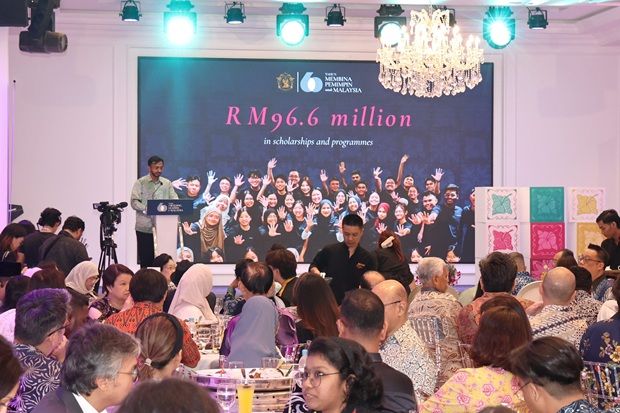
The Tunku Abdul Rahman Foundation (YTAR) reached a historic milestone on August 13, commemorating six decades of investing in Malaysia's youth through educational opportunity. Held at Bangunan Sultan Abdul Samad, the anniversary celebration reflected upon an institution born from an unusual genesis: a nationwide crowdfunding effort initiated by Utusan Melayu on Tunku Abdul Rahman's birthday, which raised more than M$60,170.20—equivalent to approximately RM380,000 in contemporary terms. What began as a community initiative crystallized into a nationally-sanctioned endeavour when Education Minister Tan Sri Mohamed Khir Johari championed the establishment of the foundation through the Tunku Abdul Rahman Foundation Fund Act 1966, transforming grassroots support into formal institutional machinery.
The foundation's creation represented a deliberate response to Malaysia's immediate post-independence development needs. During the nation's formative decade, access to higher education remained limited, and international study opportunities particularly inaccessible to most Malaysian youth. YTAR emerged as a strategic instrument for national capacity-building, enabling talented individuals across racial and religious divides to pursue tertiary qualifications abroad and subsequently contribute their expertise to nation-building efforts. This dual emphasis—widening educational access while simultaneously strengthening human capital for national development—established a framework that has persisted across six transformative decades of Malaysia's modernisation.
By 2025, the foundation's cumulative impact has become substantial and measurable. More than 12,000 Malaysian youths have received direct support through scholarships, loans, and financial assistance programmes. The total disbursement reaches RM96.6 million, announced by National Unity Minister Datuk Aaron Ago Dagang at the anniversary event. These figures represent not merely financial transfers but rather pivotal turning points in individual trajectories that have rippled outward to affect families, communities, and national institutions. Each scholarship recipient has become a vector through which educational investment multiplies across society, creating networks of professionally trained individuals positioned across government, academia, commerce, and civil society.
The foundation has evolved considerably beyond its original conception as a scholarship provider. Contemporary YTAR operations encompass talent identification, access pathway creation, and comprehensive youth development programming targeting employability and character formation. This expansion reflects changing national priorities as Malaysia transitioned from acute shortage of tertiary-educated personnel toward competition for high-potential talent amid globalisation. National Unity Minister Aaron Ago articulated an aspirational vision during the anniversary ceremony, calling upon Malaysia's corporate sector to integrate education and youth development more systematically into corporate social responsibility frameworks through partnerships with established foundations. His remarks implicitly acknowledged that public institutions alone cannot sustain the comprehensive investment required to position Malaysian youth competitively across emerging knowledge economies.
Two particularly poignant reflections emerged during the ceremony through recognition of early scholarship recipients whose subsequent careers have validated the foundation's investment logic. Ch'ng Kim See received her scholarship in 1967 during a period of acute financial hardship while studying at university. Her receipt of the award, arriving unexpectedly during a phase when she had exhausted other funding avenues and was forced to undertake employment, fundamentally altered her educational trajectory. Decades later, she achieved prominence as one of Malaysia's most distinguished librarians with regional leadership credentials in Southeast Asian history alongside library and information science domains. Her subsequent commitment to "paying forward" assistance to other deserving individuals exemplifies the multiplicative social returns that flow from strategic educational investment.
Dr Zakaria Ali's trajectory similarly illuminates the foundation's catalytic potential. His pathway to tertiary education began fortuitously through an American instructor from Texas who recognised his potential while Zakaria worked in a processing role. When financial constraints threatened to prevent his enrollment at Southwestern University in Austin, his instructor undertook an extraordinary advocacy campaign by correspondence to Malaysia's King, education minister, and prime minister. These efforts secured him a scholarship interview and ultimately the YTAR award that launched a distinguished career as a painter, writer, educator, and academic figure pioneering fine arts development in Malaysia. Ali's reflective gratitude acknowledges that educational transformation frequently depends upon convergence of individual merit, institutional advocacy, and well-timed opportunity allocation.
Datin Sri Sharifah Menyalara Syed Hussein, Tunku Abdul Rahman's granddaughter and YTAR chairperson, articulated a philosophical interpretation of the late Prime Minister's educational philosophy during remarks at the anniversary event. She emphasised that Tunku viewed education not narrowly as academic achievement but rather as foundational character development enabling young people to locate meaningful purpose within society and contribute substantively to national progress. This conception transforms educational support from transactional credential-provision into existential life-shaping, aligning with Tunku's own articulation in 1964 that Malaysia's future depends fundamentally upon effective youth development. Sharifah's reflection further distinguished between memorialisation—which encourages backward-looking remembrance—and institutional continuity, which demands ongoing adaptation of founding ideals to evolving circumstances.
The anniversary celebration honoured the accumulated contributions of YTAR's generations of custodians and supporters, acknowledging that institutional longevity depends upon distributed stewardship rather than individual leadership. YTAR Chief Executive Officer Kularetnam Vijayakumar emphasised this collective custodianship, emphasising that the foundation's enduring legacy reflects sustained commitment from numerous Malaysians across decades. The celebration thereby functioned as recognition that foundational institutions require renewal across generations; without active recommitment from contemporary leaders and supporters, even well-designed instruments risk institutional ossification. This understanding becomes increasingly consequential as Malaysia navigates contemporary challenges including brain drain, skills misalignment with emerging economic sectors, and persistent inequality in educational access across demographic categories.
The foundation's current trajectory suggests continued evolution toward more comprehensive youth empowerment models. Beyond traditional scholarship provision, YTAR now emphasises capital access, skills development, and values formation—dimensions exceeding purely financial assistance. This expansion acknowledges that contemporary Malaysian youth confront challenges extending beyond tuition barriers, including navigation of competitive knowledge economies, development of entrepreneurial capability, and cultivation of social responsibility consciousness. The 60-year institutional anniversary therefore represents not culmination but rather inflection point as YTAR recalibrates its mission to address evolving national development priorities.
Looking forward, YTAR initiated expanded engagement mechanisms through opening self-nominations for the 2026 Pingat Tunku Award. Beginning August 31 through September 30, the award process now permits direct applications from graduates of both public and private higher education institutions throughout Malaysia, a significant democratisation of previous nomination procedures. This institutional reform suggests receptivity to feedback regarding accessibility and inclusivity, recognising that talent distribution across Malaysia's population cannot be efficiently identified through restricted nomination pathways. The expanded eligibility structure potentially broadens the award's impact while simultaneously increasing institutional responsiveness to youth voices in shaping their own development trajectories.
The foundation's six-decade journey reflects broader patterns within Southeast Asian nation-building wherein education emerged as primary mechanism for democratising opportunity and accelerating development. YTAR alumni have dispersed throughout national institutions—educational leadership, civil service, professional practice, and social enterprise—creating constituencies embedded within institutional networks who understand educational access as fundamental to inclusive development. As Malaysia confronts emerging challenges including artificial intelligence integration, regional economic competition, and evolving social cohesion requirements, the foundation's continued emphasis on character development alongside technical capability appears prescient. The anniversary celebration thus commemorated not merely historical achievement but rather institutional readiness for the more demanding investment in youth development that Malaysia's future trajectory will require.

