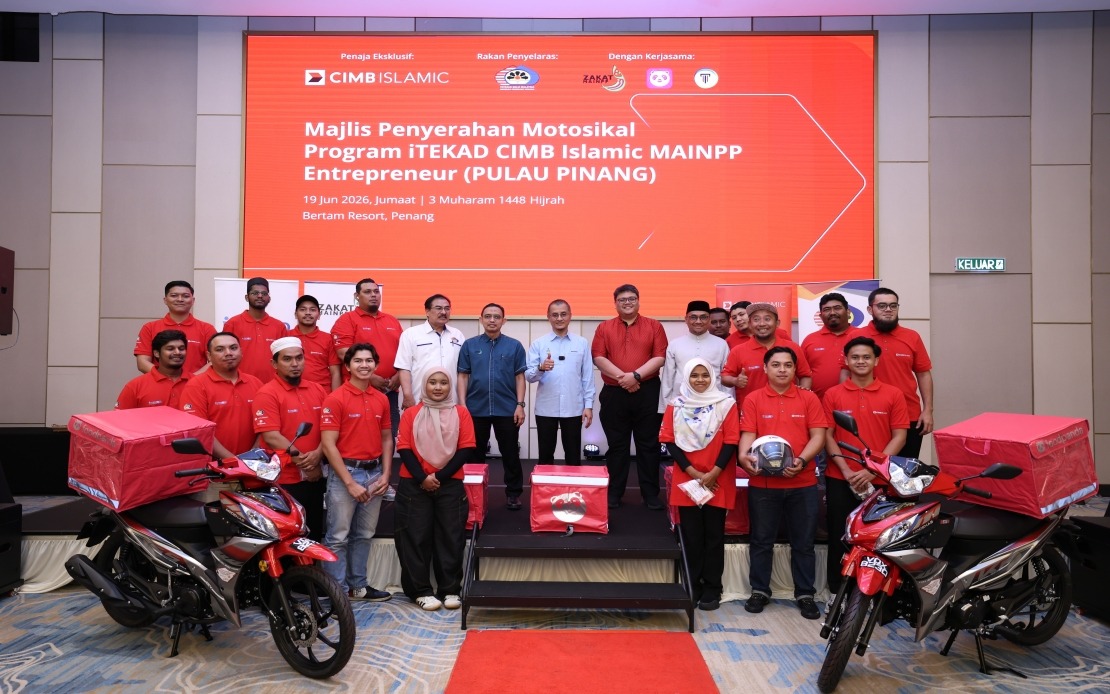
Twenty carefully selected entrepreneurs in Penang have been handed over motorcycles and delivery equipment as part of the iTEKAD CIMB Islamic-MAINPP Entrepreneur programme, a collaborative initiative designed to uplift disadvantaged communities through employment opportunities and sustainable business ventures. The milestone handover ceremony took place at Bertam Resort in Kepala Batas, marking a significant step forward in zakat-funded poverty alleviation within the state.
The programme represents an innovative partnership structure that brings together multiple stakeholders with complementary roles and expertise. CIMB Islamic Bank Berhad has joined forces with the Penang Islamic Religious Council (MAINPP) through its Zakat MAINPP division, while implementation support comes from the Malaysian Youth Foundation (YBM), Taylor's Community, and foodpanda Malaysia. This multi-sector approach reflects a recognition that effective poverty reduction requires coordination across financial institutions, religious bodies, youth development organizations, and private enterprise platforms.
According to Penang Deputy Chief Minister I Datuk Dr Mohamad Abdul Hamid, who also serves as MAINPP president, the initiative goes beyond simply distributing assets. Participants receive comprehensive support encompassing financial management training, instruction on workplace discipline, and entrepreneurial coaching alongside their motorcycles and equipment. This holistic approach seeks to equip beneficiaries with both the tools and knowledge necessary to sustain income generation over time, rather than providing temporary relief.
The programme was seeded with RM400,000 in matching grant funding, demonstrating significant financial commitment from both public and private sources. Bank Negara Malaysia contributed RM200,000 through CIMB Islamic Bank Berhad's Wakalah Zakat fund, while another RM200,000 came from the banking partner. This dual-source funding model illustrates how central bank policy initiatives and Islamic banking mechanisms can be mobilized to support grassroots economic empowerment.
The selection process proved rigorous and competitive, with demand significantly outpacing available spots. Zakat MAINPP received 151 applications from interested entrepreneurs seeking to participate in the programme. Rather than processing applications on a first-come basis, the organizers instituted a comprehensive evaluation framework that included detailed interviews and a residential Entrepreneurship BootCamp conducted between May 31 and June 3, 2026. This intensive selection camp allowed officials to assess participants' commitment, financial literacy, and business acumen before awarding the valuable motorcycle grants.
The motorcycles and associated delivery equipment serve a specific economic purpose within the programme's framework. By providing these assets, the initiative enables participants to engage in last-mile delivery services through foodpanda Malaysia's platform, creating an established revenue channel from day one. This targeted approach differs from generic cash assistance programmes, as it directly links beneficiaries to existing gig economy infrastructure and pre-established customer demand.
Datuk Dr Mohamad emphasized that the programme embodies a broader philosophical shift in how zakat funds are deployed within Penang. Rather than viewing zakat as purely charitable redistribution, the initiative positions it as a development tool capable of catalyzing economic transformation. The provision of productive assets combined with training represents an investment in human capital and entrepreneurial capacity, addressing root causes of poverty rather than merely alleviating symptoms.
The iTEKAD programme also aligns with Penang's longer-term Islamic development strategy outlined in the Penang Islamic Religious Development Agenda 2030 (APAI2030). This overarching framework prioritizes comprehensive community advancement across education, economic participation, family stability, and youth engagement. By situating the motorcycle distribution within this broader agenda, policymakers signal that economic empowerment of the asnaf community forms an integral component of holistic Islamic social development.
For Malaysian observers, the programme offers several insights relevant to national poverty reduction strategy. The collaboration between Islamic banking institutions and religious authorities demonstrates how shariah-compliant financing can be channeled toward productive investment in low-income entrepreneurs. The inclusion of private sector delivery platforms like foodpanda creates immediate livelihood pathways, while partnership with youth development foundations ensures beneficiaries receive mentoring alongside financial assets.
The emphasis on training and continuous support distinguishes this initiative from simple asset distribution schemes that have historically achieved limited poverty reduction outcomes. By bundling motorcycles with entrepreneurship camps, financial literacy instruction, and ongoing guidance, the programme acknowledges that sustainable income generation requires behavioral and attitudinal change alongside access to productive capital.
State government officials hope the assistance catalyzes lasting life transformations rather than providing temporary relief. This aspiration reflects growing recognition among development practitioners that breaking poverty cycles requires interventions addressing multiple dimensions simultaneously: access to capital, business skills, market linkages, psychological confidence, and peer support networks.
The successful completion of this first cohort may position the iTEKAD model as a replicable template for other states and Islamic institutions. The cost-effectiveness of leveraging zakat funds combined with private sector participation, coupled with the demonstrated demand among potential beneficiaries, suggests scalability potential. If outcomes align with intentions, future iterations could encompass larger participant numbers while maintaining the rigorous selection and training standards that characterize the initial programme.
Looking forward, monitoring beneficiary performance and income generation outcomes will prove crucial for validating the programme's effectiveness. Tracking metrics such as average monthly earnings, business sustainability rates beyond the first year, and participant satisfaction levels will inform whether the iTEKAD model achieves its ambition of fostering stable, self-sustaining livelihoods within Penang's asnaf communities.

