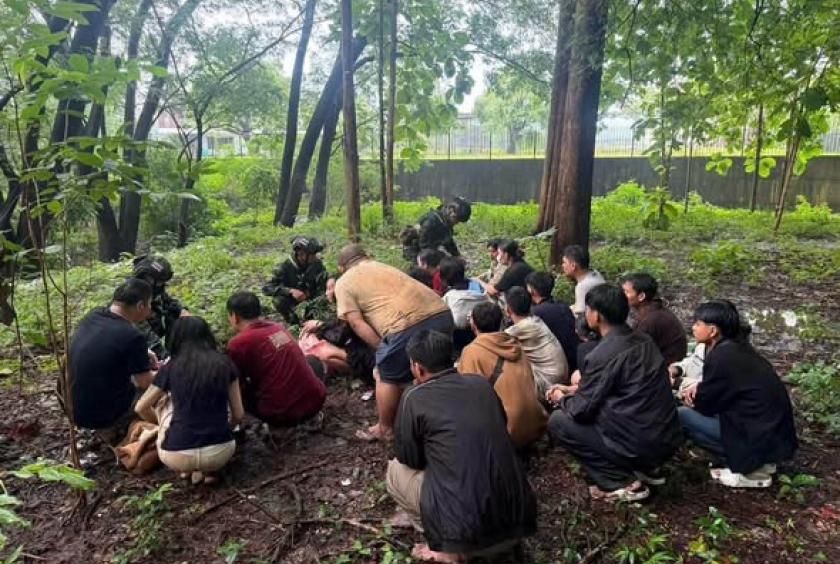
Thai military authorities have apprehended 20 people from Myanmar who were found attempting to enter Thailand without authorization in Mae Sot district, Tak province. The operation, conducted on July 24, reflected heightened efforts by Thai security forces to intercept unauthorized cross-border movement in one of Southeast Asia's busiest and most volatile frontier zones. Troops from the Ratchamanu Task Force, operating under Thailand's 3rd Army Region, discovered the individuals sheltering in woods adjacent to the Mae Moei City shopping complex in Tha Sai Luat subdistrict's Village No. 2 during routine patrols designed to prevent unlawful border activity.
The detainees—comprising 11 men and nine women—lacked the requisite travel documentation needed to lawfully enter Thailand. When questioned, they could not produce valid passports, travel permits, or other forms of recognized identification that would have allowed them to cross the border legally. This absence of proper paperwork immediately flagged them as having breached Thai immigration protocols and border control regulations. The individuals were subsequently transferred to the Mae Sot Immigration Office in Tak province, where they now face processing under Thailand's immigration legislation.
Mae Sot, situated directly across the Mae Moei River from Myanmar, has long represented one of the region's most significant transit points for cross-border movement. The area's geography—characterized by dense vegetation, multiple river crossing points, and challenging terrain—facilitates the passage of individuals seeking entry without official channels. Thai security operations along this frontier have intensified substantially over recent years, driven by concerns about human trafficking, drug smuggling, and irregular migration flows. The Ratchamanu Task Force's regular patrols form part of a coordinated approach to manage these multifaceted security challenges.
The circumstances surrounding this particular group's attempted entry remain unclear from available reporting. Myanmar has experienced profound internal instability since the military coup in February 2021, which triggered widespread conflict, civil disobedience, and displacement. Millions of citizens have fled the country seeking safety and economic opportunity, with neighbouring Thailand absorbing particularly large numbers. Some migrants pursue legal pathways through official channels, while others resort to unauthorized routes due to cost considerations, time constraints, or ineligibility for formal entry permits.
Thailand maintains complex immigration policies that simultaneously reflect humanitarian concerns and strict border enforcement protocols. The country hosts approximately 3.7 million migrants from Myanmar, Laos, and Cambodia, though accurate figures remain disputed. Among these, roughly 900,000 hold official work permits, while millions more operate in legal grey zones or remain undocumented. Authorities regularly conduct enforcement operations targeting unauthorized entrants, yet the sheer volume of cross-border movement consistently challenges border management capacity across the entire northern frontier.
For Malaysian observers, this incident illustrates broader regional dynamics affecting Southeast Asia's stability and human rights frameworks. Myanmar's protracted crisis continues generating outflows that destabilize neighbouring states' labour markets, public services, and security infrastructure. Thailand's border regions bear disproportionate costs managing both authorized and unauthorized migration flows. Malaysia itself hosts substantial Myanmar migrant populations, particularly in urban centres and industrial zones, creating parallel governance challenges regarding documentation, employment rights, and social integration.
The apprehension of migrants attempting unauthorized entry frequently raises humanitarian questions within Southeast Asian jurisdictions. International organizations have documented concerning conditions in immigration detention facilities across the region, including prolonged custody periods and inadequate access to legal representation. Thai immigration authorities face criticism from human rights monitors regarding detention practices, though Bangkok has undertaken various reforms addressing these concerns. The processing of the 20 Myanmar nationals will likely follow standard procedures, though their ultimate disposition—whether deportation, detention pending resolution, or alternative arrangements—remains undetermined.
Cross-border security operations in Mae Sot district occur regularly, yet public reporting focuses only on noteworthy incidents. Authorities estimate that detection rates represent merely a fraction of actual unauthorized crossing attempts, suggesting that substantially larger numbers successfully evade patrols daily. This enforcement-resistance dynamic reflects migrants' persistent determination to reach Thailand despite known risks, underscoring the intensity of push factors within Myanmar and pull factors attracting movement toward Thailand's relatively developed economy.
The incident underscores Thailand's continuing balancing act between enforcing border sovereignty and managing humanitarian imperatives. Successive Thai governments have grappled with calibrating responses to irregular migration, seeking to deter unauthorized entry while avoiding excessive humanitarian costs. Regional cooperation frameworks, including ASEAN mechanisms and bilateral agreements with Myanmar authorities, remain underdeveloped in addressing root causes of displacement and irregular movement. Until Myanmar's internal political situation stabilizes and economic conditions improve, pressure on Thailand's northern borders will persist, requiring sustained operational commitment and sophisticated policy approaches.

