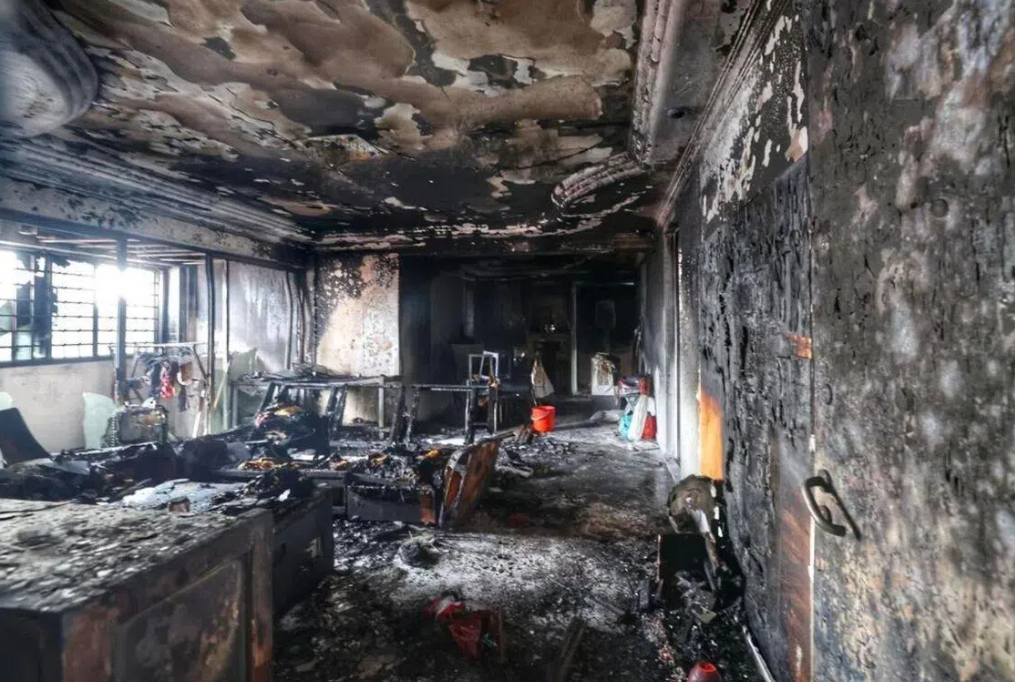
A pre-dawn fire in a high-rise public housing block in Singapore's Jurong West required emergency rescue operations and left two residents requiring medical attention. The Singapore Civil Defence Force responded to the blaze at Block 842 Jurong West Street 81 at approximately 3:35am on June 17, discovering flames consuming the living room of a unit on the 13th storey. Upon gaining entry to the smoke-filled space, firefighters deployed a water jet to suppress and extinguish the fire, while rescue teams worked to locate and evacuate occupants from the endangered unit.
The incident displaced or endangered far more residents than just those in the affected flat itself. The family occupying the burning unit—four members in total—were transported to Singapore General Hospital for treatment of fire-related injuries, though official statements did not specify the severity of their conditions. As a precautionary protocol, approximately 40 additional residents from neighbouring units in the same building were evacuated to ensure their safety and to facilitate firefighting operations without obstruction or further risk.
Early stage investigations by the authorities point to an electrical origin as the likely cause, with the malfunction occurring within the living room area of the unit. Such findings align with established patterns of residential fire incidents in Singapore's public housing estates, where aging electrical infrastructure and overloaded circuits have historically been implicated in numerous incidents. The specific appliance or outlet involved had not been formally identified in initial reports, though investigators typically examine charred remnants and wiring configurations during the days following such incidents.
The rescue operation succeeded partly due to the alertness of nearby residents. An 18-year-old neighbour residing directly above the burning flat—who was awake at the time playing video games—detected smoke drifting through windows and recognised the danger. Rather than remaining passive, the teenager descended to the affected storey and felt intense heat radiating from the door, prompting him to knock loudly and persistently on neighbouring doors to alert occupants. His swift thinking and decisive action to warn residents and subsequently notify his own family may have prevented additional casualties or injuries.
The young resident's account provides insight into the sequence of events within the unit itself. He described encountering a woman from the affected household who appeared at his family's door to request towels, explaining she intended to treat her father's injuries. Physical evidence of the fire's ferocity was already apparent on her person—her hair was visibly scorched and her face blackened by soot particles. Another member of the household, a man, bore severe thermal burns across his back and upper arms that had turned his skin bright red, indicating second-degree burn injuries from direct flame or radiant heat exposure.
It was the teenager's mother who ultimately alerted Singapore's emergency services after hearing her son's account and witnessing the condition of the neighbours. This delayed but necessary formal notification set in motion the official response that would result in the SCDF deployment. A 12th-floor resident who observed the emergency response confirmed the scale of the operation, noting at least five fire engines stationed outside the block during active firefighting.
For Malaysian readers familiar with similar housing patterns across Southeast Asia, the incident underscores shared vulnerabilities in ageing multi-unit residential buildings where electrical systems may not accommodate modern appliance loads. Many Malaysian flats and housing schemes operate under comparable infrastructure constraints, making the lessons learned from this incident directly applicable. The dense vertical arrangement of units, typical of both Singapore's HDB blocks and Malaysian public housing, creates scenarios where fires in one unit can endanger dozens of others within minutes.
The SCDF has emphasised several preventive measures in response to this and ongoing fire risks. Residents should avoid excessive load on electrical outlets—a particular concern in households with multiple devices competing for limited socket access. Appliances must be switched off when not actively in use rather than left in standby mode. All electrical equipment should bear the Safety Mark certification issued by Singapore's Consumer Product Safety Office, ensuring compliance with safety standards. Equally critical is the prohibition against leaving batteries or rechargeable devices charging unattended overnight or for extended periods, a practice that has proven dangerous in numerous documented cases.
The broader statistical context reveals an upward trend in fire incidents across Singapore. The SCDF's annual statistics, released in February of this year, documented a three-percent increase in total fires compared to the previous year, rising from 1,990 incidents in 2024 to 2,050 in 2025. Within this total, residential building fires accounted for 1,051 incidents—representing more than half of all fires and highlighting the particular vulnerability of housing environments. This escalating pattern suggests that public awareness campaigns and infrastructure improvements must accelerate to counteract the trend.
For Southeast Asian policymakers and building managers, the Jurong West incident serves as a reminder that residential fire safety requires a multi-layered approach combining preventive maintenance, resident education, and responsive emergency preparedness. The speed with which the situation could have deteriorated absent the teenager's intervention demonstrates how individual vigilance remains an essential component of community safety. Simultaneously, the SCDF's rapid response and successful rescue operation illustrate the importance of well-trained emergency services equipped with appropriate resources. Both elements—personal awareness and institutional capability—remain critical as housing density increases throughout the region's urban centres.