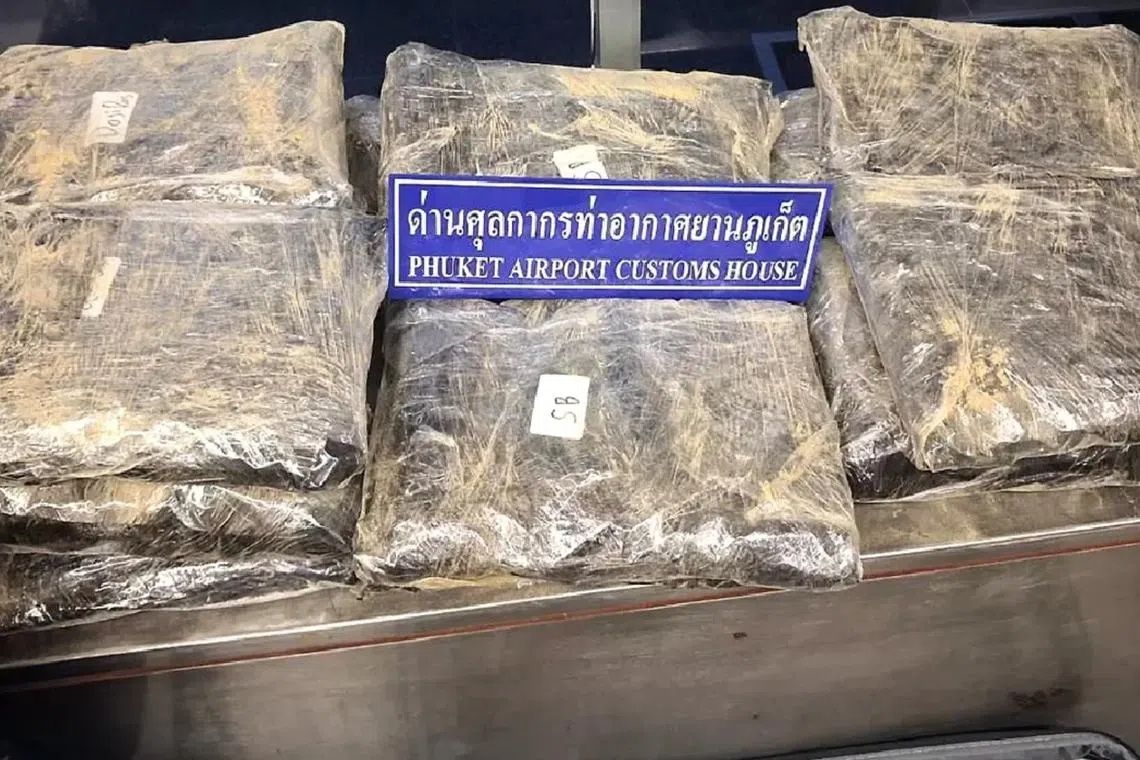
Customs officers working alongside local police at Phuket International Airport have successfully intercepted what officials describe as a significant drug smuggling attempt, detaining two women on the same day after discovering cannabis flowers totalling more than 32 kilogrammes concealed within their checked luggage. The operations unfolded within the international departures terminal on Thursday, with the Phuket Airport Customs House and Sakhu Police Station coordinating their enforcement efforts to identify and apprehend the suspects before they could board their flights.
The first incident occurred in the late morning when inspection officers opened a black Pierre Cardin suitcase belonging to 18-year-old Filipino national Levannah Chelsea Guzman. Inside the bag, they uncovered fourteen vacuum-sealed packages containing cannabis flowers, with the contents and their protective wrapping accounting for a combined weight of 14.5 kilogrammes. When questioned, Guzman acknowledged ownership of both the luggage and all items discovered within it, providing authorities with what they considered a clear admission of possession.
Thai authorities have since filed multiple charges against Guzman under a comprehensive legal framework designed to address transnational drug trafficking. The primary allegation concerns the attempted export of goods without completing mandatory customs procedures, as outlined in the Customs Act BE 2560. Additionally, she faces charges under Thailand's Narcotics Code and provisions within the Protection and Promotion of Traditional Thai Medicine Wisdom Act BE 2542, alongside regulations issued by the Public Health Ministry in 2025 that specifically govern the control of cannabis as a restricted herb. This layered approach to prosecution reflects the complexity of Thailand's regulatory environment surrounding cannabis, which maintains strict prohibitions on export despite recent domestic medical legalization efforts in certain contexts.
The second arrest followed approximately two hours later when customs officers became suspicious of a green Swish Navy wheeled suitcase presented by Penpitcha Phutsiang, identified as a Thai national. Upon examination, officers located sixteen separately vacuum-sealed packages containing cannabis flowers with a combined weight of 17.6 kilogrammes. Like her counterpart, Phutsiang admitted to ownership of the suitcase and its contents during the subsequent questioning process, providing no resistance to the allegations.
Both individuals now face identical charges relating to the attempted customs violation and narcotics infractions, with the cases having been transferred to Sakhu Police Station for formal investigation and prosecution proceedings. The confiscated cannabis material and evidence have been secured as part of the administrative process leading toward potential trial. These arrests represent tangible outcomes of Thailand's ongoing commitment to preventing the illegal export of controlled substances through its international aviation infrastructure, a significant vulnerability point in the country's border security posture.
The timing of these seizures underscores broader regional concerns regarding cannabis trafficking networks. Despite Thailand's progressive stance on medical cannabis research and limited therapeutic applications, the country maintains stringent penalties for trafficking and export violations. The simultaneous arrests of both a foreign national and a Thai citizen suggests that smuggling operations increasingly exploit diverse nationalities and cooperation networks, making detection more challenging for authorities who must manage high passenger volumes while exercising appropriate screening protocols.
For Malaysian readers and broader Southeast Asian observers, these developments carry particular significance given the region's historical sensitivity to drug trafficking and the increasing prevalence of cannabis-related enforcement operations across multiple jurisdictions. Thailand's experience demonstrates how even countries with more liberal medical cannabis frameworks still confront organised trafficking problems, particularly when wealthy markets in neighbouring nations create demand for illicit supplies. The sophistication of the smuggling attempt—with vacuum-sealed packaging designed to minimise detection—reflects professional preparation rather than opportunistic activity.
Customs agencies throughout Southeast Asia have intensified their screening procedures at departure gates in response to rising transnational smuggling attempts. These enhanced protocols impose operational costs and passenger delays, yet officials argue they remain essential given the high stakes of allowing controlled substances to cross international borders. The Phuket airport operations exemplify this tension between facilitating legitimate travel and commerce while maintaining rigorous security vigilance. Officers conducted their examinations during a period when airport traffic has rebounded significantly following pandemic-related disruptions, making comprehensive baggage screening logistically complex.
Thailand's legal framework for cannabis-related offences carries substantial penalties, with sentencing guidelines that can extend to lengthy imprisonment terms for trafficking and export convictions. Individuals convicted under the Narcotics Code potentially face decades in custody, creating powerful deterrent effects that authorities hope will discourage organised smuggling networks from targeting Thai airports. However, the persistence of such attempts—evident from regular seizure announcements—suggests that profit margins available in destination markets remain sufficiently attractive to justify the associated risks for criminal networks and individual couriers.
The confiscation of 32.1 kilogrammes of cannabis flowers represents a material disruption to supply chains, though authorities acknowledge that seizures at single airports provide only partial visibility into the broader trafficking picture. Street-level value assessments for seized cannabis typically range considerably depending on destination markets and purity assessments, but the quantities here suggest commercial-scale distribution intent rather than personal consumption. Intelligence analysts typically examine arrest patterns and seizure locations to identify emerging routes and organisational structures, contributing to longer-term counter-narcotics strategy development.
Moving forward, regional cooperation mechanisms will likely prove essential for addressing cannabis trafficking challenges comprehensively. Individual country enforcement efforts, while necessary, remain insufficient without coordinated intelligence sharing and mutual legal assistance frameworks among Southeast Asian nations. Malaysia and other ASEAN members maintain active engagement in bilateral narcotics enforcement partnerships with Thai authorities, recognising that trafficking networks operate across administrative boundaries and exploit regulatory differences between jurisdictions to maximise operational efficiency and minimise detection probability.

