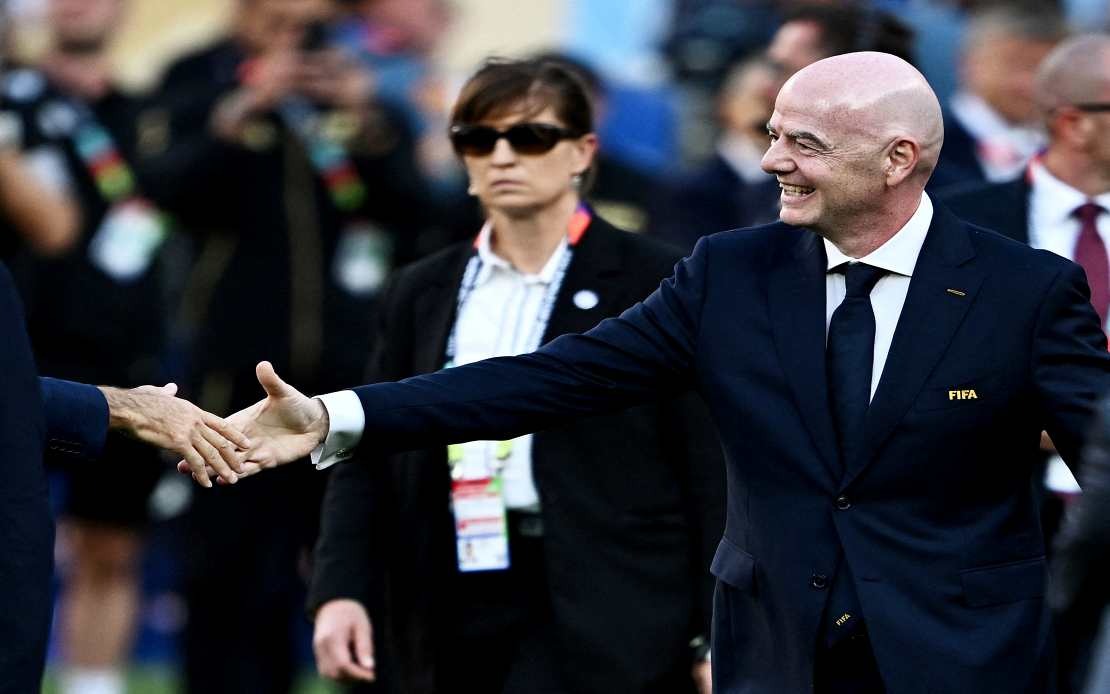
The world's leading continental football federation has escalated its standoff with FIFA by formally notifying President Gianni Infantino in writing that it is considering legal action over a controversial attempt to monetise the governing body's commercial operations. The Union of European Football Associations, which represents 55 national associations across Europe, has simultaneously demanded that FIFA preserve all materials connected to the aborted sale plan, signalling a determination to pursue accountability even after the scheme's withdrawal.
FIFA's proposal, unveiled in early August, would have generated approximately US$4.2 billion by offering private investors roughly a fifth stake in a newly created entity designed to manage the organisation's media and commercial rights portfolio, encompassing World Cup broadcasting and marketing arrangements globally. The transaction represented one of the most ambitious attempts to unlock FIFA's considerable financial assets, reflecting mounting pressure on the federation to diversify revenue streams beyond its traditional sponsorship and licensing model. Initial reporting suggested that investment capital could flow from foundations connected to the Kushner family, whose profile in international business circles gained prominence through their prominent position within the Trump administration in the United States.
The proposal triggered extraordinary institutional resistance. UEFA's member associations declared their intention to boycott all FIFA competitions unless the commercial rights initiative was abandoned completely, wielding the threat of withdrawal from global football's most prestigious tournaments as leverage. This coordinated European response represented perhaps the most serious challenge to FIFA's authority in recent years, demonstrating the federation's limited autonomy when major continental powers unite against its decisions. The collective action reflected deeper anxieties among European football's establishment about governance transparency and the concentration of decision-making authority within FIFA's leadership structure.
Within days of the boycott threat, Infantino announced that FIFA would withdraw the proposal entirely, temporarily defusing the immediate crisis. However, investigative journalism revealed that the aborted scheme would have substantially increased the FIFA president's personal compensation package, escalating his annual salary from 3 million euros to 30 million euros. This financial dimension transformed the dispute from a technical governance question into a matter of institutional self-dealing, reinforcing perceptions that FIFA's leadership had prioritised personal enrichment over democratic accountability to member associations.
UEFA's formal legal notice, obtained by The Telegraph and circulated to Infantino and FIFA's administrative apparatus, adopts the language of serious litigation preparation. The correspondence explicitly states that the federation is "actively considering legal action, arbitration, and/or regulatory complaints" arising from both the commercial rights proposal itself and the constellation of circumstances surrounding its conception and abandonment. By framing the potential proceedings to encompass not merely the scheme itself but "all related matters," UEFA has indicated that it intends to investigate the decision-making processes that generated such a controversial initiative, including potential governance violations and conflicts of interest within FIFA's executive structures.
The preservation notice carries significant legal weight in contemporary dispute resolution frameworks. By formally demanding that FIFA and Infantino identify, locate, and preserve all documents and electronically stored information pertaining to the commercial rights plan, UEFA has established a clear evidentiary record should litigation proceed. This step prevents the routine destruction of internal communications, meeting minutes, financial analyses, and strategic memoranda that might otherwise be disposed of through ordinary administrative channels. In major international business disputes, control over documentary evidence frequently determines litigation outcomes, making UEFA's early documentation demand a sophisticated defensive positioning.
European football's institutional response reflects broader anxieties about FIFA's governance culture that extend well beyond this single transaction. The federation has confronted sustained criticism over the decades regarding corruption allegations, non-transparent decision-making, and the concentration of power within the president's office. UEFA's approach signals that European football's establishment no longer intends to defer passively to FIFA's unilateral decisions but instead will deploy legal and competitive mechanisms to constrain what they perceive as unauthorised executive authority.
For Malaysian and Southeast Asian football communities, this dispute carries implications for tournament structures and administrative accountability within FIFA's broader ecosystem. The Asian Football Confederation and its member nations remain subordinate to FIFA's regulatory framework but increasingly participate in transparent governance conversations alongside European and South American federations. Should UEFA successfully pursue legal action against FIFA leadership, establishing new precedents for institutional accountability and executive restraint, such outcomes could ripple through football governance globally, potentially strengthening pressure for democratic decision-making mechanisms within FIFA's organisational hierarchy.
The timing and substance of this conflict also merit consideration within the context of FIFA's World Cup hosting cycles and media rights negotiations. FIFA's desperate pursuit of new revenue mechanisms through commercial rights privatisation suggests underlying financial pressures that remain incompletely explained to member associations. Whether these pressures reflect genuine operational requirements or merely reflect ambitions to sustain leadership compensation packages substantially above industry norms remains contested. UEFA's pursuit of legal remedies may ultimately force public disclosure of FIFA's financial circumstances, rendering previously opaque budgetary decisions subject to external scrutiny and potentially reshaping how the federation justifies future commercial initiatives to its constituent members across all continents.
The resolution of this dispute will likely establish important precedents regarding the limits of FIFA presidential authority and the capacity of continental confederations to constrain central executive decision-making. UEFA's assertive posture reflects accumulated frustration with governance structures that have permitted previous controversies including World Cup hosting controversies and integrity investigations. Should European football sustain its legal challenge despite FIFA's tactical retreat, the federation may discover that withdrawal of controversial proposals provides insufficient insulation against subsequent accountability proceedings, potentially encouraging more careful deliberation and enhanced consultation mechanisms before proposing major institutional changes.

