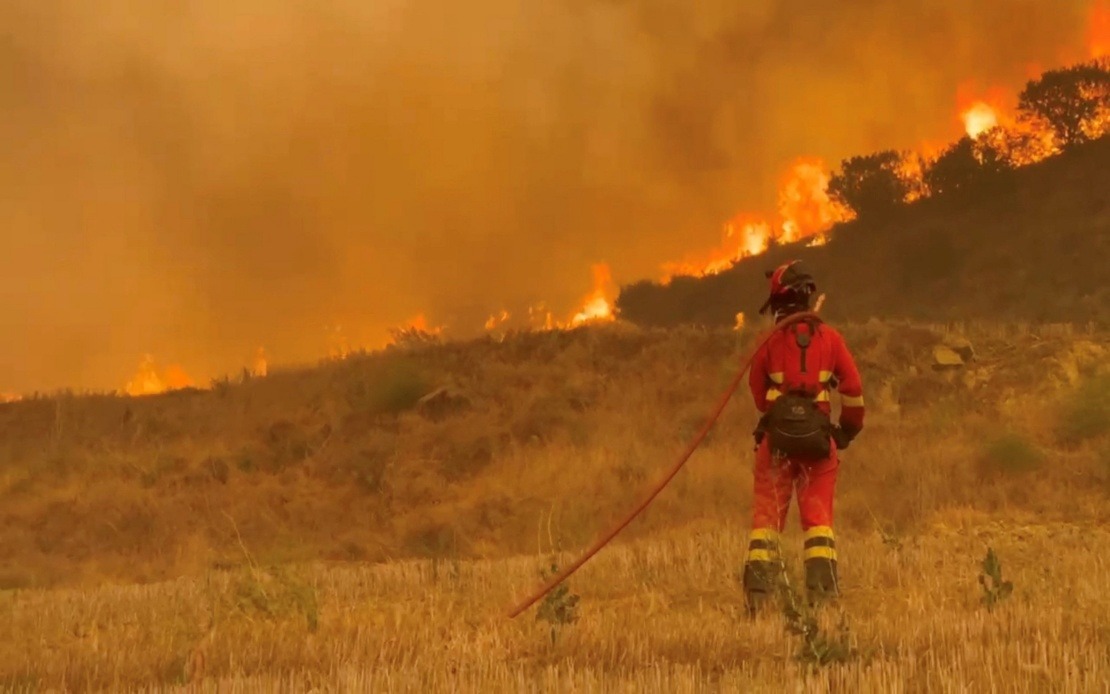
Britain's government is convening an urgent crisis meeting on Wednesday to assess the nation's response to an escalating environmental emergency driven by extreme heat, destructive wildfires and severe drought conditions. The Cobra emergency committee—a forum traditionally reserved for national security threats—will gather under Prime Minister Andy Burnham's chairmanship to coordinate efforts across multiple frontline agencies struggling with weather-related pressures. The move signals that officials now regard the climate impacts as a governance crisis requiring the same urgent attention typically given to terror threats or military conflicts.
The decision to escalate the response reflects mounting strain across three critical infrastructure pillars. Firefighting services continue battling significant blazes, including a major wildfire consuming large areas of the New Forest in Hampshire that has stretched resources thin. Simultaneously, the agricultural sector faces severe constraints from prolonged water shortages, threatening food production and farm viability across regions already declared drought zones. The National Health Service is also grappling with cascading health emergencies stemming from heat stress, as hospitals manage surge demand and staff confront hazardous working conditions.
The urgency intensified following Monday's expansion of drought designations across additional areas in England, formally acknowledging that water scarcity has become a nationwide rather than localized problem. Wales declared its own drought status on July 30 as conditions deteriorated from sustained temperature elevation and inadequate rainfall. These declarations follow an earlier drought declaration across half of England last month, indicating that Britain's water stress is neither temporary nor geographically contained. The cumulative effect has created a compound crisis where heat, fire and aridity reinforce one another.
Weather forecasters have heightened alert levels in response to projections suggesting continued danger. The Met Office, Britain's national weather service, issued a rare amber extreme heat warning specifically for Thursday, signaling the highest public alert level short of the most severe designation. More significantly, the agency announced on Tuesday that current trends position 2024 to become Britain's hottest summer on record when measured by average temperatures throughout the season. This projection carries profound implications for public health, infrastructure resilience and long-term climate adaptation planning.
The health consequences have already proven severe. The UK Health Security Agency documented 2,877 excess deaths during May and June heat waves alone, nearly doubling the 1,504 excess deaths recorded during the entire summer of 2025. This epidemiological toll indicates that heat-related mortality is not merely an isolated vulnerability among elderly populations but rather a widespread public health catastrophe affecting the broader population. The statistics suggest that current heat protection measures and public health infrastructure remain inadequate for the temperature extremes now becoming regular occurrences.
Political leaders across the spectrum have responded with varying urgency and proposals. Green Party leader Zack Polanski called for transformative action, emphasizing that climatic realities cannot be negotiated away or managed through incremental adjustment. He advocated for a comprehensive policy overhaul including taxation of fossil fuel companies to fund wildfire suppression capabilities, establishment of cooling centers accessible to all communities, legal caps on working temperatures to protect workers, and cessation of new North Sea oil and gas exploration. His framing positions the climate crisis as fundamentally incompatible with business-as-usual energy policy.
For Malaysian and Southeast Asian observers, the British crisis offers sobering lessons about climate vulnerability in developed economies. Britain's relative wealth, technological sophistication and institutional capacity have not prevented cascading failures across essential services when confronted with sustained heat and drought. The implications suggest that tropical and equatorial regions—already experiencing higher baseline temperatures—face potentially even more severe challenges should climate trends accelerate. The speed with which multiple sectors simultaneously reached crisis point in Britain indicates how suddenly integrated systems can fail when environmental parameters shift beyond historical norms.
The British experience also highlights governance gaps in climate adaptation. Emergency response mechanisms designed for discrete security threats prove inadequate for chronic, multisectoral crises unfolding gradually across entire nations. Firefighting, water management and public health typically operate as separate policy domains with limited coordination mechanisms. The Cobra convening suggests that officials recognize this fragmentation itself constitutes a vulnerability requiring institutional restructuring to enable genuine cross-sector response capacity.
The meeting's outcome will likely shape European and Commonwealth climate policy discussions in coming months. If Britain's government commits to aggressive mitigation and adaptation measures, it could influence regional approaches and international climate negotiations. Conversely, if the response remains primarily reactive and short-term, it may signal to developing nations that even wealthy democracies lack genuine capacity or political will to transform energy systems and land management practices at the pace climate science demands. For Southeast Asia, closely monitoring British policy choices provides useful intelligence about likely trajectories in wealthy nations attempting to balance climate adaptation with existing economic structures.

