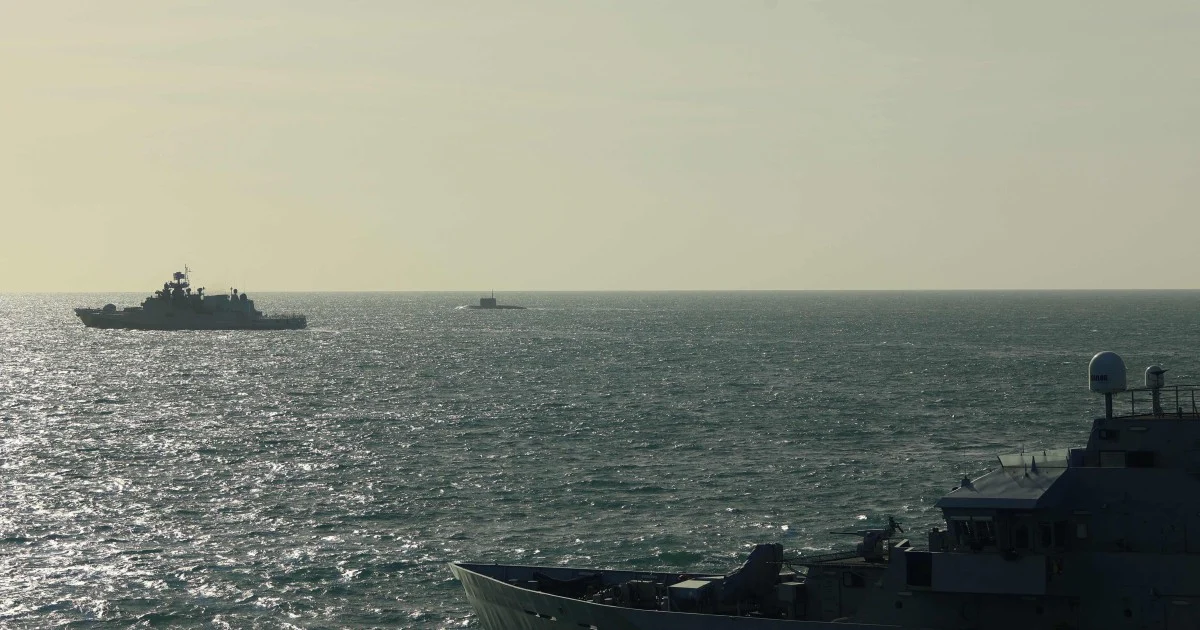
UK Prime Minister Keir Starmer has sought to frame a Russian warship's firing of warning shots near a British yacht in the English Channel as reckless conduct rather than a deliberate act of aggression, underscoring the delicate balance Western leaders are attempting to maintain in their rhetoric over escalating maritime tensions with Moscow.
The incident represents the latest in a series of at-sea confrontations between British and Russian naval forces, reflecting broader geopolitical strains stemming from Russia's invasion of Ukraine. Starmer's carefully calibrated language suggests an attempt to avoid further inflammatory exchanges while still acknowledging the concerning nature of the encounter, a distinction that carries particular weight given the volatile security environment across Europe.
The characterisation of the event as "reckless" rather than "sinister" carries important diplomatic implications for how Western nations are calibrating their responses to Russian maritime activities in contested waters. By using terminology that emphasises poor judgment over malicious intent, Starmer appears to be leaving room for de-escalation, a position that may also reflect pressure from naval and security experts who worry that further militarisation of the English Channel could establish dangerous precedents.
Incidents involving Russian military vessels operating near Western territories have become increasingly common, particularly following Moscow's withdrawal from cooperative maritime agreements and its assertion of more aggressive naval postures across multiple theatres. The English Channel, one of the world's busiest shipping lanes, has become a focal point for these tensions, with Russian vessels periodically conducting operations that Western navies view as provocative or unsafe.
From a regional perspective, such incidents resonate across Southeast Asia, where China's assertive maritime activities in the South China Sea have created parallel anxieties about freedom of navigation and the use of military force to intimidate civilian and commercial vessels. Malaysia, as a nation heavily dependent on sea trade and with territorial interests in the region, faces similar challenges in responding to military activities that test the boundaries of international maritime law without crossing into outright warfare.
The timing of Starmer's statement reflects the broader challenge facing Western capitals in managing relations with Moscow while continuing to support Ukraine. Adopting an overly aggressive stance risks further escalation, whilst appearing too accommodating could embolden further Russian incursions. The prime minister's language suggests an effort to establish a narrative that distinguishes between concerning behaviour that requires monitoring and actual military threats requiring immediate forceful response.
Warning shots fired from naval vessels carry inherent risks, as they can be misinterpreted by other parties or result in unintended escalation. Maritime experts have long cautioned that such practices, whilst technically within international law when conducted as warnings, create potential for accidents or miscalculation. The incident therefore highlights not only Russian assertiveness but also the broader fragility of maritime safety protocols when geopolitical tensions run high.
The incident also underscores the limitations of diplomatic language during periods of acute tension. Whilst Starmer's statement attempts to avoid inflammatory characterisations, the fundamental fact remains that Russian military forces have demonstrated willingness to fire weapons near civilian or commercial vessels, behaviour that falls outside peacetime norms regardless of terminology used to describe intent. This gap between careful language and underlying security realities often characterises responses to Russian actions across Europe.
The broader context of Anglo-Russian relations remains deeply strained across multiple domains, from espionage and cyberspace to military posturing and sanctions regimes. Maritime confrontations represent one visible manifestation of this deeper deterioration, with the English Channel serving as a particularly sensitive theatre given its proximity to British territory and significance to European commerce and security.
For Southeast Asian observers, the incident demonstrates how great power competition creates persistent friction points that are difficult to resolve through conventional diplomacy. Similar patterns are evident in the South China Sea, where freedom of navigation operations, near-miss encounters, and competing territorial assertions generate regular tensions that threaten to spill over into serious conflict despite absence of formal war declarations.
Starmer's framing also reflects institutional preferences within British government and NATO more broadly to avoid narratives of inexorable escalation toward conflict with Russia. By characterising the incident as reckless rather than calculated, the prime minister may be attempting to preserve possibilities for future dialogue whilst simultaneously signalling that such behaviour will not go unnoticed or unrecorded. This approach accepts a certain level of maritime friction as the new normal whilst drawing lines against actions that would constitute unambiguous acts of war.
Moving forward, these incidents will likely continue unless both sides establish clearer maritime boundaries and communication channels to prevent accidents from being misinterpreted as deliberate aggression. The challenge for Western nations lies in remaining vigilant against concerning behaviour whilst maintaining sufficient restraint to avoid converting isolated incidents into catalysts for wider conflict. Starmer's carefully chosen words reflect the complicated calculus that now defines great power relations in contested waters.