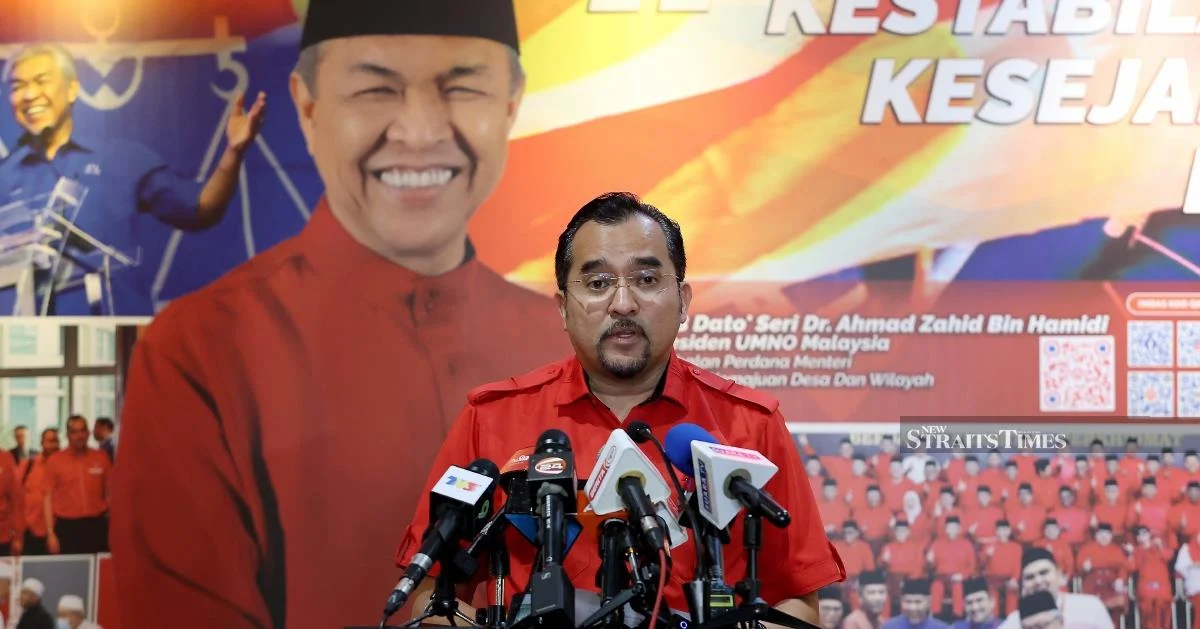
Umno's approach to the upcoming Johor and Negri Sembilan state elections will centre on constructive policy discussion rather than negative personal attacks, according to the party's secretary-general Datuk Dr Asyraf Wajdi Dusuki. The commitment signals an attempt to steer election discourse toward substantive governance issues and away from the character assassination that has increasingly defined political campaigns across Malaysia in recent years.
This positioning comes at a significant moment for the coalition, as both states represent crucial battlegrounds in Umno's efforts to consolidate support ahead of potential parliamentary elections. Johor, historically a BN stronghold but one that has seen considerable political volatility, and Negri Sembilan, where Umno-led administrations have faced mounting pressure, will test the party's capacity to reconnect with voters through policy advocacy rather than oppositional rhetoric.
The secretary-general's explicit disavowal of mudslinging reflects broader concerns within the party leadership about how negative campaigning can backfire with increasingly discerning electorates. Malaysian voters, having witnessed multiple election cycles dominated by personal attacks and inflammatory rhetoric, appear to have grown weary of this approach. By staking out higher rhetorical ground, Umno aims to differentiate itself from competitors who might resort to more aggressive tactics, thereby positioning the party as the mature, governance-focused alternative.
Focusing campaigns on substantive policy offerings requires Umno to articulate a clear vision for economic development, social welfare, and infrastructure investment in both states. In Johor, this might centre on leveraging the state's manufacturing and logistics hubs, regional trade corridors, and the Iskandar Malaysia development zone. For Negri Sembilan, the narrative could emphasise agricultural modernisation, small and medium enterprise support, and positioning the state as a complementary economic engine to the Klang Valley.
The emphasis on helping people through policy advocacy also appears designed to address legitimate grievances that have emerged in both states. Johor residents have expressed concerns about flood management, housing affordability, and employment opportunities, while Negri Sembilan faces questions about economic diversification and the sustainability of its administrative capacity. Rather than dismissing opposition critiques, Umno's stated focus on tangible solutions suggests an attempt to demonstrate responsiveness to voter concerns.
Datuk Dr Asyraf Wajdi Dusuki's pronouncement carries weight given his position as party secretary-general, making such statements reflective of formal party policy rather than individual opinion. This elevates the commitment beyond rhetoric, suggesting that Umno's leadership has deliberately chosen to distinguish its campaign strategy from the frequently contentious political environment that characterises Malaysian elections. The pronouncement also serves as implicit guidance to party members and candidates about acceptable campaign conduct, establishing expectations for tone and substance.
However, the pledge to avoid mudslinging operates within a competitive ecosystem where other parties may not observe similar restraints. Opposition parties competing in both states, as well as internal BN partners, may employ more aggressive tactics, potentially placing Umno at a disadvantage if voters perceive the party as insufficiently assertive in defending its record. This strategic gamble depends heavily on whether the Malaysian electorate genuinely values policy-focused campaigns, or whether the traditional tools of political persuasion—emotional appeals, personal narratives, and contrast positioning—continue to dominate voter decision-making.
The timing of this commitment is also noteworthy given Malaysia's intensifying political dynamics at the national level. As speculation about parliamentary elections continues, state elections in Johor and Negri Sembilan offer opportunities for parties to test messaging strategies and campaign approaches that might be deployed at the federal level. Umno's emphasis on policy substance may represent a calculated wager that voters across Malaysia are ready to engage with elections on terms of governance effectiveness rather than personal antagonism.
For Malaysian observers monitoring political culture, this commitment—if implemented authentically—could influence broader campaign standards. Should Umno successfully execute a policy-focused campaign that resonates with voters, other parties might face pressure to elevate their own discourse. Conversely, if negative campaigning from opposition competitors proves more electorally effective, Umno's own commitment to restraint could become a liability, potentially forcing a recalibration of strategy.
The secretary-general's statement also reflects calculations about Umno's organisational capacity and brand positioning. After years of internal factional disputes and public controversies, the party may benefit from campaigns anchored in tangible proposals rather than character-based appeals that invite scrutiny of party members' own conduct and credibility. By focusing external communications on policy, Umno creates space to rebuild institutional credibility through demonstrated administrative competence in the two states.
Looking forward, the actual implementation of Datuk Dr Asyraf Wajdi Dusuki's vision will determine whether this represents genuine strategic innovation or merely aspirational positioning. Malaysian voters will ultimately judge whether campaigns in Johor and Negri Sembilan deliver on the promise of substantive, respectful engagement with policy alternatives, or whether the pressures of electoral competition reassert older patterns of political discourse.