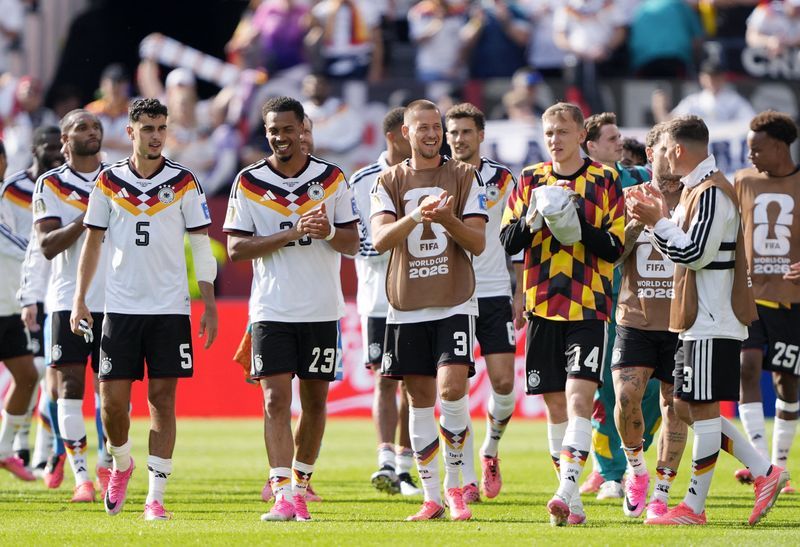
Germany's passage to the World Cup knockout stage came through a dramatic second-half reversal at the expense of Ivory Coast, with substitute Deniz Undav delivering the decisive blow twice in a 2-1 victory that underscored the European powerhouse's ability to recover from adversity. The win in Toronto extends Germany's streak of consecutive tournament qualifications while representing the nation's first knockout appearance since claiming the title in 2014, a milestone that carried particular resonance given the nine-year gap since their last deep tournament run.
The encounter between the two sides played out as a tale of frustration followed by redemption for the Germans, who found themselves repeatedly denied by the officials despite creating genuine scoring opportunities throughout the opening forty-five minutes. Julian Nagelsmann's tactical setup relied on patient, intricate build-up play and positional precision, methods that gradually began to assert control against Ivory Coast's more direct attacking approach. The West African side, meanwhile, demonstrated their characteristic flair and dynamism, moving the ball with considerable purpose and creating dangerous transitions from deep positions.
Germany's first-half struggles extended beyond mere statistical disappointment, as they had two legitimate goals disallowed in circumstances that tested the patience of both players and supporters. Midfielder Aleksandar Pavlovic appeared to have opened the scoring from a set-piece routine in the 25th minute when his header found the target, only for the referee to penalize him for contact with goalkeeper Yahia Fofana. The decision left Pavlovic visibly bewildered, and the substantial German contingent in Toronto—drawn partly from the city's 100,000-strong German diaspora—made their displeasure clear through sustained protest. A similar fate befell Jamal Musiala's effort later in the half, when officials deemed he had fouled defender Odilon Kossounou in the build-up, further deepening German frustration at the interval.
Ivory Coast seized the momentum created by Germany's setbacks, with Franck Kessie converting a rebound in the 31st minute after Amad Diallo's initial effort struck an opponent. The goal capped a well-constructed attacking sequence initiated by Yan Diomande's purposeful run down the left flank and subsequent cutback, exemplifying the technical quality that has characterized Ivory Coast's recent tournament performances. The West Africans' ability to find the target proved particularly impressive when contextualized against their competition; they have now scored in seven consecutive World Cup matches, establishing their longest such streak at the tournament and demonstrating a refreshing potency in the final third.
The introduction of Undav as a substitute fundamentally altered the trajectory of the match, with the German forward immediately injecting renewed purpose into attacking movements. His equalizer arrived in the 68th minute through a technical and well-controlled volley that arrowed past Fofana, signaling Germany's return to competitive form. The psychological shift proved consequential; having broken through the goalkeeper's resistance, Germany pressed forward with renewed conviction, and Undav capitalized on the momentum within minutes by receiving possession on the half-turn, spinning sharply, and firing a finish that Fofana could not reach. Undav's performance now stands as part of a remarkable personal trajectory, with the striker having accumulated nine goals across his last eight appearances—a remarkable ratio that places him among the tournament's most in-form attacking players.
Ivory Coast mounted a spirited response to falling behind, with Simon Adingra fashioning a genuine late opportunity in the penalty area, though the winger ultimately failed to generate a clean strike under German pressure. Defensive midfielder Nathaniel Brown forced a late save from Fofana immediately afterward, illustrating how completely Germany had seized control of the game's tempo and direction. The final passages reflected a side increasingly confident in their capacity to manage opponents, a psychological advantage that typically proves decisive in tournament football.
The result leaves Germany atop Group E with six points and mathematically assured of advancing to the round of thirty-two, while Ivory Coast remain on three points after two matches played. The standings suggest a likely contest between Ivory Coast and Ecuador for the second qualification spot, with Ecuador and Curaçao due to meet later on Saturday. Germany's remaining group assignment against Ecuador in New Jersey on Thursday will likely serve as an opportunity for Nagelsmann to experiment with formation and personnel, secure in their progression. Ivory Coast, by contrast, faces a must-win scenario against Curaçao in Philadelphia, where anything short of victory will most likely eliminate them from the tournament proper.
The victory carries significance beyond the immediate points tally, as it reinforces Germany's pedigree in tournament football despite their nine-year absence from the knockout stages. The comeback character displayed here, allied with the technical sophistication of their passing sequences, suggests they possess sufficient tactical flexibility to trouble higher-seeded opponents. For Ivory Coast, the defeat represents a frustrating reversal of fortunes after they had seized the initiative in the first half, though they remain positioned to salvage their tournament with a positive result against Curaçao, a fixture that carries do-or-die implications for their campaign.

