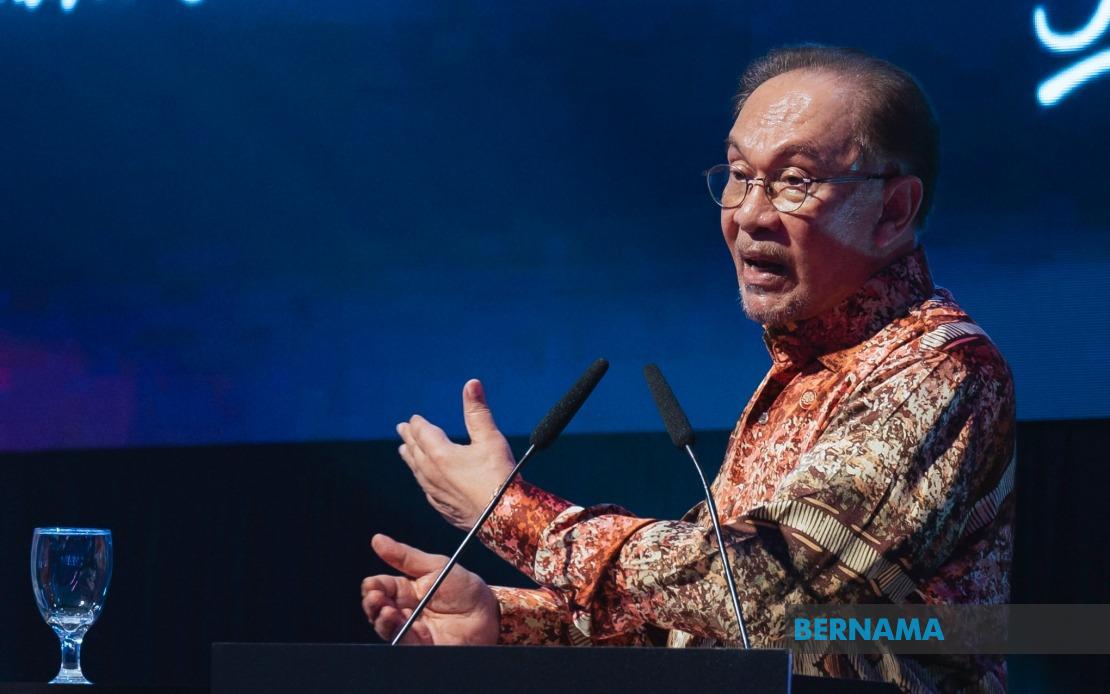
Prime Minister Datuk Seri Anwar Ibrahim's recent comments regarding Taiwan generated significant regional attention, particularly his acknowledgement of China's position that military force remains an option should peaceful reunification efforts fail. Yet interpreting these remarks as advocacy for conflict fundamentally misreads his underlying argument, which pivots instead on classical principles of state sovereignty, territorial integrity, and the deterrence mechanism that underpins international stability.
Anwar's core contention rests on a proposition that few governments would find controversial in private: no sovereign state willingly accepts dismemberment of its territory without mounting a defence. He employed Malaysia itself as an instructive parallel, suggesting that our own federation would resist breakup through whatever means necessary if peaceful alternatives proved exhausted. This analogy extends beyond mere rhetoric; it illustrates how deterrence functions as a stabilising force in international relations. A credible capacity to resist territorial challenges serves paradoxically to prevent their emergence in the first place, since potential adversaries recognise the costs of any attempt at coercion.
Critically, maintaining the theoretical option of military response differs substantially from preferring it as a first recourse. Anwar's framework explicitly positions negotiation, legal instruments, and political settlement as the primary pathways toward resolution. The existence of a deterrent capability alongside genuine commitment to peaceful methods does not represent contradiction; rather, it reflects how sophisticated state strategy operates in practice. Nations that foreswear force entirely while facing territorial pressures may inadvertently invite the very challenges they seek to avoid, as adversaries perceive weakness where they detect no cost to aggression.
The deterrence principle underlying Anwar's position holds that genuine uncertainty regarding potential consequences dissuades actors from pursuing destabilising actions. China's own strategic calculus presumably operates from this foundation—the maintenance of military capacity and expressed willingness to employ it serves to discourage separatist movements and external interference in what Beijing considers a domestic matter. Whether one endorses this logic or rejects it as illegitimate remains a separate question from accurately understanding what Anwar articulated. His remarks constitute neither advocacy for kinetic conflict nor moral sanction for coercion, but rather recognition of how security dilemmas and deterrence dynamics function within the international system.
Malaysia's foreign policy framework adds further nuance to this discussion. Our nation officially recognises the People's Republic of China and does not accord Taiwan separate diplomatic status, yet simultaneously maintains substantive economic and people-to-people engagement with Taipei. This carefully calibrated position reflects Malaysia's commitment to the One China principle while avoiding explicit endorsement of any particular reunification timeline or methodology. Within this diplomatic architecture, Anwar's argument gains additional coherence: if Malaysia genuinely accepts the One China framework, logical consistency demands acknowledging Beijing's legitimate concerns regarding its own territorial integrity. The Prime Minister essentially extrapolated from this acceptance to suggest that China's security interests regarding Taiwan cannot be dismissed as inherently illegitimate, even as separate questions exist regarding appropriate means of pursuing those interests.
Taiwan's perspective demands equal recognition within any complete analysis. Democratic Taiwan views itself as a sovereign polity with its own government, military, and democratic institutions, rendering any external reference to force fundamentally coercive from Taipei's standpoint. From this vantage point, merely acknowledging China's position regarding military options risks normalising the threat or legitimising coercion against a self-governing population. This represents a genuine tension within Anwar's remarks rather than their refutation; the Prime Minister addressed a strategic reality without implying moral approval of military solutions.
Regional stability considerations impose particular urgency on this debate for Malaysia and the broader Association of Southeast Asian Nations. A military confrontation across the Taiwan Strait would generate consequences extending far beyond the immediate belligerents, destabilising global supply chains upon which Southeast Asian economies depend and threatening ASEAN's institutional coherence and strategic autonomy. Malaysia consistently advocates for dialogue, restraint, and peaceful dispute settlement mechanisms—positions that remain entirely compatible with Anwar's deterrence-centred analysis. Supporting peaceful resolution and maintaining capacity for defence represent complementary objectives rather than contradictory ones.
The intellectual foundation of Anwar's position reflects sophisticated realist analysis rather than warmongering or advocacy for conflict escalation. States do not typically commit in advance to accepting territorial dissolution or coercive pressure, nor would they realistically be expected to do so. The capacity to defend territorial integrity provides insurance against scenarios where peaceful mechanisms fail, diplomacy reaches impasse, or third parties calculate that intervention carries acceptable costs. This insurance function operates most effectively when potential challengers understand its presence and credibility.
Malaysia's balancing act requires maintaining several positions simultaneously without contradiction. Our nation upholds the One China principle, avoids supporting external coercion against Taiwan, continues promoting peaceful dispute settlement through dialogue and international law, and recognises that states legitimately preserve military capacity as deterrent. These positions cohere logically around recognition that deterrence operates most effectively when communicated clearly yet coupled with genuine commitment to peaceful resolution. The alternative—unilateral renunciation of defensive capacity while facing territorial pressures—would constitute diplomatic self-harm.
Anwar's remarks, understood correctly, articulate not enthusiasm for conflict but rather sober assessment of how states protect themselves against existential threats. The Prime Minister distinguished between possessing and maintaining capacity for action (which deterrence requires) and actually desiring or initiating conflict (which constitutes fundamentally different behaviour). Malaysia's position accordingly maintains equilibrium between acknowledging China's security perspective and avoiding endorsement of any particular methodology for achieving reunification, while simultaneously affirming commitment to regional stability and peaceful resolution of disputes.
Moving forward, Malaysian policymakers must continue articulating this nuanced position clearly to international audiences while sustaining dialogue with all parties. Regional stability depends not on collective amnesia regarding deterrence logic but rather on transparent communication about red lines, genuine commitment to peaceful mechanisms, and recognition that multiple legitimate security interests operate simultaneously in the Taiwan Strait. Anwar's remarks, properly understood, contribute to this clarity rather than undermining it.

