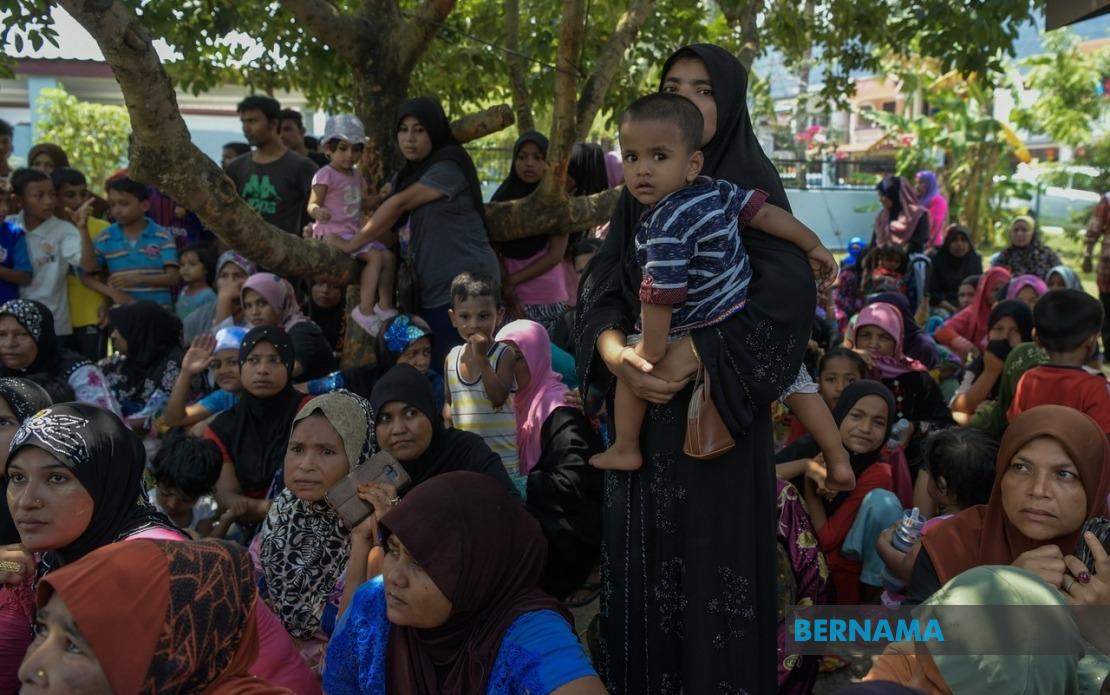
The Malaysian government moved to dispel public misconceptions about refugee documentation on Thursday, with Economy Minister Datuk Akmal Nasrullah Mohd Nasir emphasising that a UNHCR card carries no legal exemptions or citizenship status within the country. Speaking during the Global Supply Crisis Briefing, Akmal Nasrullah underscored that individuals holding such cards remain fully subject to Malaysian criminal and civil law, regardless of their refugee status.
The clarification arrives as authorities grapple with mounting public anxiety surrounding refugee populations, particularly fears centred on security risks, human trafficking networks, and the adequacy of identification systems. Akmal Nasrullah's statement suggests these concerns have risen to the cabinet level, prompting the government to provide explicit reassurance that refugee documentation does not create a legal grey zone or shield vulnerable populations from accountability.
The Home Ministry tabled the refugee management issue at Thursday's National Economic Action Council (MTEN) meeting, chaired by Prime Minister Datuk Seri Anwar Ibrahim at Parliament. According to Akmal Nasrullah, KDN has been advancing the Refugee Registration Document (DPP) Programme as a cornerstone of its approach, incorporating biometric data collection, comprehensive security screening, and ongoing monitoring mechanisms designed to enhance visibility into refugee populations across the country.
Enforcement operations targeting smuggling rings, human trafficking syndicates, and fraudulent documentation schemes are being ramped up, the minister indicated. The government plans to deploy data analytics and surveillance technology to identify potential security risks and enable more targeted law enforcement action. This technological pivot reflects a broader shift towards intelligence-led border management rather than purely reactive approaches.
Financial backing for these initiatives remains substantial. The government has committed RM1.2 billion across multiple agencies to support border control infrastructure, security upgrades, and operational capacity. Alongside these investments, authorities are expediting the expansion of the Malaysian Border Control and Protection Agency, seeking to consolidate border oversight under a single institutional framework and eliminate coordination gaps that might enable unauthorised entry or movement.
The refugee issue has become increasingly contentious within Malaysian public discourse, driven partly by concerns that inadequate documentation systems create vulnerabilities for criminal exploitation. Local communities have voiced apprehension about potential links between refugee populations and organised crime, particularly labour trafficking and document fraud. By reiterating that UNHCR cards do not confer any legal privilege, the government appears intent on addressing fears that refugees operate outside normal legal constraints.
International humanitarian frameworks recognise refugees as individuals fleeing persecution who warrant protection but remain bound by host country laws. Malaysia's position—that UNHCR documentation merely establishes a person's standing with the UN agency and their eligibility for humanitarian assistance, not legal immunity—aligns with standard international practice. However, the explicit public reiteration suggests authorities believe this distinction requires reinforcement within Malaysia's political and social environment.
The MTEN discussion extended beyond refugee management into allied security dimensions, with border control and regional trafficking networks representing interconnected challenges. The DPP Programme's emphasis on biometric registration represents a material enhancement to the government's information-gathering capabilities, potentially enabling cross-referencing with international databases and law enforcement networks. Technological integration signals recognition that managing irregular migration and identifying persons of concern demands more sophisticated tools than traditional document checks alone.
Beyond security implications, the refugee issue intersects with Malaysia's broader economic and social stability priorities. The MTEN meeting also addressed food security and manufacturing sector resilience—concerns reflecting Malaysia's vulnerability to global supply chain disruptions. Yet the prominence given to refugee management suggests the cabinet perceives this as a political priority matching economic challenges in terms of public concern and policy urgency.
For Malaysian communities and businesses, Akmal Nasrullah's clarification carries practical implications. It affirms that law enforcement retains full jurisdiction over refugee populations and that holding a UNHCR card does not create barriers to investigation, prosecution, or detention for criminal conduct. This message appears designed to reassure the public that security risks—whether genuine or perceived—are not being overlooked due to humanitarian considerations or international diplomatic sensitivities.
The government's approach reflects an attempt to balance humanitarian obligations with security imperatives and public reassurance. By investing substantially in registration, monitoring, and enforcement while explicitly stating that refugee status confers no legal privilege, authorities signal they are neither indifferent to community security concerns nor prepared to sacrifice protection principles for optics. Whether this multifaceted strategy will satisfy public anxieties or require further refinement remains to be seen as implementation progresses.
The refugee question will likely continue shaping Malaysia's domestic policy agenda, particularly as Southeast Asia grapples with displacement crises stemming from regional conflicts and economic pressures. How Malaysia calibrates its humanitarian responsibilities against public security demands will influence not only national policy but also its standing within the international community and its relationships with neighbouring states managing similar populations.

