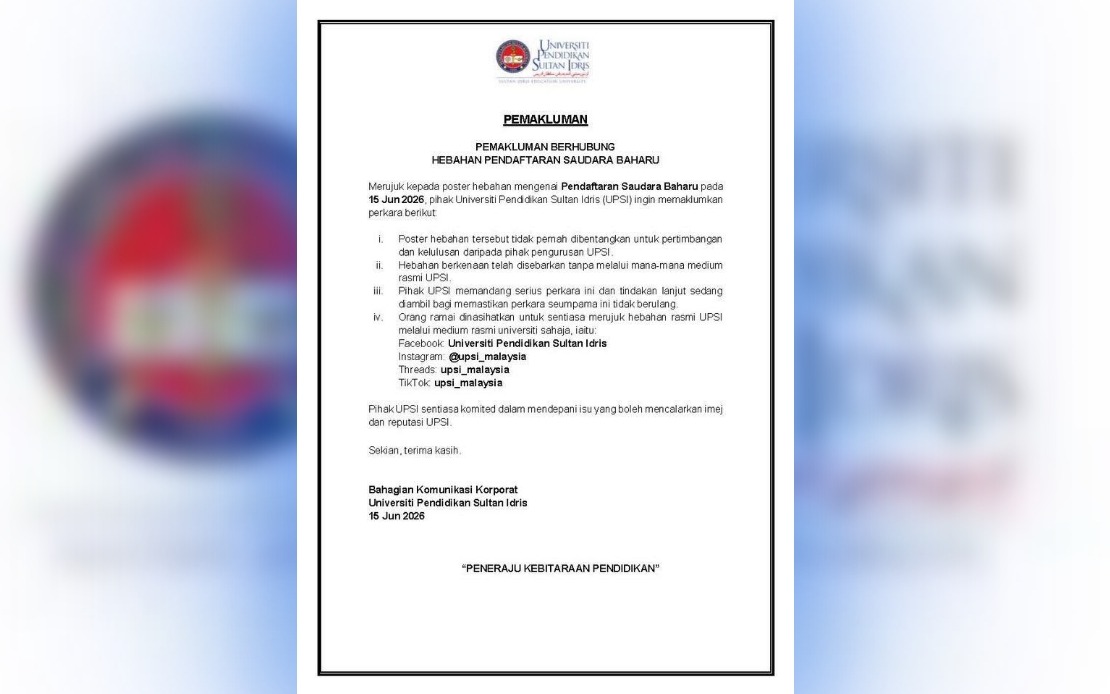
Universiti Pendidikan Sultan Idris (UPSI) has firmly rejected any involvement in a poster concerning the registration of 'saudara baharu' or newly converted Muslims that recently gained significant traction across social media platforms. The institution released a statement through its official social media accounts clarifying that the poster, dated June 15, had not been formally presented to university leadership for review or authorization prior to its circulation online.
According to UPSI's clarification, the viral material was disseminated entirely through unofficial channels and without any institutional endorsement or participation. The university emphasized that it does not condone the unauthorized use of its name or reputation to promote initiatives or campaigns that have not gone through proper administrative vetting procedures. This distinction is important for a public institution that must maintain strict governance standards over communications bearing its identity.
The university indicated that it takes the matter with considerable seriousness and has initiated an investigation to determine how the poster came to be associated with UPSI and to identify those responsible for its creation and distribution. The institution committed itself to implementing preventative measures designed to obstruct similar occurrences in the future, recognizing that unauthorized communications can damage institutional credibility and mislead the public about the university's actual positions and initiatives.
UPSI has advised the general public to exercise caution when encountering announcements or promotional materials that purport to represent the institution and to verify their authenticity by consulting only the university's legitimately designated communication platforms. This guidance is particularly relevant in an era of rapid information dissemination through social networks, where misinformation and false attributions can spread with alarming speed before official clarifications can be issued.
The university's response underscores a broader institutional concern about protecting its brand and ensuring that all public-facing communications reflect the institution's actual values, policies, and approved positions. Malaysian universities, as government-linked institutions, are particularly vulnerable to reputational damage when their names are appropriated for purposes they do not authorize, as this can blur public understanding of their genuine academic and administrative missions.
The episode highlights the challenges educational institutions face in the digital age, where social media enables rapid amplification of content regardless of its official status. The ability to quickly and decisively respond to false associations has become a critical component of institutional reputation management. UPSI's prompt public denial and commitment to further investigation represent standard best practices for organizations seeking to maintain credibility and public trust.
For Malaysian citizens and residents, the incident serves as a reminder to verify official information directly through institutional channels rather than relying solely on social media posts, even when they appear to carry institutional branding or logos. The ease with which visual materials can be created and shared online means that apparent authenticity should not be assumed without independent verification.
UPSI's statement also implicitly addresses concerns about how organizations' names might be misused in recruitment or administrative contexts. The university is signaling to stakeholders that any communications regarding staff recruitment, registration processes, or institutional programs should be treated with skepticism unless they originate from officially verified sources. This protective stance helps prevent members of the public from being inadvertently misled by fraudulent or unauthorized initiatives.
The handling of this matter reflects the increasing sophistication with which Malaysian institutions must approach digital communication governance. Universities must balance openness and accessibility with careful control over institutional messaging, ensuring that their reputations remain intact while their authorized communications reach intended audiences effectively. UPSI's response demonstrates recognition that swift, transparent communication is essential for managing such situations in the contemporary information landscape.
As the investigation continues, the university is positioned to use its findings to strengthen internal protocols governing the approval and distribution of materials bearing its name or logo. Such institutional learning from incidents like this contributes to improved governance structures across the Malaysian higher education sector, ultimately benefiting both the institutions themselves and the public they serve.