The Upper Rajang Development Agency (URDA) is embarking on a strategic push to reshape the rural economy of Sarawak's interior regions through deeper partnerships with universities, government development authorities, and grassroots communities. The initiative represents a significant shift away from traditional resource extraction models towards knowledge-intensive, technology-enabled production systems capable of generating higher incomes and sustainable livelihoods across the Upper Rajang constituency.
Datuk Seri Alexander Nanta Linggi, who chairs URDA while serving as Kapit Member of Parliament and Works Minister, articulated the philosophical underpinning of this economic transformation during a recent visit to research facilities in Kelantan. He emphasized that contemporary rural development cannot rely indefinitely on the export of raw materials and unprocessed commodities, a model that has historically characterized resource-rich regions in Malaysian Borneo. Instead, the new approach prioritizes constructing integrated value chains that position rural producers as active participants in processing, quality enhancement, and direct market engagement rather than mere suppliers of bulk inputs to urban-based processing facilities.
A compelling demonstration of this model's viability emerged from the performance of the High Impact Community Projects (HICP) initiative, which has been piloted across several communities in the Kapit parliamentary constituency. Participating households have achieved income increases exceeding 25 per cent, a measurable outcome that validates the underlying theory that strategic investments in research capabilities, technological transfer, and community knowledge accumulation can generate concrete economic improvements. This success metrics carries particular significance for Malaysian policymakers grappling with persistent rural-urban income disparities and the challenge of retaining population in interior regions facing demographic decline and outmigration.
Universities occupy a central position within this reconceptualized development framework, though Nanta emphasized they must transcend their conventional role as abstract centers of intellectual inquiry. When academic research becomes deliberately aligned with the practical challenges confronting rural communities and receives systematic government support through dedicated implementing agencies, the outcomes extend beyond publishable discoveries in academic journals to encompass viable commercial enterprises capable of substantially improving household prosperity. This partnership model addresses a longstanding gap between frontier research conducted in tertiary institutions and the adoption barriers that typically prevent rural communities from accessing and implementing technological innovations.
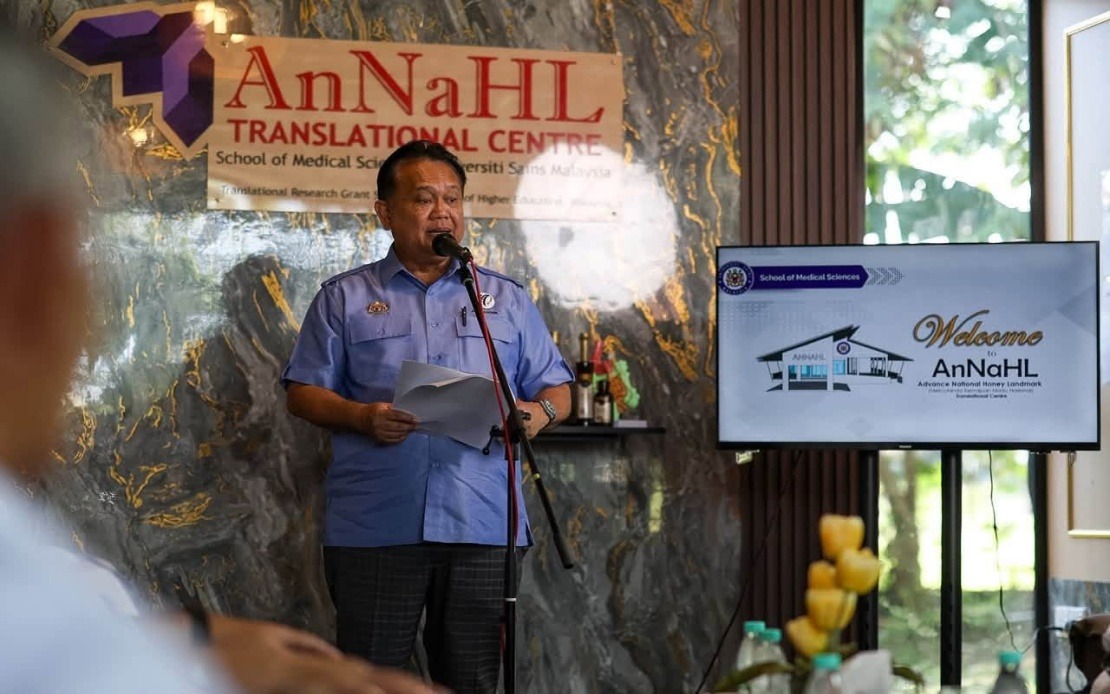
The visit to the Advanced National Honey Landmark (AnNaHL) Translational Centre at Universiti Sains Malaysia's Health Campus in Kubang Kerian provided a concrete illustration of how this collaborative architecture functions in practice. The facility represents a deliberate bridge between academic research into honeybee products and their medicinal applications, and the commercial development of marketable products derived from stingless bee cultivation. For Upper Rajang communities with suitable ecological conditions and existing cultural familiarity with beekeeping, such translational facilities offer pathways to transform traditional knowledge and practices into high-value agricultural enterprises accessible to smallholder producers.
Capacity building constitutes the foundation upon which this entire innovation ecosystem rests, according to Nanta's articulation of the development strategy. Rural communities require not merely access to new technologies but systematic development of human capital through targeted skills training, practical knowledge transfer, and sustained mentoring relationships with technical specialists. Equally crucial is ensuring that community producers possess genuine market access rather than remaining dependent on exploitative intermediaries who capture the value-added margins that producers themselves generate. Addressing these capacity and market access constraints simultaneously distinguishes the proposed approach from previous rural development initiatives that often provided technology or training in isolation without addressing the systemic barriers to commercial viability.
The Regional Corridor Development Authority (RECODA), which jointly participated in the Kelantan facility visit alongside URDA representatives, brings complementary expertise in large-scale infrastructure planning and regional economic integration. This inter-agency collaboration signals government recognition that sustainable rural transformation requires coordinated action across multiple institutional mandates rather than siloed departmental efforts. RECODA's involvement suggests that rural innovation initiatives will be embedded within broader regional development corridors, potentially improving rural producers' integration into provincial and national value chains rather than maintaining their isolation as marginalized economic actors.
The stingless bee cultivation projects already identified for implementation within several Kapit locations exemplify how this strategic framework translates into concrete community development initiatives. Stingless bee honey commands premium pricing in regional and international markets due to its purported medicinal properties and scarcity, offering opportunities for substantially higher revenue per unit of production compared to conventional commodity crops. The AnNaHL facility's expertise in processing protocols, quality standards, and product certification positions it to provide the technical foundation enabling Upper Rajang producers to access these high-value markets while maintaining compliance with increasingly stringent regional quality and traceability requirements.
The timing of this initiative aligns with broader Malaysian policy emphases on reducing regional inequality and addressing the structural challenges confronting rural economies throughout Peninsular Malaysia and East Malaysia. As conventional primary industries face secular decline due to resource depletion, rising input costs, and international competition, policymakers have increasingly recognized that sustainable rural prosperity requires deliberate transitions toward knowledge-intensive and technology-enabled production systems. The Upper Rajang initiative represents an operational test of how such transitions can be managed in practice, with lessons potentially applicable to rural regions throughout Southeast Asia confronting similar structural economic challenges.
The proposed hub function of the AnNaHL facility extends beyond simple product processing to encompass training provision, market development support, and ongoing research refinement of production methodologies. This comprehensive approach addresses multiple constraints simultaneously rather than attempting incremental improvements within existing economic structures. By positioning the facility as a genuine ecosystem hub rather than merely a laboratory or processing plant, URDA and its collaborators appear committed to ensuring that community enterprises maintain sustainable access to technical expertise, quality assurance, and market intelligence necessary for long-term commercial viability in competitive regional markets.
For Malaysian policymakers and development practitioners observing this initiative, the Upper Rajang model offers valuable insights into how strategic partnerships between academic institutions, government agencies, and rural communities can catalyze genuine economic transformation. Success will require sustained commitment to capacity building, patient investment in infrastructure and institutional development, and genuine commitment to empowering rural producers as active participants in value creation rather than passive beneficiaries of top-down development schemes. The substantial income improvements already achieved through the HICP initiative suggest that when these elements align coherently, rural innovation-led development can deliver measurable improvements to household welfare and community economic resilience.

