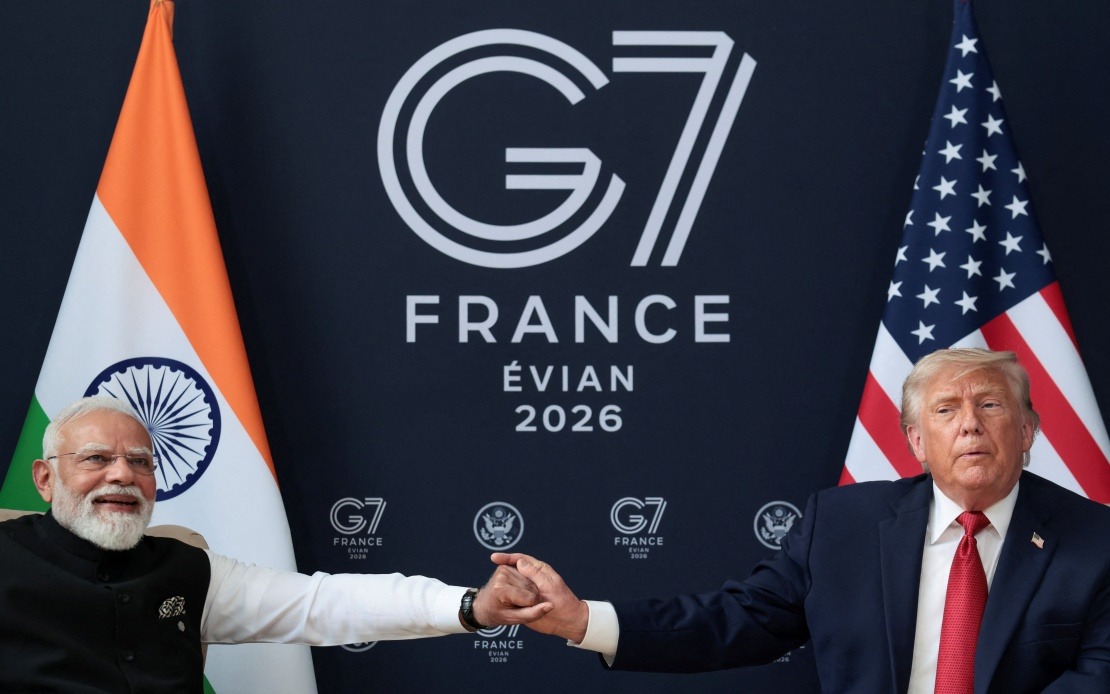
India has declared that meaningful headway has been achieved in its protracted negotiations with the United States aimed at finalising a long-pending trade accord, according to statements released following high-level discussions between the two nations' leaders. Prime Minister Narendra Modi and US President Donald Trump broached the subject during their bilateral meeting held on the sidelines of the Group of Seven summit in Evian, France, this week. The development signals renewed momentum in talks that have spanned several years and assumes particular importance given the deepening economic partnerships between New Delhi and Washington amid broader geopolitical shifts in Asia.
India's External Affairs Ministry characterised the discussions as yielding "significant progress" in advancing negotiations towards an interim Bilateral Trade Agreement. Officials from both capitals have been instructed to pursue an accord that balances the commercial interests of both nations while delivering tangible benefits to their respective economies. The emphasis on achieving a "commercially meaningful agreement at the earliest" underscores the urgency both sides attach to concluding these negotiations, reflecting the growing recognition that bilateral trade serves as a cornerstone of deepening India-US strategic partnership.
The trajectory towards a finalised agreement appears to be accelerating. US Trade Representative Jamieson Greer is scheduled to visit India in the coming week specifically to advance the trade discussions, a move that suggests concrete momentum and willingness to resolve outstanding issues expeditiously. Such high-level engagement by the US trade representative indicates that Washington views this negotiation as a priority within its broader Indo-Pacific strategy and its efforts to strengthen ties with major economies beyond traditional Western allies.
Trump's public characterisation of Modi as an exceptionally skilled negotiator provides insight into the dynamics surrounding these discussions. The US president described Modi as "one of the toughest" negotiators, employing colourful language that acknowledged the Indian leader's resolute approach to protecting national interests. Trump's observation that Modi appears "like an angel" but proves "as tough as a killer" in negotiations underscores the complexity of reaching mutually acceptable terms when both sides come to the table with clearly defined objectives and non-negotiable parameters.
The historical context of these negotiations reveals the longstanding nature of trade difficulties between the two countries. An interim trade agreement was successfully concluded in February of this year, representing a breakthrough after years of incremental progress and periodic setbacks. Under that interim arrangement, the United States reduced certain tariffs to 18 per cent, providing some relief to Indian exporters and demonstrating the possibility of reaching accommodations despite fundamental differences.
However, the broader trade relationship has been marked by significant turbulence. In 2025, Trump imposed a blanket 25 per cent tariff on Indian goods, a move that disrupted bilateral commerce and heightened tensions. Additionally, Washington levied an additional 25 per cent penalty on Indian purchases from Russia, attempting to use trade leverage to influence India's foreign policy and energy procurement decisions. These measures reflected the Trump administration's willingness to employ protectionist measures and geopolitical pressure as tools for advancing American interests, a reality that frames the current negotiations.
For Malaysia and the wider Southeast Asian region, the progress in US-India trade relations carries significant implications. A substantive bilateral trade framework between Washington and New Delhi could reshape regional commercial architecture and influence investment flows throughout Asia. India's growing economic clout and strategic importance have made it an attractive partner for countries seeking to balance Chinese influence, and a strengthened India-US economic relationship could alter the competitive dynamics within ASEAN and among its dialogue partners.
The negotiations also reflect broader patterns in contemporary international commerce, where traditional tariff-based frameworks are increasingly interwoven with geopolitical considerations and efforts to reshape supply chains. India's position as a major consumer economy and manufacturing hub makes it a valuable partner for the United States, particularly as Washington seeks to reduce dependence on Chinese manufacturing and develop alternative sources for critical goods and raw materials.
The emphasis on reaching a "balanced, mutually beneficial" agreement suggests that both sides recognise the necessity of crafting terms that permit political leaders to claim victory domestically while maintaining the arrangement's viability over time. For India, this means securing improved market access for its agricultural products, pharmaceuticals, and technology services. For the United States, it involves maintaining protections for domestic industries while leveraging trade relationships for strategic advantage in the Indo-Pacific region.
The coming weeks will be critical as negotiators from both countries work to translate the expressed political commitment into concrete terms. Greer's forthcoming visit to India will provide an opportunity to address specific outstanding issues and determine whether the apparent momentum can translate into a final agreement that withstands domestic political scrutiny in both democracies. Success would represent a significant diplomatic achievement and validate the strategic partnership that both governments have increasingly emphasised in their regional and global strategies.