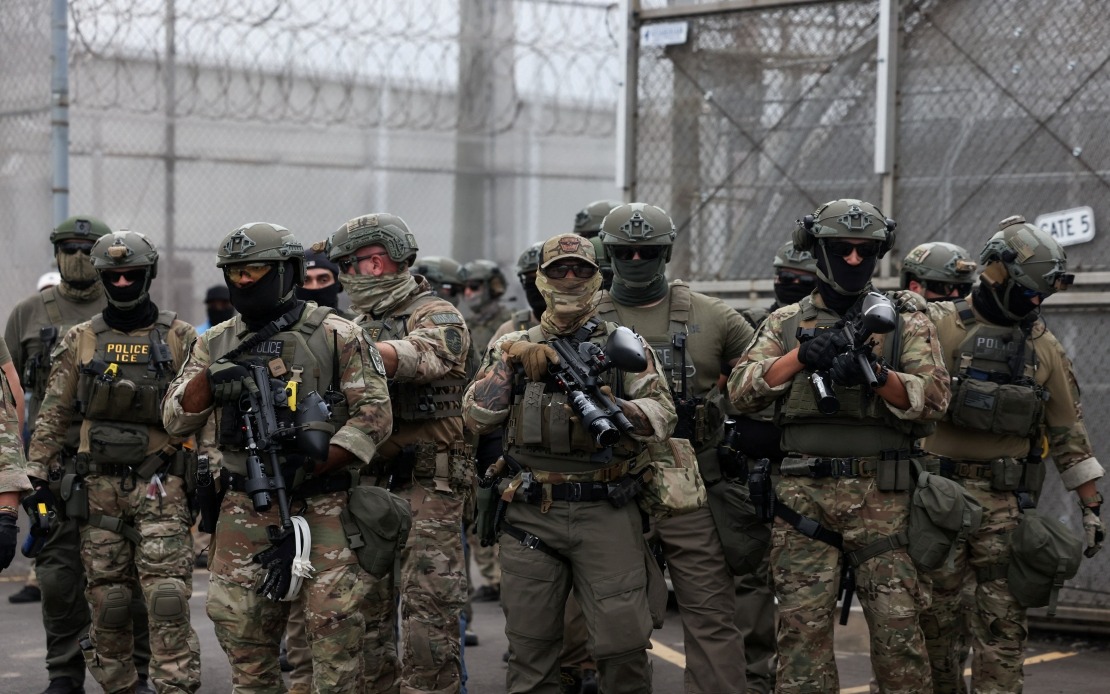
A federal judge in California has issued a sweeping nationwide ruling that prohibits United States Immigration and Customs Enforcement (ICE) officers from detaining migrants at immigration courthouses, striking down a cornerstone enforcement tactic of President Donald Trump's aggressive deportation agenda. The court's decision represents a significant legal setback for the administration's hardline immigration enforcement approach and reflects growing judicial scrutiny of policies critics contend violate fundamental procedural safeguards.
The injunction applies across all US jurisdictions and effectively terminates an enforcement practice that accelerated during Trump's second term, in which ICE agents conduct arrests of migrant individuals both inside courthouse facilities and in surrounding areas. This practice has ensnared hundreds of immigrants, many of whom were detained before completing their immigration proceedings or receiving legal determinations regarding their residency status. The targeting of courthouses has become particularly controversial because it occurs in spaces nominally designated for judicial proceedings, raising questions about the appropriate boundaries between law enforcement operations and the justice system itself.
Immigration courts throughout the United States handle deportation proceedings involving migrants and asylum seekers whose legal status is contested or uncertain. These specialized tribunals, already burdened by massive backlogs exceeding one million cases, represent the primary mechanism through which the government pursues removal of non-citizens. The introduction of courthouse-based enforcement operations last year fundamentally altered the institutional environment of these proceedings, as immigrants began facing the prospect of apprehension while exercising their right to appear before a judge.
The Trump administration had repositioned its enforcement strategy at the outset of the president's second term, issuing revised internal guidelines that explicitly emphasized the operational advantages of conducting arrests within courthouse precincts. According to ICE's internal justifications, such arrests yield efficient enforcement outcomes by capturing individuals already present in government facilities. However, the federal judge rejected this rationale as legally insufficient, finding that the agency had failed to adequately analyze or address the serious due process implications inherent in the practice.
The court's reasoning centered on the Trump administration's procedural shortcomings rather than a wholesale rejection of immigration enforcement authority. The judge found that ICE had provided no meaningful explanation for the dramatic policy shift and had not seriously grappled with evidence that courthouse arrests create a chilling effect on immigrants' willingness to attend legal hearings. When migrants fear detention at the moment they appear in court, they may choose to forfeit their proceedings and disappear into the undocumented population rather than present their cases—an outcome that ironically undermines the orderly resolution of immigration matters.
For Southeast Asian observers, the ruling offers insights into how democratic judicial systems can function as a counterbalance to executive immigration enforcement agendas. Malaysia and neighbouring countries have their own immigration enforcement systems, and the California court's insistence on procedural transparency and reasoned decision-making reflects international standards of administrative law that many nations aspire to implement. The decision demonstrates that even during periods of strong executive political support for enforcement-focused policies, courts can require government agencies to meet baseline standards of justification and legal reasoning.
The practical implications extend beyond individual cases. When immigrants withdraw from court proceedings due to detention fears, immigration files remain unresolved, courts become less efficient, and the very goals of enforcement become compromised. The federal judge's opinion implicitly recognizes this institutional dynamic, suggesting that enforcement effectiveness requires maintaining at least minimal confidence among migrant populations that courthouses remain spaces where legal proceedings, however difficult, can occur without immediate police apprehension.
The ruling also illuminates broader tensions within US immigration policy. The Trump administration has framed aggressive deportation enforcement as a response to public concerns about undocumented migration and border security. Yet the court's decision suggests that enforcement divorced from procedural legitimacy may ultimately undermine public confidence in the immigration system itself. When judicial proceedings become entangled with enforcement operations, the resulting institutional compromises affect not only immigrants but also the rule of law framework that citizens depend upon.
ICE's policy shift appears to have been driven by data suggesting that courthouse arrests yield high removal rates. However, the federal judge found this metric insufficient justification for practices that fundamentally alter the character of immigration court proceedings. The ruling requires the Trump administration to either abandon the practice entirely or undergo a more extensive administrative process that addresses the substantive concerns the judge identified.
For migrants currently navigating the US immigration system, the decision provides immediate relief by removing the threat of detention at courthouse entrances. However, it does not address the broader uncertainty surrounding Trump-era immigration enforcement or the massive backlog of pending cases that continues to delay resolution of immigrant legal status claims. The ruling represents a tactical victory for advocates challenging enforcement practices, yet leaves the underlying strategic landscape of US immigration policy largely unchanged.
The California court's intervention also reflects a broader pattern of federal judiciary pushback against executive immigration enforcement actions deemed legally inadequate. Multiple courts have challenged various Trump administration immigration policies on similar grounds—that agencies failed to provide reasoned explanations or follow required administrative procedures. These decisions collectively suggest that while presidents possess substantial discretion over immigration enforcement priorities, they cannot exercise that discretion through arbitrary or inadequately justified means.
Looking forward, the ruling establishes that ICE cannot simply relocate enforcement operations to sensitive institutional spaces without legal justification, even when doing so might produce enforcement efficiencies. The decision affirms that immigrant due process rights, while subject to legitimate government restriction, cannot be eliminated through administrative convenience. For Malaysia and other nations observing US immigration jurisprudence, the case illustrates how national court systems can maintain meaningful oversight over executive enforcement power, even amid political pressure for stricter immigration control.

