The United States military apparatus is undergoing a significant geographical reorientation, moving naval firepower away from Middle Eastern deployments and back towards the Indo-Pacific theatre as tensions in the Persian Gulf begin to stabilise. This strategic recalibration, evidenced by the redeployment of major amphibious platforms and documented through satellite imagery and official US Navy announcements, reflects Washington's reassessment of global priorities following what appears to be a de-escalation of hostilities in the region. The shift carries profound implications for Southeast Asian nations and broader regional security architecture, particularly as great power competition with China continues to intensify.
Earlier in the year, the United States had concentrated significant military resources in the Middle East, drawing assets from across its global posture including valuable naval units previously stationed in or earmarked for the Pacific. The USS Tripoli, a Wasp-class amphibious assault ship that typically serves as a flagship for the US Seventh Fleet operating from Japan, became the most visible symbol of this westward pivot, leaving the region's security balance visibly altered. This reallocation of naval presence generated considerable apprehension among traditional American allies and partners throughout Asia, who worried that Washington's strategic attention and security commitments were being diluted by Middle Eastern entanglements.
However, recent diplomatic developments have begun reversing this trend. Washington and Pakistan jointly announced an agreement with Tehran that addresses a critical flashpoint: the reopening of the strategically vital Strait of Hormuz and the termination of the American naval blockade that had been enforcing pressure on Iranian maritime commerce. This breakthrough suggests that the acute phase of regional confrontation has passed, freeing up substantial military resources for redeployment elsewhere. The timing of this agreement has proven instrumental in allowing the United States to redirect its attention back towards the Pacific, where competing interests with China require sustained naval presence and capability.
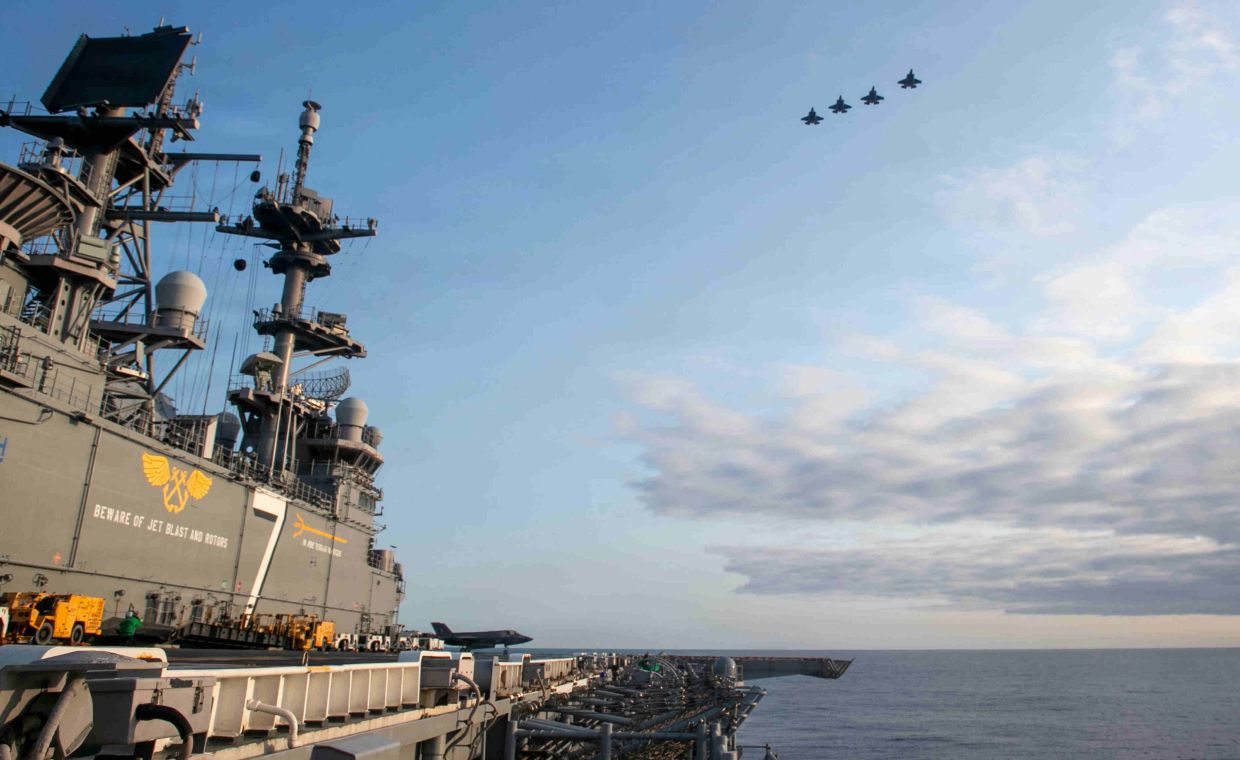
The USS Boxer, a San Diego-based Wasp-class amphibious assault ship that was originally scheduled to proceed to the Middle East, instead began operating with the US Seventh Fleet in the South China Sea from June onwards. Accompanying the Boxer is the USS Portland, an amphibious transport dock vessel, alongside a sophisticated air wing incorporating F-35B stealth fighter jets and MV-22B Osprey transport helicopters that represent cutting-edge military technology. These platforms constitute genuinely formidable instruments of power projection, capable of conducting a wide spectrum of operations from humanitarian assistance to high-intensity combat scenarios. The presence of such capabilities in contested waters carries unmistakable messaging implications for regional actors monitoring the American security commitment.
Embarked aboard these vessels is the 11th Marine Expeditionary Unit, a deployable force comprising more than 2,000 military personnel combining infantry, aviation, and support specialists. The US Seventh Fleet characterised this unit as delivering persistent combat credibility in its operational area, explicitly identifying deterrence and crisis response as its primary functions. Based in Yokosuka, Japan, the Seventh Fleet maintains responsibility for the vast western Pacific region and serves as the primary instrument through which Washington projects military power and reassurance across Asia. The reestablishment of robust surface warfare capabilities in this theatre represents a tangible restoration of the naval presence that allies had missed during the Middle East-focused period.
Expert observers from regional institutions have emphasised the psychological and diplomatic dimensions of these naval redeployments. Collin Koh, a senior fellow at the S. Rajaratnam School of International Studies based at Nanyang Technological University in Singapore, noted that maritime assets have historically functioned as crucial expressions of American commitment and strategic intent throughout the region. The diversion of these forces to the Middle East during the past several months generated genuine disquiet among Washington's regional partners, who interpret naval presence as a concrete manifestation of alliance solidarity. The reappearance of major amphibious warfare ships in the Pacific therefore serves important reassurance functions beyond their purely military capabilities.
Koh further suggested that the Boxer deployment specifically demonstrates Washington's attempt to signal that Pacific naval force levels have returned to sustainable peacetime operating patterns rather than crisis-driven reductions. This messaging becomes particularly important given the questions raised in American congressional testimony about the sustainability of the Middle East campaign. Admiral Samuel Paparo, testifying before the US Senate in April, acknowledged finite limitations on military expenditure and munitions availability, though he declined to specify timelines for potential exhaustion of resources. The implication was clear: indefinite engagement in the Middle East would undermine American capabilities for potential Indo-Pacific contingencies.
Military analysts in China have interpreted these developments through the lens of long-term American strategic calculations. Ni Lexiong, a Shanghai-based defence expert, emphasised that both major American political parties view China as the primary long-term strategic competitor, making Pacific-focused deployments fundamentally reflective of national priority-setting. Redeployment decisions consequently communicate diplomatic signals beyond their narrow military dimensions, indicating the geographic focus of American strategic concern and the allocation of precious defence resources. The visible movement of sophisticated warships and marine forces carries symbolic weight that shapes regional perceptions of American resolve and strategic seriousness.
Furthering this pivot, the US Department of Defence announced a administrative restructuring that reflects these strategic priorities. The command responsible for the Indo-Pacific region reverted to being designated the US Pacific Command, moving away from nomenclature that emphasised the broader Indo-Pacific architecture. Although the geographic area of responsibility remained unchanged, extending from American west coast waters to India's western borders, the naming revision spotlights the Pacific as the primary focus within that expansive theatre. The department provided no details regarding whether this nomenclatural shift would accompany substantive policy or deployment modifications, though the symbolic realignment suggests institutional recalibration towards Pacific-centric planning.
The implications of this rebalancing extend throughout Southeast Asia and the broader region. Nations including Malaysia, Thailand, Vietnam, and Indonesia maintain significant maritime interests and have increasingly looked to American naval presence as a counterweight to expanding Chinese capabilities. The restoration of robust US naval deployment patterns provides renewed reassurance to these partners concerning the sustainability of the rules-based maritime order that underpins regional prosperity and stability. These developments also demonstrate how Middle Eastern crises, while demanding temporary attention, ultimately remain subordinate to American strategic calculations centred on Pacific great power competition.
Looking forward, the sustainability of this Pacific reorientation remains contingent upon continued de-escalation in the Middle East and the durability of agreements like the Strait of Hormuz accord. Should new crises emerge in the Persian Gulf region, American military assets might again experience pressure for westward redirection, potentially straining commitments to Asian partners. However, the fundamental American assessment appears to be settling into a posture that prioritises Pacific presence while seeking to manage Middle Eastern challenges through diplomatic channels and reduced military footprints. This represents a significant shift from the crisis-driven military expansionism of earlier in the year, suggesting that the American security establishment increasingly views the Pacific rather than the Middle East as the critical theatre for twenty-first century strategic competition.

