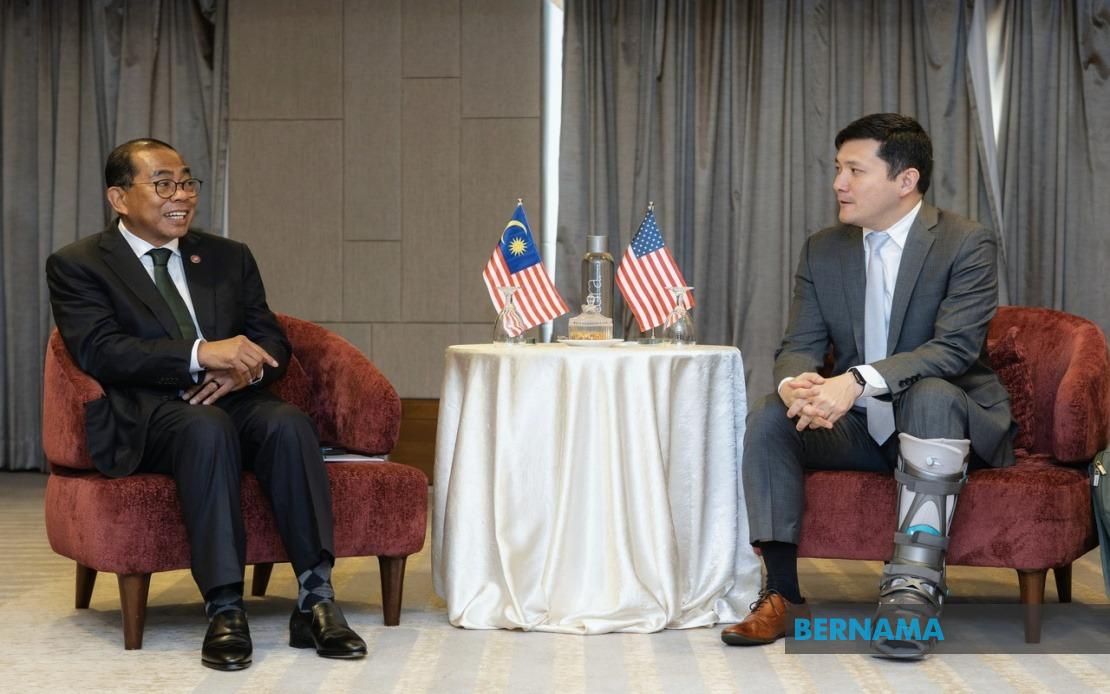
The United States remains firmly committed to broadening and deepening its defence partnership with Malaysia, underscoring Washington's strategic interest in Southeast Asia at a time of shifting regional dynamics. This assurance came directly from US Ambassador to ASEAN Kevin Kim during a courtesy call with Malaysian Defence Minister Datuk Seri Mohamed Khaled Nordin in Kuala Lumpur on August 3, the first day of the 37th Annual Military Law and Operations Conference being held in the capital through August 6.
The bilateral meeting, held against the backdrop of heightened geopolitical tensions in the region, focused principally on consolidating existing defence arrangements rather than breaking new policy ground. Mohamed Khaled characterised the discussions as centred on strengthening the institutional and operational frameworks that already bind the two nations together militarily and strategically. The emphasis on continuity and incremental advancement reflects a pragmatic approach by both capitals to managing defence relations in a period when regional stability concerns loom large.
Beyond the US commitment, Mohamed Khaled's calendar of high-level engagements on the sidelines of the MILOPS conference revealed the multilayered nature of Malaysia's security architecture. The Defence Minister also received Singapore's newly appointed Permanent Secretary for the Ministry of Defence, Joseph Leong, who articulated Singapore's determination to sustain and expand cooperative ventures with Malaysia. The encounter highlighted how defence partnerships in Southeast Asia operate simultaneously at bilateral, sub-regional and multilateral levels, with each tier reinforcing the others.
Crucially, the Singapore interaction underscored the centrality of the Five Power Defence Arrangements, the long-standing security mechanism linking Malaysia, Singapore, Australia, New Zealand and the United Kingdom. This framework remains a cornerstone of stability in the Strait of Malacca and surrounding waters, regions of vital importance to global maritime commerce and energy security. For Malaysia, participation in FPDA represents both a security anchor and a mechanism for deepening ties with traditional Western partners while maintaining its cherished strategic autonomy.
Malaysia's broader diplomatic engagement during the conference also encompassed high-level contact with ASEAN's own institutional leadership. A separate courtesy call from ASEAN Secretary-General Dr Kao Kim Hourn allowed Mohamed Khaled to coordinate perspectives on the mounting security challenges confronting the ten-member regional bloc. The dialogue between the two officials centred on the indispensable role defence establishments must play in upholding ASEAN Centrality, the organisational principle that positions Southeast Asia as the driving force in determining its own security architecture and regional affairs.
The conversation with Kao Kim Hourn also touched on how defence sector cooperation can serve broader ASEAN objectives around peace, stability and shared prosperity. This formulation reflects a maturation in how regional security is conceptualised, moving beyond traditional military-to-military interactions toward a more holistic understanding of defence as integral to economic development and social cohesion. For Malaysia, championing this approach reinforces its standing as a bridge-builder within ASEAN between developed and developing member states.
The 37th MILOPS conference itself represents the kind of multilayered security dialogue that characterises contemporary Southeast Asian regional architecture. Drawing government officials and military representatives from more than 30 countries, the gathering creates space for practitioners to grapple with shared security challenges spanning maritime security, counter-terrorism, humanitarian assistance and disaster relief, and the legal dimensions of military operations. Malaysia's role as host and participant elevates its profile as a serious contributor to regional security thinking.
For Malaysian readers, these developments carry practical implications. The deepening of defence ties with the United States ensures continued access to military technology, training and intelligence sharing arrangements that enhance Malaysia's capacity to protect its sovereign territory and maritime interests. Similarly, strengthened cooperation within ASEAN and through FPDA provides reassurance that Malaysia's security concerns receive sustained attention from both regional partners and longstanding Western allies.
The emphasis on defence sector contributions to regional stability also reflects a recognition that traditional security challenges persist. Malaysia faces ongoing maritime security pressures, including disputes in the South China Sea where territorial claims overlap with China, Vietnam, the Philippines and others. Strengthening the rules-based international order through defence cooperation mechanisms helps preserve the space for multilateral diplomacy and prevents security competition from spiralling into confrontation.
Looking forward, the commitment to enhanced defence ties signals continuity in Malaysia's foreign policy orientation. Despite periodic tensions in US-Malaysia relations over domestic governance issues, defence cooperation has remained largely insulated from broader diplomatic fluctuations. This compartmentalisation allows both nations to pursue shared strategic interests while managing differences elsewhere in the relationship.
For Southeast Asia more broadly, Malaysia's role as a locus of defence diplomacy underscores the region's growing salience in great power competition. The convergence of American, Australian, New Zealand, Singaporean and Malaysian defence establishments within frameworks like FPDA and ASEAN reflects efforts to maintain a balance as major powers compete for influence. Malaysia's ability to cultivate relationships across multiple security partnerships without forfeiting its strategic independence remains a defining feature of its approach to regional security.

