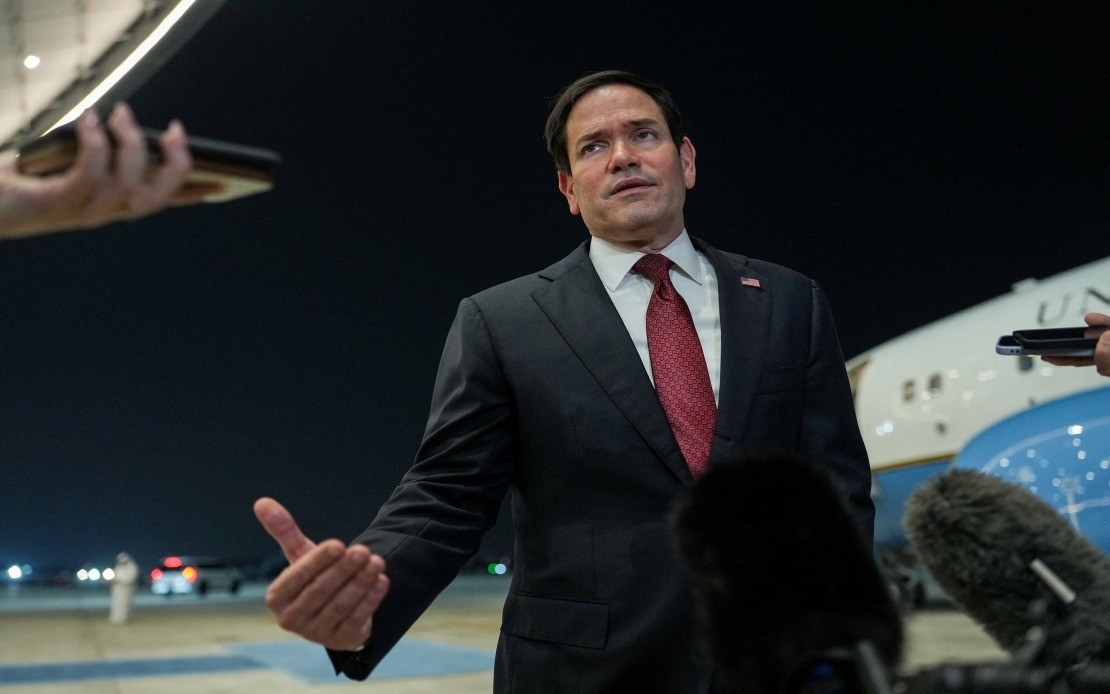
The United States has made clear it will not commit government resources to any reconstruction fund for Iran, according to remarks by Secretary of State Marco Rubio on Tuesday. The statement comes as discussions about potential international contributions to Iranian economic development have gained momentum following recent diplomatic progress between Washington and Tehran. Rubio's position effectively distances the American government from financing mechanisms that might emerge from ongoing negotiations, though he left the door open for private investment and contributions from other nations.
Rubio told journalists that decisions regarding which countries and entities would participate in such a fund remain premature and have not been finalized. His comments came in response to queries about whether Gulf states might channel resources into Iranian reconstruction. The secretary emphasized that any American involvement would be restricted to private sector initiatives rather than federal spending. "It won't be our investment. It won't be our government money," Rubio stated, underscoring the distinction between potential private economic engagement and official government participation.
The remarks reflect a careful calibration by the State Department regarding America's posture toward Iran's economic future. While the US has moved toward de-escalation and military agreement with Iran, Rubio's statement suggests Washington intends to maintain fiscal distance from reconstruction efforts. This positioning allows the administration to pursue diplomatic progress without the domestic political complications that could arise from direct government funding of an adversary nation.
According to Rubio, Iran itself possesses the capacity to generate economic opportunities if it chooses to pursue that path. However, he tied any broader international economic cooperation to progress on security matters that remain under negotiation. The statement implies that economic reconstruction cannot be decoupled from security considerations, a position consistent with the Trump administration's approach to sanctions and engagement policies. The secretary indicated that economic developments would be contingent upon successful resolution of outstanding security challenges in the coming months.
These comments follow President Trump's dismissal last week of reports suggesting a $300 billion reconstruction fund was being contemplated as part of a broader US-Iran settlement. The president's skepticism regarding such figures reflected concerns that American resources might be mischaracterized as funding Iranian development. Rubio's clarification appears designed to prevent similar misunderstandings and to establish clear boundaries regarding American fiscal commitments.
Recent diplomatic activity has intensified between Washington and Tehran. Both sides held substantive talks in Burgenstock, Switzerland, on Sunday, with Qatar and Pakistan serving as mediators. The US delegation was led by JD Vance, while Iran's parliamentary speaker Mohammad Bagher Ghalibaf headed the Iranian team. Subsequent statements from both the Iranian Foreign Ministry and American officials indicated tangible progress on multiple fronts, suggesting movement toward comprehensive arrangements addressing military and economic dimensions of the relationship.
The parties recently formalized a memorandum through remote signing that addresses cessation of military conflict originating on February 28. The agreement establishes specific timelines for key commitments, including American naval blockade removal and Iranian restoration of shipping operations through the Strait of Hormuz. These provisions address critical commercial and security interests that have shaped the region's geopolitical dynamics for years. For Southeast Asian nations reliant on Persian Gulf trade, such agreements carry profound implications for maritime security and energy supplies.
A separate nuclear arrangement forms another crucial pillar of the emerging framework. Iran has committed to forgoing nuclear weapons acquisition, with detailed nuclear programme resolution scheduled for negotiation within a 60-day window. This component represents perhaps the most technically complex and politically sensitive aspect of the overall arrangement. The nuclear dimension has historically been the most contentious issue in US-Iran relations, and reaching agreement on verification mechanisms and timelines will require sustained diplomatic effort.
For Malaysia and the broader Southeast Asian region, these developments carry significance on multiple levels. The Strait of Hormuz remains a vital shipping lane for regional commerce and energy supplies. Any stabilization of the Iran-US relationship that improves maritime security benefits regional economies dependent on Persian Gulf trade. Additionally, reduced tension in the Middle East could diminish pressure on Southeast Asian nations to choose sides in broader geopolitical competitions. However, the clear American position against subsidizing Iranian reconstruction suggests that benefits for Iran's economy may be limited, potentially creating uncertainties regarding Tehran's economic trajectory and regional policy adjustments.
The distinction Rubio has drawn between private and public American engagement also has implications for international investors evaluating Iranian opportunities. Companies seeking to operate in Iran will need assurance that their efforts have political cover from major powers, yet lack of direct US government support might complicate financing arrangements and risk assessments. This ambiguity could slow reconstruction timelines and alter the composition of international partners involved in Iranian economic development, potentially shifting influence toward Chinese, Russian, or regional actors willing to assume greater financial commitments.

