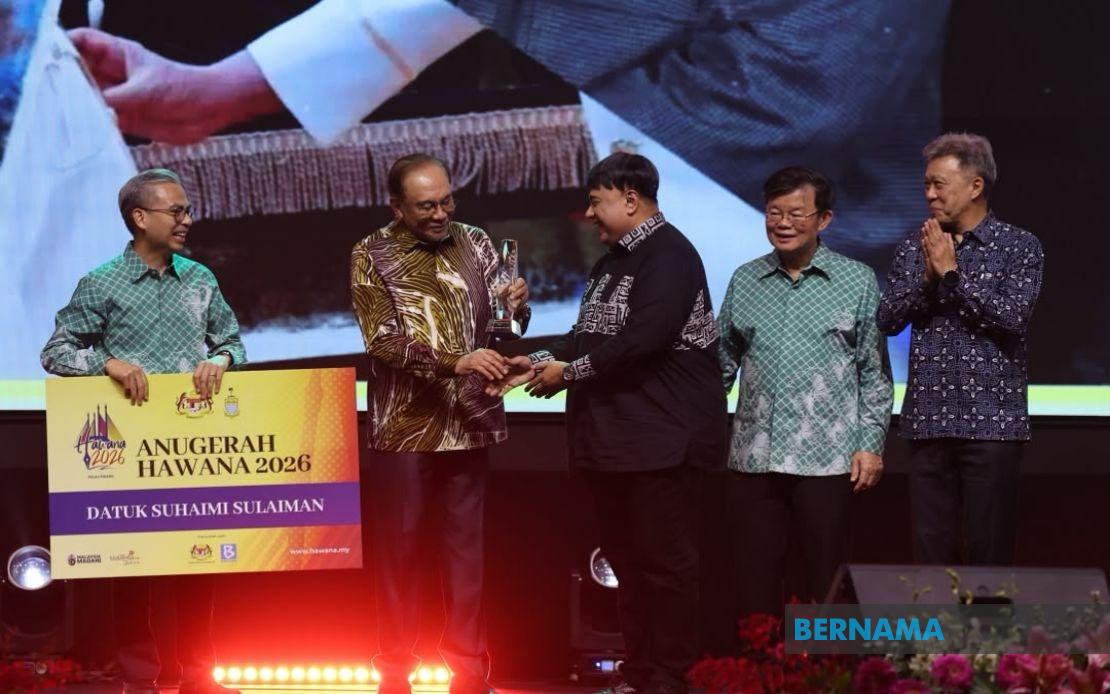
Datuk Suhaimi Sulaiman has been recognised with the HAWANA 2026 National Journalists' Day Award at a ceremony in Butterworth, honouring more than thirty years of dedication to broadcasting and journalism in Malaysia. The distinguished media veteran, who previously served as director-general of Broadcasting Malaysia (RTM), received the accolade from Prime Minister Datuk Seri Anwar Ibrahim in a prestigious gathering that underscored the significance of his contributions to the nation's news and information landscape.
The award ceremony took place at PICCA @ Arena Butterworth Convention Centre on June 20, drawing attendance from senior figures across Malaysia's media and government sectors. Penang Chief Minister Chow Kon Yeow, Communications Minister Datuk Fahmi Fadzil, and Malaysian National News Agency (Bernama) chairman Datuk Seri Wong Chun Wai witnessed the presentation, reflecting the national importance accorded to recognising outstanding media professionals. The presence of such high-ranking officials underscores the government's commitment to honouring those who have shaped Malaysia's broadcasting heritage and journalistic standards over decades of service.
Also present at the HAWANA 2026 Grand Finale were Bernama chief executive officer and HAWANA 2026 Working Committee chairman Datin Paduka Nur-ul Afida Kamaludin, and Bernama editor-in-chief Arul Rajoo Durar Raj. The gathering of media industry leaders and government representatives highlighted the collaborative relationship between Malaysia's government communications apparatus and the broader media ecosystem, reflecting how institutions have evolved to support and recognise professional excellence.
Upon receiving the award, Suhaimi emphasised the profound significance of the recognition, characterising it not merely as a personal honour but as a renewed mandate to continue contributing meaningfully to Malaysia's media sector. His reflective acceptance speech conveyed humility and a commitment to lifelong learning, qualities that have evidently sustained his career through significant transformations in the broadcasting and journalism fields. The veteran broadcaster's approach to the award signals a philosophical perspective on professional achievement—one that views recognition as an opportunity for deepened responsibility rather than culmination.
A central theme of Suhaimi's remarks focused on the transformative impact of artificial intelligence on media practice and journalism. He acknowledged that media professionals in Malaysia and globally now operate in an environment fundamentally altered by AI technologies, which are reshaping how news is gathered, processed, and disseminated to audiences. This forward-looking perspective is particularly relevant for Malaysian media practitioners, who must navigate the intersection of traditional journalistic values and emerging technological capabilities that are still being understood and integrated across newsrooms.
Suhaimi emphasised that adaptation and continuous knowledge acquisition have become essential competencies for contemporary media professionals. His experience spanning more than three decades provides a unique vantage point from which to assess how Malaysian broadcasting has evolved through technological cycles—from analogue to digital transmission, from centralised to distributed information networks, and now toward AI-assisted journalism. The recognition of his career trajectory implicitly validates the importance of experienced voices in guiding the industry through periods of rapid transformation.
The award itself carries significance within Malaysia's media calendar, as HAWANA (Hari Anugerah Wartawan Nasional, or National Journalists' Day) recognises outstanding contributions to Malaysian journalism and broadcasting. HAWANA awards have historically honoured those whose work has elevated journalistic standards, advanced media freedoms, or contributed substantially to public understanding through news coverage. Suhaimi's selection places him among Malaysia's most respected media figures, a distinction earned through decades of leadership roles and mentorship within the broadcasting sector.
For Malaysian readers and regional media observers, Suhaimi's recognition carries broader implications about the future direction of professional journalism in Southeast Asia. As traditional media institutions work to maintain relevance and credibility in an increasingly digital information landscape, honouring experienced practitioners like Suhaimi reinforces the value of institutional knowledge and ethical journalism principles. His appointment to leadership positions at RTM made him instrumental in steering Malaysia's public broadcaster through multiple eras of development and regulatory change.
The emphasis on continuous learning in Suhaimi's acceptance remarks also resonates with current debates within Southeast Asian journalism about sustainability and adaptation. As newsrooms across Malaysia, Singapore, Thailand, and beyond grapple with audience fragmentation, revenue pressures, and technological disruption, the perspectives of experienced practitioners who have navigated previous transformations become increasingly valuable. Suhaimi's career demonstrates that longevity in media leadership often correlates with flexibility and intellectual openness to new approaches.
Looking forward, Suhaimi's stated intention to continue sharing his experience with younger journalists and broadcasters positions him as a potential mentor figure during this critical period of media sector evolution. His recognition by the Prime Minister's office and senior communications officials suggests that the Malaysian government views institutional memory and professional continuity in media as assets worth celebrating. This perspective may influence how media organisations across the region approach succession planning and knowledge transfer between generations of journalists and broadcasters.

