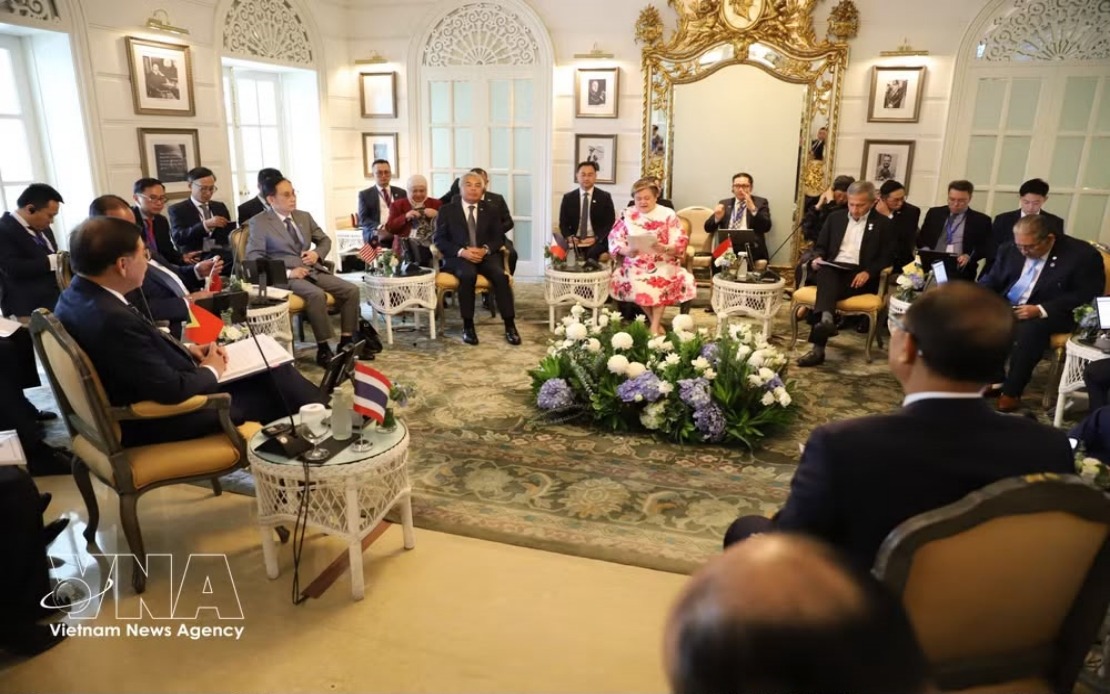
Vietnam's Foreign Minister Le Hoai Trung has signalled Hanoi's readiness to intensify collaboration with ASEAN partners in bolstering Myanmar's stability and progress, underscoring that Vietnam continues to view the troubled nation as a core member of the regional bloc despite the military administration that has governed since 2021. Speaking at an informal gathering of ASEAN foreign ministers alongside Myanmar's counterpart in Bangkok on July 12, Trung positioned Vietnam as an active participant in the bloc's strategy to support Myanmar's recovery through the Five-Point Consensus—ASEAN's principal diplomatic framework for engagement with Yangon since the breakdown of civilian rule.
The session, convened under Philippine leadership as Manila assumes the ASEAN chairmanship for 2026, marked a significant moment in regional diplomacy. Philippines Secretary of Foreign Affairs Maria Theresa P. Lazaro presided over discussions that represented the highest-level direct contact between the ten-member association and Myanmar's current administration since the 2021 coup. The symbolic importance of the gathering lies in ASEAN's determination to maintain diplomatic channels rather than isolate Yangon, a strategy that remains contested within the bloc yet continues to define official engagement.
Trung acknowledged concrete steps that Myanmar authorities have undertaken to address longstanding vulnerabilities that destabilise both the country and the broader region. He specifically recognised initiatives aimed at stabilising the political environment, revitalising economic activity following years of turmoil, enhancing administrative capacity, and intensifying crackdowns on transnational criminal networks including narcotics trafficking and digital crime. Border security improvements were also noted as part of Myanmar's broader stabilisation agenda. These acknowledgements, while measured in diplomatic tone, reflect ASEAN's strategy of recognising progress however incremental to encourage continued reform.
Yet Trung's remarks also betrayed underlying frustration with the pace of change. He articulated hopes that Myanmar would accelerate efforts toward sustainable peace, genuine national reconciliation, durable security improvements, and tangible enhancements in living standards for ordinary citizens. The choice of language—emphasising that progress "will continue to be promoted"—suggests ASEAN's desire for Myanmar to move beyond defensive stabilisation toward transformative reconstruction. For Southeast Asian observers, this signals that the region's diplomatic patience is not unlimited.
The Vietnamese minister argued that while implementation of the Five-Point Consensus remains essential, ASEAN must escalate its practical engagement beyond the diplomatic framework. He advocated for sustained, direct dialogue and regular contact with Yangon as mechanisms to monitor developments closely and translate consensus into measurable outcomes. This distinction—between formal agreements and operational follow-through—reflects growing concerns within ASEAN capitals that verbal commitments to the consensus have not yielded the institutional progress necessary to restore Myanmar to a democratic trajectory or resolve its deepening humanitarian crisis.
Hanoi's pledge went further, with Trung committing Vietnam to joint action with the incoming Philippine chair and other member states. Vietnam offered to participate in supporting Myanmar's economic rehabilitation, tackling social challenges exacerbated by three years of instability, and reinforcing regional efforts against organised crime networks that exploit Myanmar's ungoverned spaces. Notably, Vietnam positioned this engagement as serving the broader ASEAN Community-building project, framing Myanmar's recovery as essential to the bloc's collective security architecture rather than merely as an act of bilateral goodwill.
Myanmar's Foreign Minister Tin Maung Swe presented his government's roadmap during the session, unveiling a 100-day development plan and detailing measures intended to promote peace, encourage reconciliation, and establish stability. Swe also outlined his administration's strategy for maintaining contact with internal stakeholders, a delicate formulation that reflects Myanmar's fractured political landscape where armed opposition groups, ethnic armed organisations, and civilian networks resist military rule. ASEAN ministers engaged with this briefing in what diplomats characterised as frank and constructive dialogue, suggesting candid exchanges beneath the cordial exterior.
The Five-Point Consensus, adopted by ASEAN in April 2021 following the coup, has become the framework through which the bloc attempts to balance non-interference principles with pressure for political reform. The consensus calls for dialogue between Myanmar's government and opposition, cessation of violence, humanitarian assistance delivery, mediation, and fact-finding visits by ASEAN envoys. However, implementation has remained largely symbolic, with minimal diplomatic breakthroughs and worsening humanitarian conditions suggesting the framework's limitations. Yet ASEAN continues to champion it as the bloc's mechanism for Myanmar engagement, partly because abandoning it would require consensus on alternative approaches—a consensus that does not exist.
The positioning of Myanmar within ASEAN's collective strategy has grown increasingly complex given the country's centrality to regional geopolitics. Myanmar shares borders with China, India, Thailand, and Laos, making instability there a concern for multiple great powers. ASEAN's effort to maintain dialogue rather than impose sanctions reflects partly the bloc's desire to prevent Myanmar from drifting entirely into Beijing's orbit or becoming a proxy battleground in broader Indo-Pacific competition. Vietnam's emphasis on maintaining engagement aligns with this strategic calculus, particularly given Hanoi's own complicated relationship with China and its interest in preserving ASEAN's relevance as a counterweight.
For Malaysian observers, Vietnam's statements carry implications for Southeast Asian stability and ASEAN's credibility. Malaysia has largely supported the consensus framework while quietly maintaining diplomatic pressure on Myanmar, reflecting the region's broader discomfort with the military administration. Vietnam's commitment to "concrete and practical steps" suggests frustration with diplomatic stalemate, hinting that ASEAN capitals may be moving toward more assertive engagement strategies despite maintaining official commitment to consensus-based principles.
The meeting's significance extends to demonstrating ASEAN's internal cohesion despite individual members' varying approaches to Myanmar. The fact that foreign ministers gathered in person rather than via video links signals the bloc's determination to project unity on a challenge that tests both ASEAN's diplomatic framework and its foundational principle of non-interference. However, the continuing absence of substantive breakthroughs in Myanmar's transition suggests that unity of rhetoric may mask deeper divisions about optimal strategy.
Going forward, Vietnam's pledge commits Hanoi to active participation in whatever mechanisms ASEAN develops for Myanmar support. Whether this translates into meaningful economic assistance, diplomatic initiatives, or capacity-building remains to be seen. The coming months under Philippine stewardship will reveal whether ASEAN can move beyond consensus statements toward implementing the "concrete and practical steps" that increasingly appear necessary to prevent Myanmar's further deterioration and regional consequences. For now, Vietnam has positioned itself as a constructive partner in this endeavour, while the fundamental challenges driving Myanmar's crisis remain substantially unaddressed.

