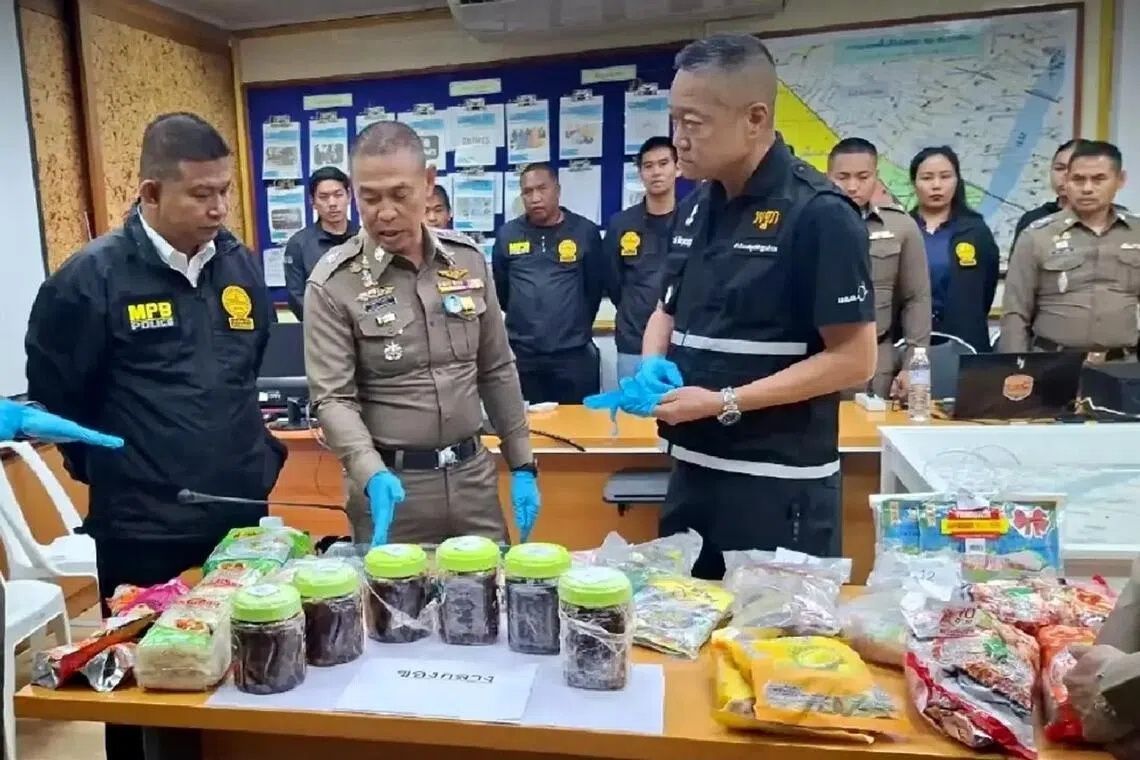
Bangkok police announced the discovery of an international methamphetamine smuggling network that exploited Thailand's geographic position to move contraband towards Japan, revealing an operation that demonstrated alarming sophistication in evading detection through multiple intermediaries and layered logistics. The investigation, disclosed by Metropolitan Police Bureau commissioner police lieutenant-general Siam Boonsom on July 17 alongside police major general Chaiya Phetpanya and officers from Bang Yi Khan Police Station, emerged after a courier's suspicions about unusually heavy tamarind paste containers led to the seizure of more than 2kg of crystal methamphetamine, commonly referred to as ice in the illicit drug trade.
The case began when an individual working as a courier, tasked with transporting goods internationally, contacted police on July 13 after noticing that several jars of tamarind paste destined for Tokyo felt far heavier than expected. Upon closer inspection and testing by investigators, authorities discovered six foil-wrapped packages secreted within the jars, containing crystal methamphetamine in quantities suggesting this was not a minor trafficking effort but rather part of a structured operation. The choice of tamarind paste as a concealment method reflects the creative approaches criminal organisations employ to disguise narcotics within legitimate-seeming food products, a technique that has surfaced repeatedly across Southeast Asian smuggling networks.
What emerged from subsequent interrogation of Sompong, the Thai suspect detained in connection with the ring, was evidence of a hierarchically organised network with operational control centred in Hanoi. Vietnamese nationals allegedly orchestrated the smuggling chain from Vietnam itself, directing operations through anonymous Facebook accounts used to recruit delivery riders willing to collect packages from residential addresses where Vietnamese nationals maintained temporary accommodation throughout Thailand. This distributed model deliberately fragmented the supply chain into disconnected segments, ensuring that individual participants remained unaware of the full scope of the operation and could provide minimal information to authorities if apprehended.
The structural design of the network reflected careful consideration of law enforcement vulnerabilities. Rather than employing direct chains of command, operatives recruited riders through social media to transport goods from Vietnamese safe houses to Thai couriers who would subsequently carry packages across international borders. This separation of functions created multiple barriers between the senior organisers in Hanoi and the physical contraband, making it substantially more difficult for investigators to establish direct links between decision-makers and the actual smuggling activities. The strategy acknowledged that disrupting any single point in the chain would not immediately expose those directing operations, though it also created opportunities for law enforcement to follow financial and logistical threads backwards towards the network's core.
Financial investigation proved crucial in unravelling the operation's mechanics. Police discovered that payments flowed through a bank account belonging to Sompong, the Thai national at the centre of the arrested network. Vietnamese operatives reportedly rotated through Thailand and systematically withdrew cash sums ranging from 20,000 to 50,000 baht from Sompong's account before departing the country, a pattern suggesting deliberate effort to avoid accumulating large balances that might trigger banking scrutiny or create concentrated records of illegal transactions. The withdrawal strategy, combined with the rotating cast of Vietnamese nationals handling money, represented an attempt to obscure the financial trail and distribute risk across multiple individuals unlikely to remain in Thailand for extended periods.
The case mirrors a troubling pattern emerging across Southeast Asia whereby transnational drug networks exploit unwitting or semi-willing couriers to move contraband across borders. Bangkok police specifically highlighted that the arrangement resembled previous incidents where individuals had been recruited to transport packages internationally without full awareness of their contents, suggesting that vulnerability to such recruitment remains widespread among individuals seeking overseas income opportunities. For Southeast Asian readers, the implications extend beyond Thailand: such networks often utilise regional transit hubs to move product between manufacturing regions and distant markets, with countries like Thailand, Malaysia, and the Philippines serving as crucial chokepoints where law enforcement interdiction can significantly disrupt trafficking flows.
Investigators determined that at least four individuals warrant arrest on charges related to the operation. Warrants have been issued for Sompong and three Vietnamese nationals allegedly involved in withdrawing funds, managing the anonymous social media accounts used for recruitment, or directing specific aspects of the smuggling enterprise. Sompong has categorically denied involvement in the allegations, maintaining his innocence despite police findings implicating his bank account in the financial mechanics of the operation. The denial raises questions about whether Sompong knowingly facilitated the arrangement or whether he was himself manipulated into providing banking infrastructure for the network's transactions.
Police investigations have further implicated Sompong's girlfriend, though she has not yet been named in arrest warrants. Authorities believe she possessed knowledge of the operation and are examining the extent of her participation, a line of inquiry that suggests the network may have operated through trusted personal relationships that extended beyond strictly commercial connections. This aspect of the investigation underscores how transnational criminal organisations often exploit personal and romantic relationships to establish trust-based operational cells, making detection more difficult because family members and intimate partners may be reluctant to report suspicious activities or may rationalise criminal involvement as acceptable due to personal loyalties.
The methamphetamine destined for Japanese markets reflects broader regional drug trafficking dynamics. Crystal methamphetamine production has expanded substantially across Southeast Asia, particularly in border regions where precursor chemicals remain readily available and manufacturing facilities operate with relative impunity. Japan represents a high-value destination market where ice commands premium prices, making the risk-reward calculus attractive for Vietnamese and other Southeast Asian trafficking organisations despite heightened interdiction efforts by Japanese law enforcement. The routing through Thailand capitalises on the country's established role as a regional logistics hub where cross-border movement of goods, whether legitimate or criminal, blends into massive volumes of daily commerce.
For Malaysian observers, this case demonstrates how regional drug trafficking networks operate across multiple countries simultaneously, utilising each nation's particular vulnerabilities and geographic position to maximise distribution efficiency while minimising exposure to law enforcement. Thailand's porous borders, developed transportation infrastructure, and significant Vietnamese expatriate community provide ideal conditions for such operations to establish temporary presence. The sophistication displayed by this particular network—from the use of social media recruitment to the rotating withdrawal strategy—suggests that law enforcement agencies across Southeast Asia face increasingly capable and adaptive adversaries. Successful interdiction, as demonstrated in the Bangkok case, requires not merely street-level enforcement but also financial investigation, intelligence work, and cross-border cooperation among agencies in countries serving as both transit points and final markets for illicit drugs.

