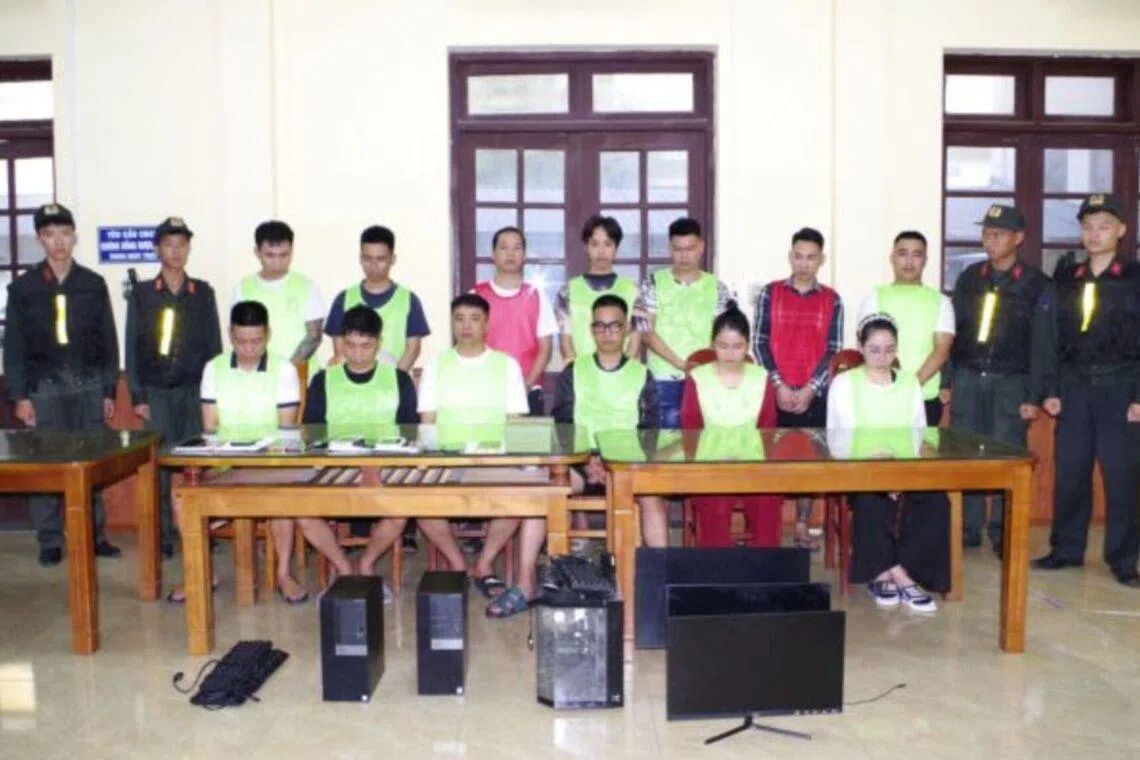
Authorities in Vietnam's northern Ninh Binh province have successfully dismantled a sophisticated transnational online fraud operation that bilked victims of more than 250 billion dong, equivalent to RM39.2 million. The operation, which spanned multiple countries and involved coordinated criminal activity across borders, represents a significant cross-border enforcement victory in Southeast Asia's ongoing battle against organized cybercrime.
The investigation culminated in the arrest of 12 suspects, with investigations currently ongoing to identify and apprehend additional members of the criminal network. Officers conducting search operations recovered substantial physical evidence including cash, a vehicle, mobile devices, computers, forged identity documents, jewellery, and extensive records documenting the fraudulent operations. The discovery of these materials provided investigators with critical intelligence about the scope and sophistication of the conspiracy.
The conspiracy was led by Nguyen Van Cuong, 28, and Nguyen Van Phuong, 34, who orchestrated the recruitment and transportation of Vietnamese nationals to Cambodia, where the bulk of their criminal infrastructure was established. This geographical arrangement allowed the perpetrators to operate across international boundaries while maintaining a degree of distance from law enforcement in their home country. The network operated with clear hierarchical structures and specialized roles, indicating a level of organizational sophistication typical of professional criminal enterprises rather than amateur opportunistic fraud.
The gang employed an impressive arsenal of deception techniques designed to exploit trust and manipulate victims across multiple scenarios. Fraudsters impersonated legitimate authority figures including police officers, prosecutors, judges, financial institution employees, and tax officials—personas specifically chosen because they carry inherent authority and can compel rapid decision-making from targets. The psychological manipulation was reinforced through technological deception: perpetrators created counterfeit websites and mobile applications that mimicked the digital interfaces of government agencies and recognized commercial entities, creating a veneer of legitimacy that enhanced their ability to convince victims.
The criminal methodology encompassed diverse fraud vectors adapted to different victim profiles and circumstances. Fabricated recruitment advertisements for part-time work lured job-seekers into schemes requiring upfront payments or personal financial information. Investment fraud schemes promising returns in finance, securities, and cryptocurrency exploited both financial ignorance and the aspirations of those seeking to grow their wealth. Romance scams leveraged emotional manipulation and trust-building over extended periods before requesting money transfers. The syndicate also engaged in account takeover fraud, hijacking social media profiles to extract loans from the victims' network of friends and family members.
One particularly elaborate variant involved fraudsters posing as military officers who contacted retail shops and businesses with ostensibly legitimate large purchase orders. The perpetrators then manipulated business owners into procuring additional inventory on their behalf, requesting advance payments and deposits to accounts controlled by the criminals. This scheme exploited both the commercial instincts of business operators and the natural deference many people extend toward military authority figures, creating multiple opportunities for fund diversion.
The temporal scope of confirmed fraudulent activity spans from October 2024 through the arrest date, during which time the network successfully defrauded approximately 500 identified victims across Vietnam. The substantial victim count, combined with the average loss per person implied by the total amount, indicates victims ranged from individuals with modest savings to small business operators with access to larger sums. This broad victimization pattern reflects the calculated targeting strategy employed by the syndicate, which adapted their approach based on available opportunities and victim vulnerability.
Criminal charges have been formally filed against six of the detained suspects under Vietnamese law for fraudulent appropriation of property, with these individuals placed in temporary custody pending trial proceedings. The remaining six suspects remain subject to ongoing investigative procedures as authorities develop additional evidence and determine appropriate charges. The multi-tiered approach to detention and charging reflects standard Vietnamese prosecutorial practice of securing custody for priority targets while maintaining flexibility in lower-tier cases.
Beyond criminal prosecution, authorities have launched parallel asset recovery operations, moving to identify, seize, and freeze accounts and property connected to the criminal proceeds. These civil forfeiture measures serve the dual purpose of disrupting the financial infrastructure supporting the network and generating funds to compensate defrauded victims. The sophistication of money laundering methods employed by transnational cybercriminal enterprises typically requires sustained investigative effort to trace funds through multiple intermediary accounts and jurisdictions.
The case illustrates the evolving challenges facing law enforcement across Southeast Asia as cybercriminal networks exploit geographical distance, digital anonymity, and jurisdictional complexity to conduct organized fraud at scale. The transportation of personnel to Cambodia suggests the perpetrators understood and deliberately exploited the regulatory and enforcement environment across borders. For Malaysian readers and regional policymakers, the case underscores the critical importance of bilateral and multilateral law enforcement cooperation, shared intelligence protocols, and coordinated prosecution efforts to effectively counter transnational cybercrime operations that routinely target victims across multiple Southeast Asian nations.
The investigation remains active, with authorities prioritizing the identification of additional network members believed to be operating either within Vietnam or in neighboring countries. The comprehensive evidentiary materials seized during searches are expected to yield further leads regarding the full scope of the conspiracy and enable authorities to track related fraudulent activities that may have previously gone undetected or been attributed to different criminal groups.

