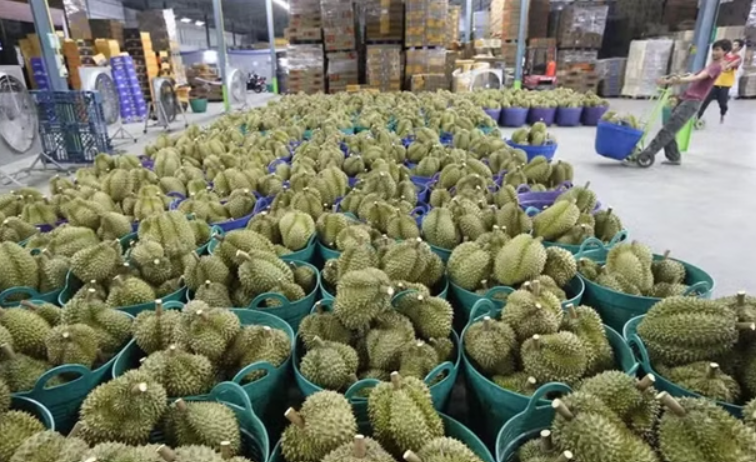
Vietnamese authorities have widened their grip on a sprawling corruption investigation into the country's durian export sector, detaining four officials including a senior agricultural administrator accused of weaponising his government position to enrich connected business interests. The arrest of Deputy Minister Hoang Trung signals that investigators are moving aggressively up the administrative hierarchy in what has become one of Southeast Asia's most strategically sensitive agricultural scandals, given the enormous financial stakes and China's outsized influence over Vietnamese exporters.
Hoang Trung stands accused of abusing his ministerial authority by orchestrating illegal policy measures designed to benefit specific commercial entities at the expense of broader industry integrity. According to Vietnam's Ministry of Public Security, his alleged misconduct included fabricating "sub-licences" that served the interests of favoured companies while generating what the authorities characterize as "particularly large" unlawful profits tied directly to durian shipments destined for Chinese markets. Alongside Trung, Nguyen Quang Hieu, who held the position of deputy head within the Department of Crop Production and Plant Protection, faced identical accusations of similar violations involving the same export certification schemes.
Two additional agricultural ministry staff members were arrested on separate but related charges of producing falsified official documentation, indicating a broader institutional problem rather than isolated misconduct by individual actors. The scale of the alleged wrongdoing appears significant enough that authorities emphasised the damage wrought extended beyond mere financial loss. According to official statements, the corruption caused substantial harm to legitimate durian farmers and export enterprises, while simultaneously inflicting what officials described as "exceptionally" large fiscal damage to state coffers and severely tarnishing Vietnam's standing within international agricultural communities that increasingly scrutinise supply chain integrity.
This latest enforcement action represents a dramatic escalation in an investigation that has been unfolding incrementally since at least the previous year, when police detained eight individuals connected to the same network of alleged wrongdoing. The core of the investigation centres on certification and testing procedures governing durian consignments intended for Chinese importation, with particular focus on entities including the Center for Testing, Certification and Quality Services operating under the agriculture ministry's umbrella, alongside private companies NhoNho Technology Co. and Thuy Fruit Co. These certification gatekeepers occupy extraordinarily powerful positions within Vietnam's export machinery, controlling which shipments receive official clearance and which face delays or rejection, making them prime targets for corrupt officials seeking to extort payments or facilitate illicit commerce.
The ramifications of these allegations strike at the heart of Vietnam's agricultural export strategy. During the five-year period spanning 2021 through 2025, Vietnam exported more than three million tonnes of fresh durian alongside an additional 190,000 tonnes of processed frozen durian products. Strikingly, Chinese markets absorbed more than 95 percent of Vietnam's entire durian export volume, creating an extraordinarily lopsided dependency that leaves Vietnamese producers uniquely vulnerable to supply chain disruptions or regulatory crackdowns originating from Beijing. When certification procedures become compromised by corruption, the entire export relationship risks deterioration as Chinese importers and regulators lose confidence in Vietnamese quality assurance mechanisms.
The political dimension cannot be overlooked. Hoang Trung's expulsion from the Communist Party, announced through state media channels on Tuesday, signals that party leadership has determined his misconduct so egregious that rehabilitation through party disciplinary processes remains impossible. This represents an unusually harsh party sanction that typically precedes criminal prosecution and substantial prison sentences in Vietnamese jurisprudence. The decision to publicly announce his expulsion rather than quietly removing him from office suggests the government intends to demonstrate to both domestic constituencies and international trading partners that it takes agricultural export corruption with utmost seriousness.
Vietnam's acute vulnerability regarding durian exports reflects broader challenges confronting Southeast Asian agricultural exporters dependent on Chinese markets. The fruit represents a high-value commodity commanding premium prices, yet remains subject to rigorous Chinese phytosanitary and quality inspections that can fluctuate based on diplomatic considerations. Corruption within certification agencies erodes the foundational trust that permits frictionless border crossings and timely deliveries. When falsified certificates enter circulation, even minor quality issues at Chinese ports risk triggering widespread suspicion affecting legitimate shipments from competitors and innocent producers alike.
The investigation's expansion also underscores institutional vulnerabilities within Vietnam's regulatory apparatus. When a deputy minister allegedly creates parallel licensing schemes outside legal frameworks, it indicates that oversight mechanisms and internal accountability structures failed to identify wrongdoing before it reached systemic proportions. This raises uncomfortable questions about whether similar corruption might exist within other export-critical sectors including seafood, rice, or coffee, where certification procedures similarly determine market access and commercial survival. Vietnamese policymakers must now address not merely individual criminal behaviour but potentially pervasive institutional dysfunction across export-control agencies.
For Malaysian and broader Southeast Asian observers, this scandal illustrates how concentrated dependency on single export markets creates opportunities for corruption while simultaneously magnifying the consequences when regulatory integrity collapses. Malaysia's own agricultural and commodity export sectors, while more diversified than Vietnam's durian trade, nonetheless face similar governance challenges. The Vietnamese case demonstrates that even middle-income countries pursuing export-driven development strategies remain vulnerable to sophisticated corruption schemes that exploit the intersection between government certification authority and high-value international commerce. As regional economies deepen integration with Chinese supply chains, maintaining credible, corruption-resistant certification mechanisms becomes not merely a technocratic concern but an essential foundation for commercial viability and international competitiveness.

