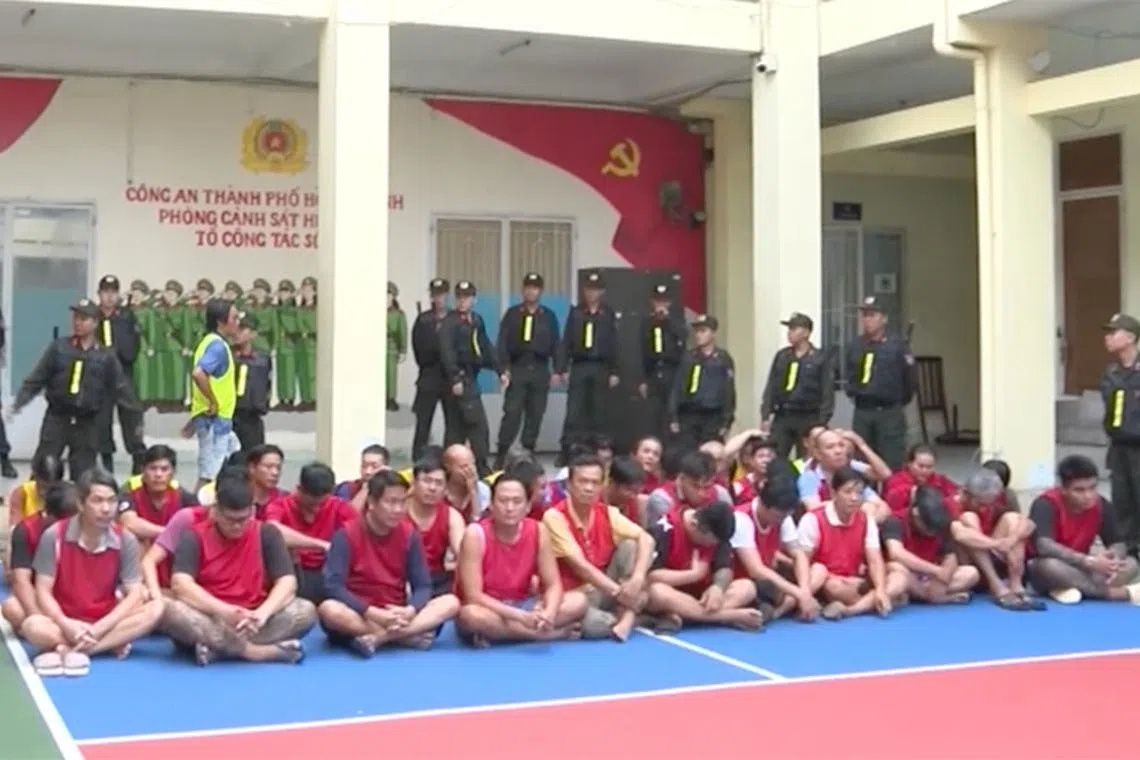
Vietnamese police have moved swiftly against organised illegal gambling, arresting 85 individuals linked to two separate betting syndicates with combined turnover reaching US$133 million. The enforcement action, carried out in late June, represents a significant escalation in the government's efforts to suppress underground wagering operations during the FIFA World Cup 2026 cycle, underscoring the persistence of unlicensed gambling networks across Southeast Asia despite decades of prohibition.
The raided operations displayed hallmarks of sophisticated criminal enterprise, operating with hierarchical structures and tight operational security that allowed them to function largely undetected until police intervention. Ho Chi Minh City police characterised both rings as "exceptionally large-scale" in their statements, suggesting that Vietnamese authorities had been monitoring their activities for some time before executing coordinated arrests. The scale of these operations—processing US$133 million in transactions since October 2025 alone—illustrates the enormous financial magnetism that World Cup betting exerts across the region, drawing both casual punters and serious gamblers into illegal channels.
Central to the syndicates' operational model was their reliance on cross-border supply chains extending into Cambodia. Arrested leaders acknowledged obtaining "master-level betting accounts" from Cambodian sources, which they subsequently disaggregated into smaller agent and member accounts distributed through online platforms to individual gamblers. This transnational dimension reveals a troubling pattern in Southeast Asian organised crime: the compartmentalisation of illegal gambling infrastructure across multiple jurisdictions, making enforcement more challenging and allowing operators to exploit regulatory gaps and differences in law enforcement capacity between nations.
Vietnam's crackdown extends well beyond these two rings. The public security ministry disclosed that across the first 20 days of World Cup matches, police had dismantled 73 separate gambling operations nationwide, resulting in 346 arrests connected to illegal wagering and football betting. Colonel Bui Tuan Anh of the public security ministry noted that transaction volumes across these cases ran to "thousands of billions of dong"—hundreds of millions of dollars in aggregate—revealing the staggering scale of underground betting infrastructure operating within Vietnam's borders.
The timing of these enforcement campaigns is not coincidental. International sporting events, particularly the World Cup, create extraordinary surges in gambling demand, as millions of fans seek to place wagers on matches. For governments like Vietnam's, which maintains comprehensive prohibition on online gambling, these periods present both heightened enforcement challenges and critical windows for intervention, as police can mobilise resources against swollen betting operations that become temporarily visible under the pressure of massive transaction volumes.
Vietnam's blanket prohibition on online gambling reflects ideological commitments rooted in the country's communist governance, but it has proven remarkably ineffective at suppressing demand. The existence of lucrative illegal networks demonstrates a classic policy failure: when legitimate channels are unavailable, criminally-organised alternatives flourish, capturing regulatory arbitrage profits and generating revenue streams for transnational crime syndicates. This dynamic mirrors challenges across Southeast Asia, where restrictive gambling policies coexist with weak enforcement capacity and porous borders.
The involvement of Cambodian sources is particularly significant for Malaysian observers. Cambodia has become a notorious hub for illegal online gambling operations serving the entire Southeast Asian region, including Malaysia. The fact that Vietnamese operators source accounts from Cambodia indicates how deeply integrated underground betting networks have become across the subregion, with each country serving particular functions within a larger ecosystem. Malaysian authorities face similar pressures from betting rings operating through Cambodian intermediaries, suggesting that regional cooperation mechanisms need strengthening.
Looking ahead to World Cup 2026, which will be hosted across Canada, Mexico and the United States with the final scheduled for July 19, the betting syndicates Vietnam has targeted represent merely the visible portion of a much larger underground economy. Experience from previous World Cups indicates that suppression efforts in one country often displace operations rather than eliminating them entirely, shifting betting infrastructure to jurisdictions with weaker enforcement or higher corruption tolerance. Vietnamese authorities will likely face renewed challenges as the tournament approaches, requiring sustained commitment and international coordination to prevent replacement syndicates from reconstituting.
For Malaysia and other Southeast Asian nations, Vietnam's enforcement actions carry important lessons. The regional expansion of cross-border gambling operations demands more sophisticated intelligence-sharing and joint operations protocols than currently exist. The fact that relatively small groups—85 individuals in two rings, 346 across all 73 operations—generate hundreds of millions of dollars in turnover suggests that betting syndicates operate with remarkable efficiency and capital accumulation. Any meaningful reduction in illegal gambling will require not merely periodic crackdowns during major tournaments, but sustained year-round enforcement, better regulation of legitimate betting channels where they exist, and genuine regional cooperation mechanisms that make cross-border operations riskier and more difficult.
Vietnamese police have demonstrated impressive operational capacity in identifying and neutralising these particular syndicates, but success will ultimately be measured not by arrests alone, but by whether their actions genuinely disrupt betting networks or merely create temporary disruptions before operators rebuild elsewhere. The billions of dollars at stake suggest that criminal organisations will continue adapting their methods, using new technologies and border evasion strategies to maintain revenue flows. Without complementary policy reforms that address demand through legalisation and regulation rather than prohibition, Vietnam and its neighbours will likely find themselves locked in perpetual enforcement cycles, capturing periodic victories while the underlying market dynamics remain essentially unchanged.

