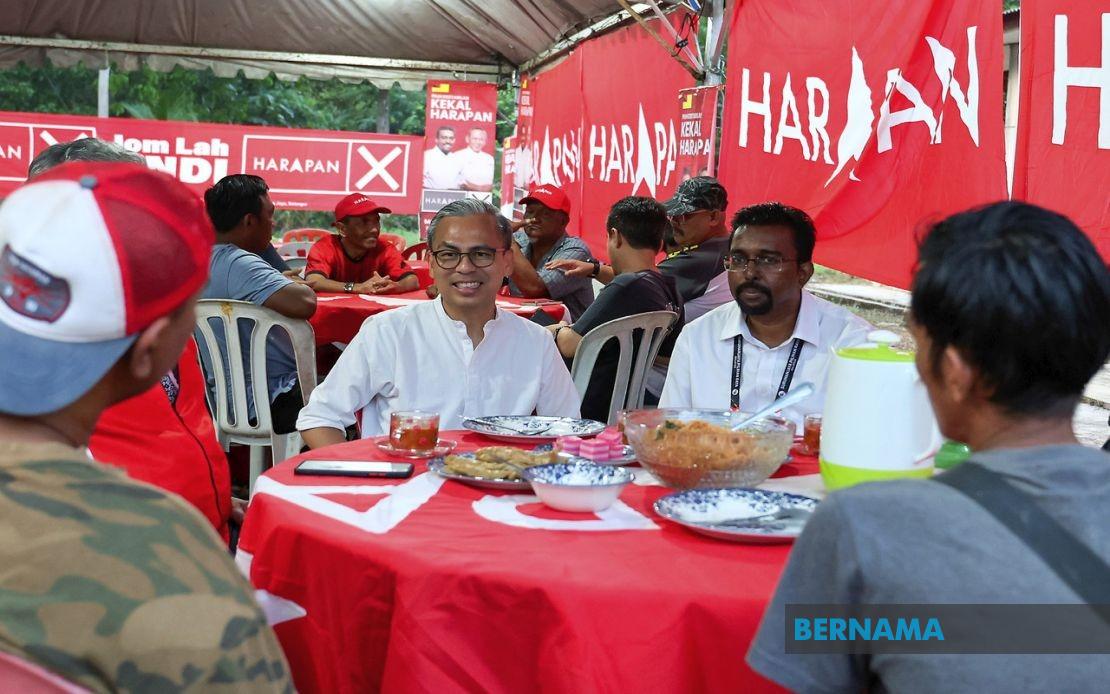
The ultimate arbiters of the Negeri Sembilan state election are voters themselves, not polling analysts or political commentators, according to Pakatan Harapan communications director Datuk Seri Fahmi Fadzil. Making this point during a community gathering in Jempol, Fahmi reframed the pre-election forecasting frenzy as something far more constructive: an opportunity for candidates to intensify their ground efforts and reinforce their appeal to undecided voters.
Fahmi's remarks came in response to predictions made by former Bangi MP Dr Ong Kian Ming regarding likely contest outcomes across several Negeri Sembilan constituencies. Rather than dismissing such forecasts as irrelevant, Fahmi chose to interpret them as motivation for his coalition's representatives to strengthen voter engagement, particularly among those still on the fence about which direction to cast their ballot. This framing transforms pre-election polling from a potential source of discouragement into fuel for deeper campaign work.
The Communications Minister drew parallels with the 2018 general election, when he himself faced a situation where advance surveys overwhelmingly predicted his defeat in the Lembah Pantai parliamentary seat. The actual voting outcome confounded those predictions entirely, vindicating his belief that genuine voter sentiment can diverge sharply from analyst projections. This personal experience has shaped his perspective on dismissing current predictions about Negeri Sembilan, lending credibility to his argument that traditional forecasting methods do not always capture electoral reality.
According to feedback being gathered by Pakatan Harapan operatives on the ground, voter sentiment in Negeri Sembilan has been leaning favourably toward the coalition heading into the election. However, Fahmi was careful to emphasize that this groundswell of support means little without voters actually turning out to cast their ballots. The difference between positive polling indicators and actual electoral success hinges entirely on voter mobilization and participation rates, which remain unpredictable until polling day.
Fahmi highlighted specific government programmes that have resonated with Negeri Sembilan residents, including entrepreneurship incentives, targeted financial assistance for newlyweds, and laptop distribution schemes for students. These tangible policy offerings have apparently contributed to the positive reception the coalition is experiencing during its campaign, suggesting that governance performance and voter appreciation for concrete benefits play a decisive role in shaping electoral outcomes.
As voting day approached, Fahmi issued a stern warning about the escalating threat of misinformation and defamatory content circulating on social media platforms, particularly WhatsApp. He cautioned that opportunistic actors invariably seek to exploit the final days of campaigning to sow confusion and distrust among voters through deliberately misleading narratives. This phenomenon has become a predictable pattern in recent Malaysian elections, where bad-faith actors weaponize information asymmetries to influence undecided voters.
The nature of misinformation being disseminated has become increasingly sophisticated. Rather than outright fabrications, much of the problematic content consists of partial statements taken out of context, video clips presented in misleading ways, or older footage recycled and repackaged as current events. Fahmi cited a specific example involving a video of Prime Minister Datuk Seri Anwar Ibrahim from his time as opposition leader, which had been circulated with the false implication that it contained recent critical remarks about the armed forces. This type of decontextualized content poses particular challenges for voters trying to make informed decisions.
Fahmi urged all voters, but especially those still undecided, to apply rigorous scrutiny to information encountered on social media. He recommended using mainstream media outlets and official government channels as reference points for verifying the authenticity and accuracy of electoral claims. Media organizations such as Berita Harian, TV3, RTM, Bernama, and Awani serve as gatekeepers of journalistic standards, making them more reliable sources than anonymous social media accounts or unverified messaging applications.
The emphasis on media literacy and source verification reflects growing recognition across Malaysia's political establishment that information disorders pose a genuine threat to democratic processes. When voters cannot reliably distinguish between genuine news and manipulated content, their ability to make decisions based on accurate information becomes compromised. This concern transcends partisan political boundaries, as misinformation campaigns can be deployed against any political actor or coalition.
Fahmi's broader message encapsulates a tension at the heart of modern democratic elections: while pre-election analysis and polling provide useful data about voter trends, they ultimately cannot determine electoral outcomes. The unpredictable element of actual voter behavior, whether driven by last-minute persuasion, changing circumstances, or strategic abstention, always retains the power to confound predictions. This reality should encourage both candidates and voters to remain engaged through to the final moment.
For Malaysian observers watching the Negeri Sembilan election as a potential bellwether for broader political trends in the country, the outcome will provide valuable insights into voter sentiment regarding the current government's performance and the viability of opposition alternatives. The state election also serves as a testing ground for campaign tactics and messaging strategies that may be replicated or refined in future national contests. Whether pre-election predictions prove accurate or are once again confounded by voter decisions remains to be seen.

